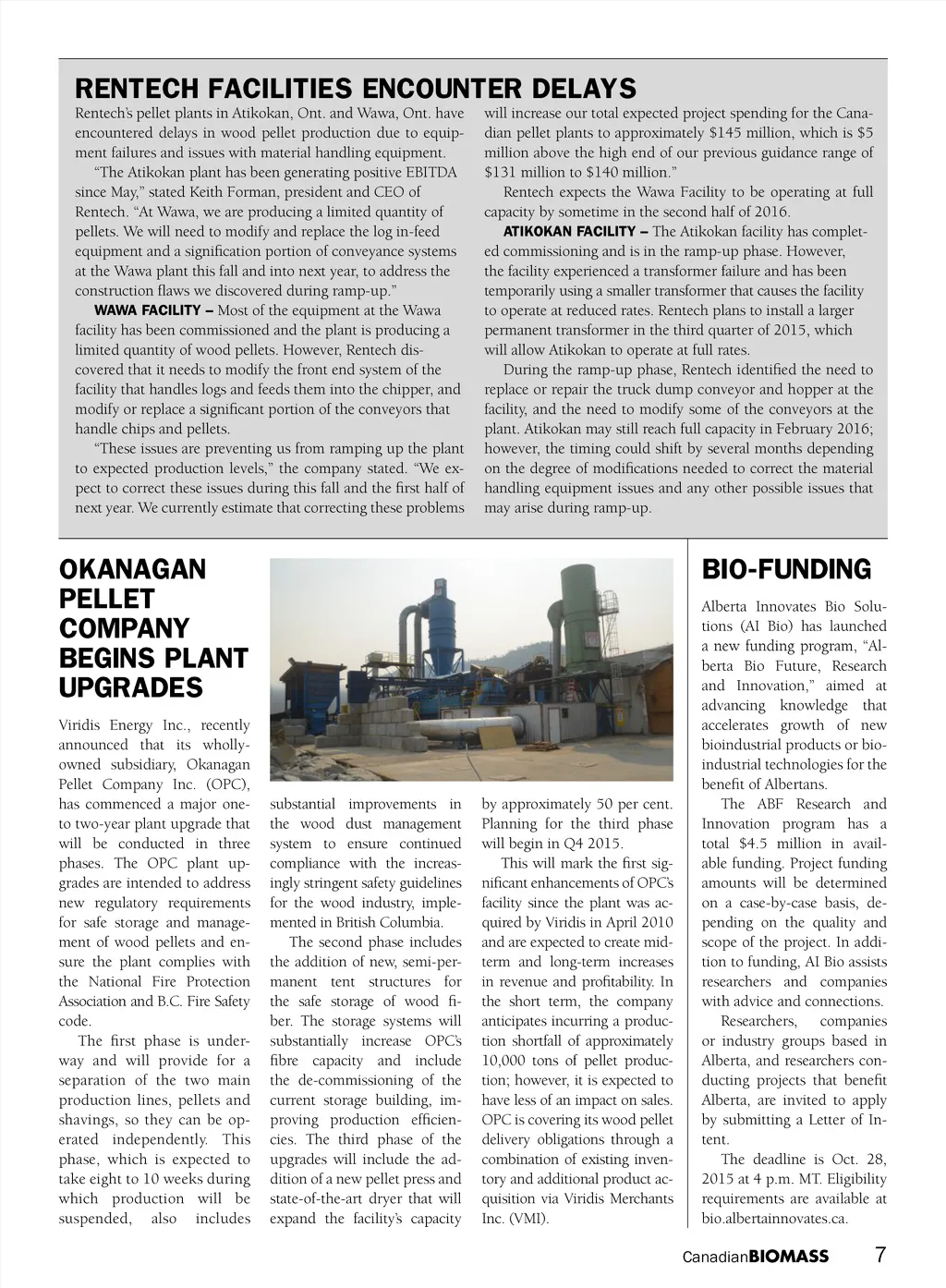
RENTECH FACILITIES ENCOUNTER DELAYS Rentech’s pellet plants in Atikokan, Ont. and Wawa, Ont. have encountered delays in wood pellet production due to equip-ment failures and issues with material handling equipment. “The Atikokan plant has been generating positive EBITDA since May,” stated Keith Forman, president and CEO of Rentech. “At Wawa, we are producing a limited quantity of pellets. We will need to modify and replace the log in-feed equipment and a signification portion of conveyance systems at the Wawa plant this fall and into next year, to address the construction flaws we discovered during ramp-up.” WAWA FACILITY – Most of the equipment at the Wawa facility has been commissioned and the plant is producing a limited quantity of wood pellets. However, Rentech dis-covered that it needs to modify the front end system of the facility that handles logs and feeds them into the chipper, and modify or replace a significant portion of the conveyors that handle chips and pellets. “These issues are preventing us from ramping up the plant to expected production levels,” the company stated. “We ex-pect to correct these issues during this fall and the first half of next year. We currently estimate that correcting these problems will increase our total expected project spending for the Cana-dian pellet plants to approximately $145 million, which is $5 million above the high end of our previous guidance range of $131 million to $140 million.” Rentech expects the Wawa Facility to be operating at full capacity by sometime in the second half of 2016. ATIKOKAN FACILITY – The Atikokan facility has complet-ed commissioning and is in the ramp-up phase. However, the facility experienced a transformer failure and has been temporarily using a smaller transformer that causes the facility to operate at reduced rates. Rentech plans to install a larger permanent transformer in the third quarter of 2015, which will allow Atikokan to operate at full rates. During the ramp-up phase, Rentech identified the need to replace or repair the truck dump conveyor and hopper at the facility, and the need to modify some of the conveyors at the plant. Atikokan may still reach full capacity in February 2016; however, the timing could shift by several months depending on the degree of modifications needed to correct the material handling equipment issues and any other possible issues that may arise during ramp-up. OKANAGAN PELLET COMPANY BEGINS PLANT UPGRADES Viridis Energy Inc., recently announced that its wholly-owned subsidiary, Okanagan Pellet Company Inc. (OPC), has commenced a major one-to two-year plant upgrade that will be conducted in three phases. The OPC plant up-grades are intended to address new regulatory requirements for safe storage and manage-ment of wood pellets and en-sure the plant complies with the National Fire Protection Association and B.C. Fire Safety code. The first phase is under-way and will provide for a separation of the two main production lines, pellets and shavings, so they can be op-erated independently. This phase, which is expected to take eight to 10 weeks during which production will be suspended, also includes BIO-FUNDING Alberta Innovates Bio Solu-tions (AI Bio) has launched a new funding program, “Al-berta Bio Future, Research and Innovation,” aimed at advancing knowledge that accelerates growth of new bioindustrial products or bio-industrial technologies for the benefit of Albertans. The ABF Research and Innovation program has a total $4.5 million in avail-able funding. Project funding amounts will be determined on a case-by-case basis, de-pending on the quality and scope of the project. In addi-tion to funding, AI Bio assists researchers and companies with advice and connections. Researchers, companies or industry groups based in Alberta, and researchers con-ducting projects that benefit Alberta, are invited to apply by submitting a Letter of In-tent. The deadline is Oct. 28, 2015 at 4 p.m. MT. Eligibility requirements are available at bio.albertainnovates.ca. substantial improvements in the wood dust management system to ensure continued compliance with the increas-ingly stringent safety guidelines for the wood industry, imple-mented in British Columbia. The second phase includes the addition of new, semi-per-manent tent structures for the safe storage of wood fi-ber. The storage systems will substantially increase OPC’s fibre capacity and include the de-commissioning of the current storage building, im-proving production efficien-cies. The third phase of the upgrades will include the ad-dition of a new pellet press and state-of-the-art dryer that will expand the facility’s capacity by approximately 50 per cent. Planning for the third phase will begin in Q4 2015. This will mark the first sig-nificant enhancements of OPC’s facility since the plant was ac-quired by Viridis in April 2010 and are expected to create mid-term and long-term increases in revenue and profitability. In the short term, the company anticipates incurring a produc-tion shortfall of approximately 10,000 tons of pellet produc-tion; however, it is expected to have less of an impact on sales. OPC is covering its wood pellet delivery obligations through a combination of existing inven-tory and additional product ac-quisition via Viridis Merchants Inc. (VMI). Canadian BIOMASS 7
Canadian Biomass September/October 2015: Page 7