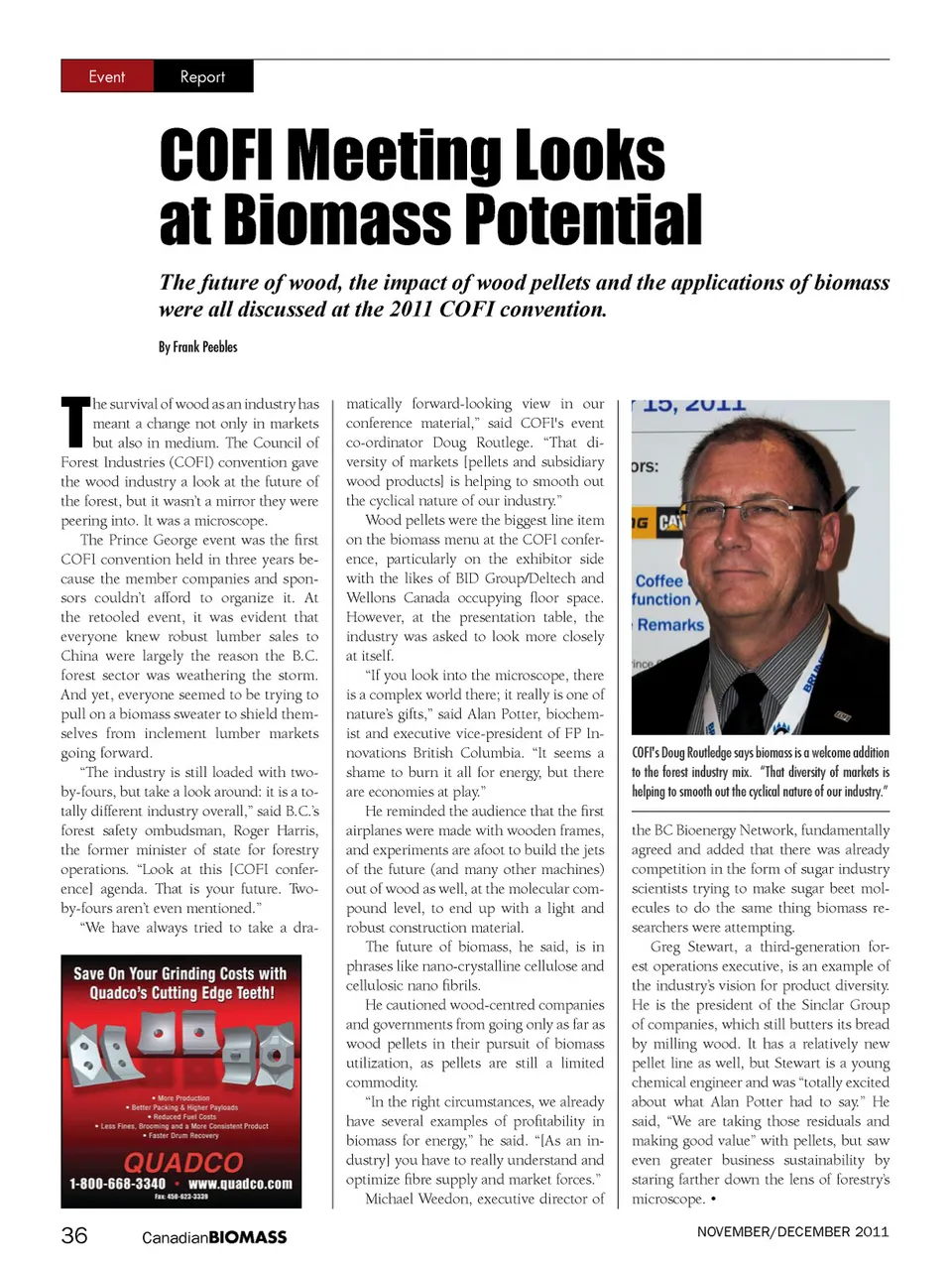
Event Report COFI Meeting looks at Biomass Potential The future of wood, the impact of wood pellets and the applications of biomass were all discussed at the 2011 COFI convention. By Frank Peebles T he survival of wood as an industry has meant a change not only in markets but also in medium. The Council of Forest Industries (COFI) convention gave the wood industry a look at the future of the forest, but it wasn’t a mirror they were peering into. It was a microscope. The Prince George event was the first COFI convention held in three years be-cause the member companies and spon-sors couldn’t afford to organize it. At the retooled event, it was evident that everyone knew robust lumber sales to China were largely the reason the B.C. forest sector was weathering the storm. And yet, everyone seemed to be trying to pull on a biomass sweater to shield them-selves from inclement lumber markets going forward. “The industry is still loaded with two-by-fours, but take a look around: it is a to-tally different industry overall,” said B.C.’s forest safety ombudsman, Roger Harris, the former minister of state for forestry operations. “Look at this [COFI confer-ence] agenda. That is your future. Two-by-fours aren’t even mentioned.” “We have always tried to take a dra-matically forward-looking view in our conference material,” said COFI's event co-ordinator Doug Routlege. “That di-versity of markets [pellets and subsidiary wood products] is helping to smooth out the cyclical nature of our industry.” Wood pellets were the biggest line item on the biomass menu at the COFI confer-ence, particularly on the exhibitor side with the likes of BID Group/Deltech and Wellons Canada occupying floor space. However, at the presentation table, the industry was asked to look more closely at itself. “If you look into the microscope, there is a complex world there; it really is one of nature’s gifts,” said Alan Potter, biochem-ist and executive vice-president of FP In-novations British Columbia. “It seems a shame to burn it all for energy, but there are economies at play.” He reminded the audience that the first airplanes were made with wooden frames, and experiments are afoot to build the jets of the future (and many other machines) out of wood as well, at the molecular com-pound level, to end up with a light and robust construction material. The future of biomass, he said, is in phrases like nano-crystalline cellulose and cellulosic nano fibrils. He cautioned wood-centred companies and governments from going only as far as wood pellets in their pursuit of biomass utilization, as pellets are still a limited commodity. “In the right circumstances, we already have several examples of profitability in biomass for energy,” he said. “[As an in-dustry] you have to really understand and optimize fibre supply and market forces.” Michael Weedon, executive director of COFI's Doug Routledge says biomass is a welcome addition to the forest industry mix. “That diversity of markets is helping to smooth out the cyclical nature of our industry.” the BC Bioenergy Network, fundamentally agreed and added that there was already competition in the form of sugar industry scientists trying to make sugar beet mol-ecules to do the same thing biomass re-searchers were attempting. Greg Stewart, a third-generation for-est operations executive, is an example of the industry’s vision for product diversity. He is the president of the Sinclar Group of companies, which still butters its bread by milling wood. It has a relatively new pellet line as well, but Stewart is a young chemical engineer and was “totally excited about what Alan Potter had to say.” He said, “We are taking those residuals and making good value” with pellets, but saw even greater business sustainability by staring farther down the lens of forestry’s microscope. • NOVEMBER/DECEMBER 2011 36 Canadian BIOMASS
Canadian Biomass November/December 2011: Page 36