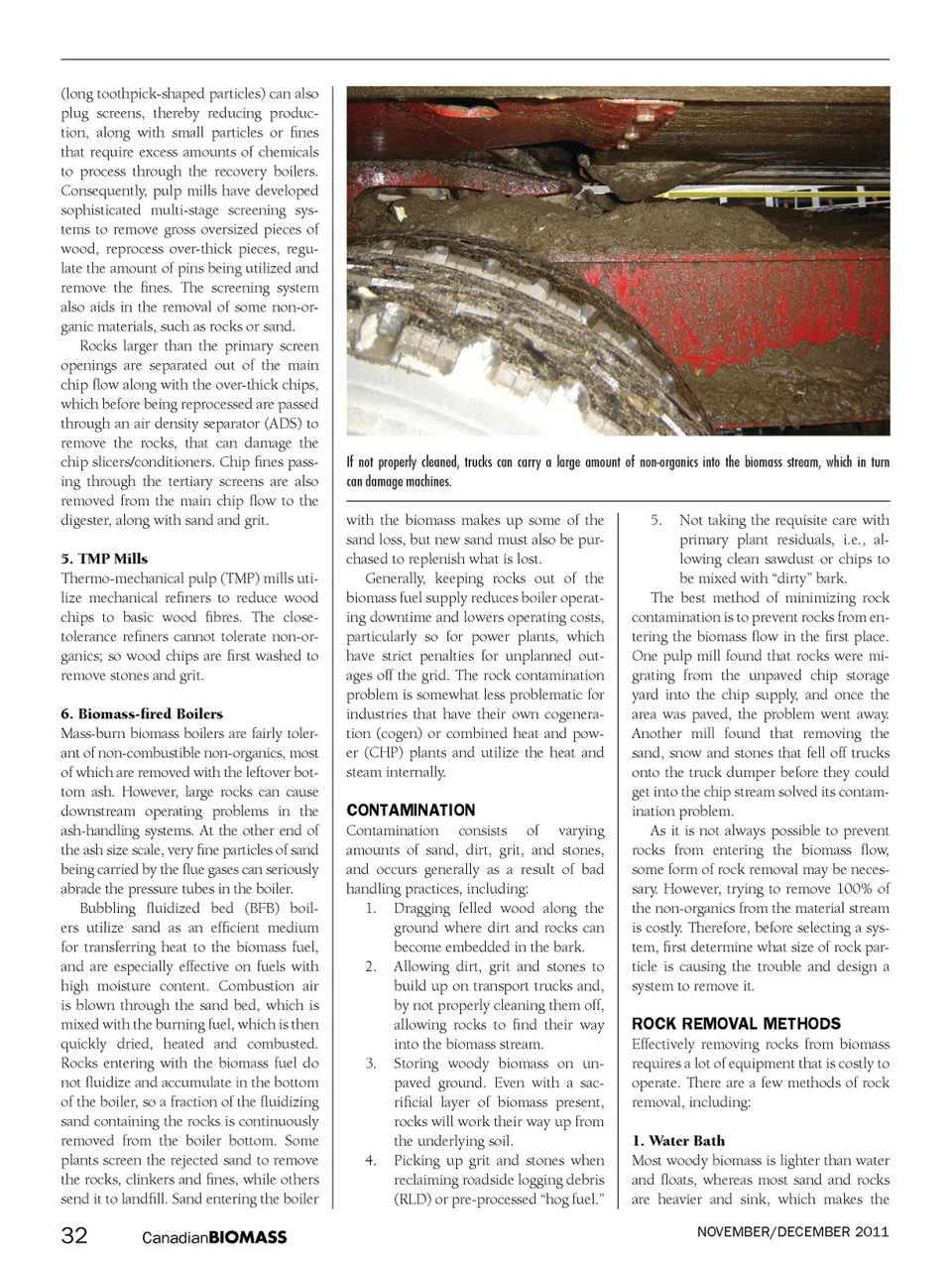
(long toothpick-shaped particles) can also plug screens, thereby reducing produc-tion, along with small particles or fines that require excess amounts of chemicals to process through the recovery boilers. Consequently, pulp mills have developed sophisticated multi-stage screening sys-tems to remove gross oversized pieces of wood, reprocess over-thick pieces, regu-late the amount of pins being utilized and remove the fines. The screening system also aids in the removal of some non-or-ganic materials, such as rocks or sand. Rocks larger than the primary screen openings are separated out of the main chip flow along with the over-thick chips, which before being reprocessed are passed through an air density separator (ADS) to remove the rocks, that can damage the chip slicers/conditioners. Chip fines pass-ing through the tertiary screens are also removed from the main chip flow to the digester, along with sand and grit. 5. tMP Mills Thermo-mechanical pulp (TMP) mills uti-lize mechanical refiners to reduce wood chips to basic wood fibres. The close-tolerance refiners cannot tolerate non-or-ganics; so wood chips are first washed to remove stones and grit. 6. biomass-fired boilers Mass-burn biomass boilers are fairly toler-ant of non-combustible non-organics, most of which are removed with the leftover bot-tom ash. However, large rocks can cause downstream operating problems in the ash-handling systems. At the other end of the ash size scale, very fine particles of sand being carried by the flue gases can seriously abrade the pressure tubes in the boiler. Bubbling fluidized bed (BFB) boil-ers utilize sand as an efficient medium for transferring heat to the biomass fuel, and are especially effective on fuels with high moisture content. Combustion air is blown through the sand bed, which is mixed with the burning fuel, which is then quickly dried, heated and combusted. Rocks entering with the biomass fuel do not fluidize and accumulate in the bottom of the boiler, so a fraction of the fluidizing sand containing the rocks is continuously removed from the boiler bottom. Some plants screen the rejected sand to remove the rocks, clinkers and fines, while others send it to landfill. Sand entering the boiler If not properly cleaned, trucks can carry a large amount of non-organics into the biomass stream, which in turn can damage machines. with the biomass makes up some of the sand loss, but new sand must also be pur-chased to replenish what is lost. Generally, keeping rocks out of the biomass fuel supply reduces boiler operat-ing downtime and lowers operating costs, particularly so for power plants, which have strict penalties for unplanned out-ages off the grid. The rock contamination problem is somewhat less problematic for industries that have their own cogenera-tion (cogen) or combined heat and pow-er (CHP) plants and utilize the heat and steam internally. Contamination Contamination consists of varying amounts of sand, dirt, grit, and stones, and occurs generally as a result of bad handling practices, including: 1. Dragging felled wood along the ground where dirt and rocks can become embedded in the bark. 2. Allowing dirt, grit and stones to build up on transport trucks and, by not properly cleaning them off, allowing rocks to find their way into the biomass stream. 3. Storing woody biomass on un-paved ground. Even with a sac-rificial layer of biomass present, rocks will work their way up from the underlying soil. 4. Picking up grit and stones when reclaiming roadside logging debris (RLD) or pre-processed “hog fuel.” Not taking the requisite care with primary plant residuals, i.e., al-lowing clean sawdust or chips to be mixed with “dirty” bark. The best method of minimizing rock contamination is to prevent rocks from en-tering the biomass flow in the first place. One pulp mill found that rocks were mi-grating from the unpaved chip storage yard into the chip supply, and once the area was paved, the problem went away. Another mill found that removing the sand, snow and stones that fell off trucks onto the truck dumper before they could get into the chip stream solved its contam-ination problem. As it is not always possible to prevent rocks from entering the biomass flow, some form of rock removal may be neces-sary. However, trying to remove 100% of the non-organics from the material stream is costly. Therefore, before selecting a sys-tem, first determine what size of rock par-ticle is causing the trouble and design a system to remove it. roCk removal metHods 5. Effectively removing rocks from biomass requires a lot of equipment that is costly to operate. There are a few methods of rock removal, including: 1. Water bath Most woody biomass is lighter than water and floats, whereas most sand and rocks are heavier and sink, which makes the NOVEMBER/DECEMBER 2011 32 Canadian BIOMASS
Canadian Biomass November/December 2011: Page 32