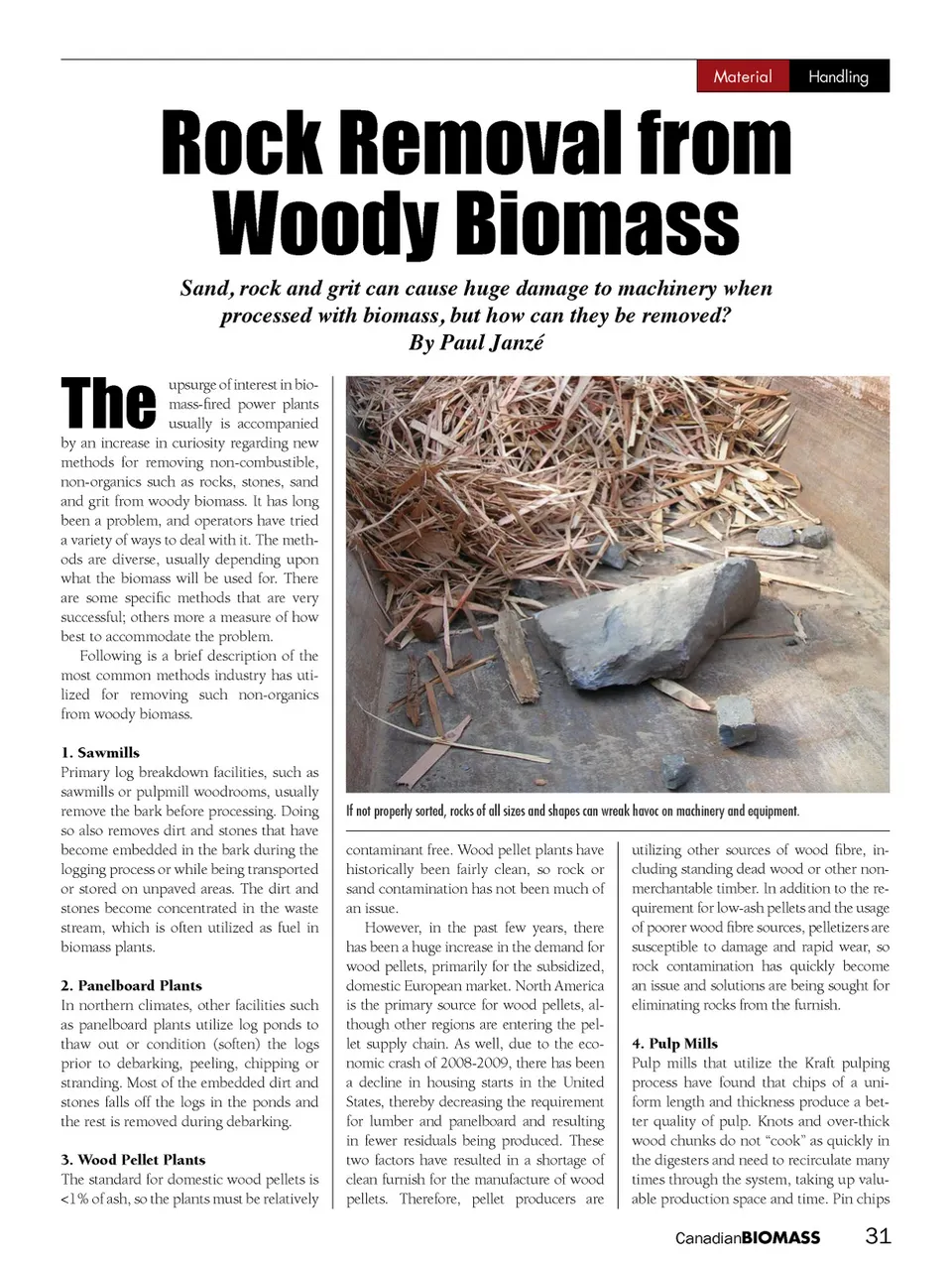
Material Handling Rock Removal from Woody Biomass Sand, rock and grit can cause huge damage to machinery when processed with biomass, but how can they be removed? By Paul Janzé The upsurge of interest in bio-mass-fired power plants usually is accompanied by an increase in curiosity regarding new methods for removing non-combustible, non-organics such as rocks, stones, sand and grit from woody biomass. It has long been a problem, and operators have tried a variety of ways to deal with it. The meth-ods are diverse, usually depending upon what the biomass will be used for. There are some specific methods that are very successful; others more a measure of how best to accommodate the problem. Following is a brief description of the most common methods industry has uti-lized for removing such non-organics from woody biomass. 1. sawmills Primary log breakdown facilities, such as sawmills or pulpmill woodrooms, usually remove the bark before processing. Doing so also removes dirt and stones that have become embedded in the bark during the logging process or while being transported or stored on unpaved areas. The dirt and stones become concentrated in the waste stream, which is often utilized as fuel in biomass plants. 2. Panelboard Plants In northern climates, other facilities such as panelboard plants utilize log ponds to thaw out or condition (soften) the logs prior to debarking, peeling, chipping or stranding. Most of the embedded dirt and stones falls off the logs in the ponds and the rest is removed during debarking. 3. Wood Pellet Plants The standard for domestic wood pellets is <1% of ash, so the plants must be relatively If not properly sorted, rocks of all sizes and shapes can wreak havoc on machinery and equipment. contaminant free. Wood pellet plants have historically been fairly clean, so rock or sand contamination has not been much of an issue. However, in the past few years, there has been a huge increase in the demand for wood pellets, primarily for the subsidized, domestic European market. North America is the primary source for wood pellets, al-though other regions are entering the pel-let supply chain. As well, due to the eco-nomic crash of 2008-2009, there has been a decline in housing starts in the United States, thereby decreasing the requirement for lumber and panelboard and resulting in fewer residuals being produced. These two factors have resulted in a shortage of clean furnish for the manufacture of wood pellets. Therefore, pellet producers are utilizing other sources of wood fibre, in-cluding standing dead wood or other non-merchantable timber. In addition to the re-quirement for low-ash pellets and the usage of poorer wood fibre sources, pelletizers are susceptible to damage and rapid wear, so rock contamination has quickly become an issue and solutions are being sought for eliminating rocks from the furnish. 4. Pulp Mills Pulp mills that utilize the Kraft pulping process have found that chips of a uni-form length and thickness produce a bet-ter quality of pulp. Knots and over-thick wood chunks do not “cook” as quickly in the digesters and need to recirculate many times through the system, taking up valu-able production space and time. Pin chips Canadian BIOMASS 31
Canadian Biomass November/December 2011: Page 31