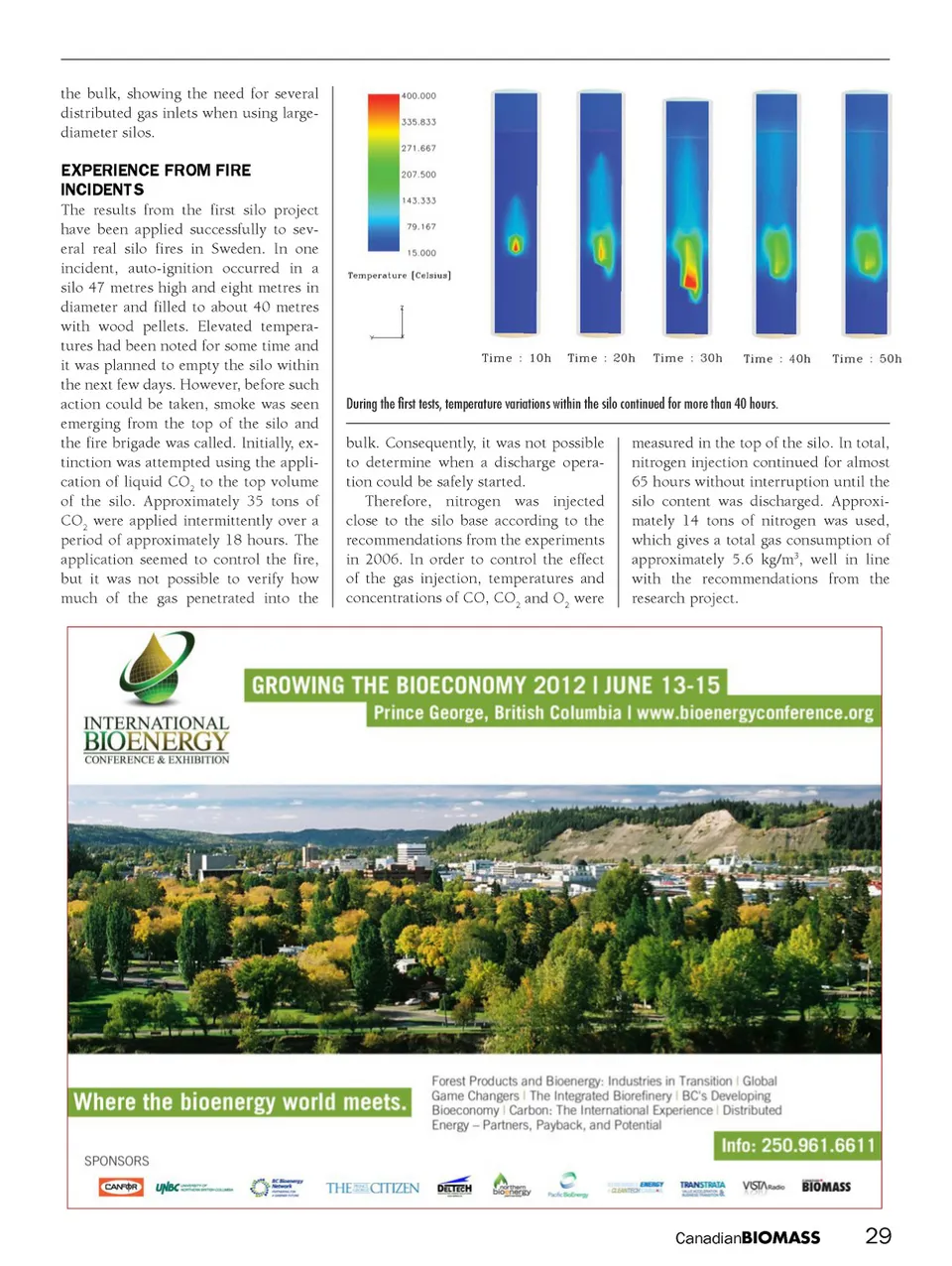
the bulk, showing the need for several distributed gas inlets when using large-diameter silos. experienCe From Fire inCidents The results from the first silo project have been applied successfully to sev-eral real silo fires in Sweden. In one incident, auto-ignition occurred in a silo 47 metres high and eight metres in diameter and filled to about 40 metres with wood pellets. Elevated tempera-tures had been noted for some time and it was planned to empty the silo within the next few days. However, before such action could be taken, smoke was seen emerging from the top of the silo and the fire brigade was called. Initially, ex-tinction was attempted using the appli-cation of liquid CO 2 to the top volume of the silo. Approximately 35 tons of CO 2 were applied intermittently over a period of approximately 18 hours. The application seemed to control the fire, but it was not possible to verify how much of the gas penetrated into the During the first tests, temperature variations within the silo continued for more than 40 hours. bulk. Consequently, it was not possible to determine when a discharge opera-tion could be safely started. Therefore, nitrogen was injected close to the silo base according to the recommendations from the experiments in 2006. In order to control the effect of the gas injection, temperatures and concentrations of CO, CO 2 and O 2 were measured in the top of the silo. In total, nitrogen injection continued for almost 65 hours without interruption until the silo content was discharged. Approxi-mately 14 tons of nitrogen was used, which gives a total gas consumption of approximately 5.6 kg/m 3 , well in line with the recommendations from the research project. Canadian BIOMASS 29
Canadian Biomass November/December 2011: Page 29