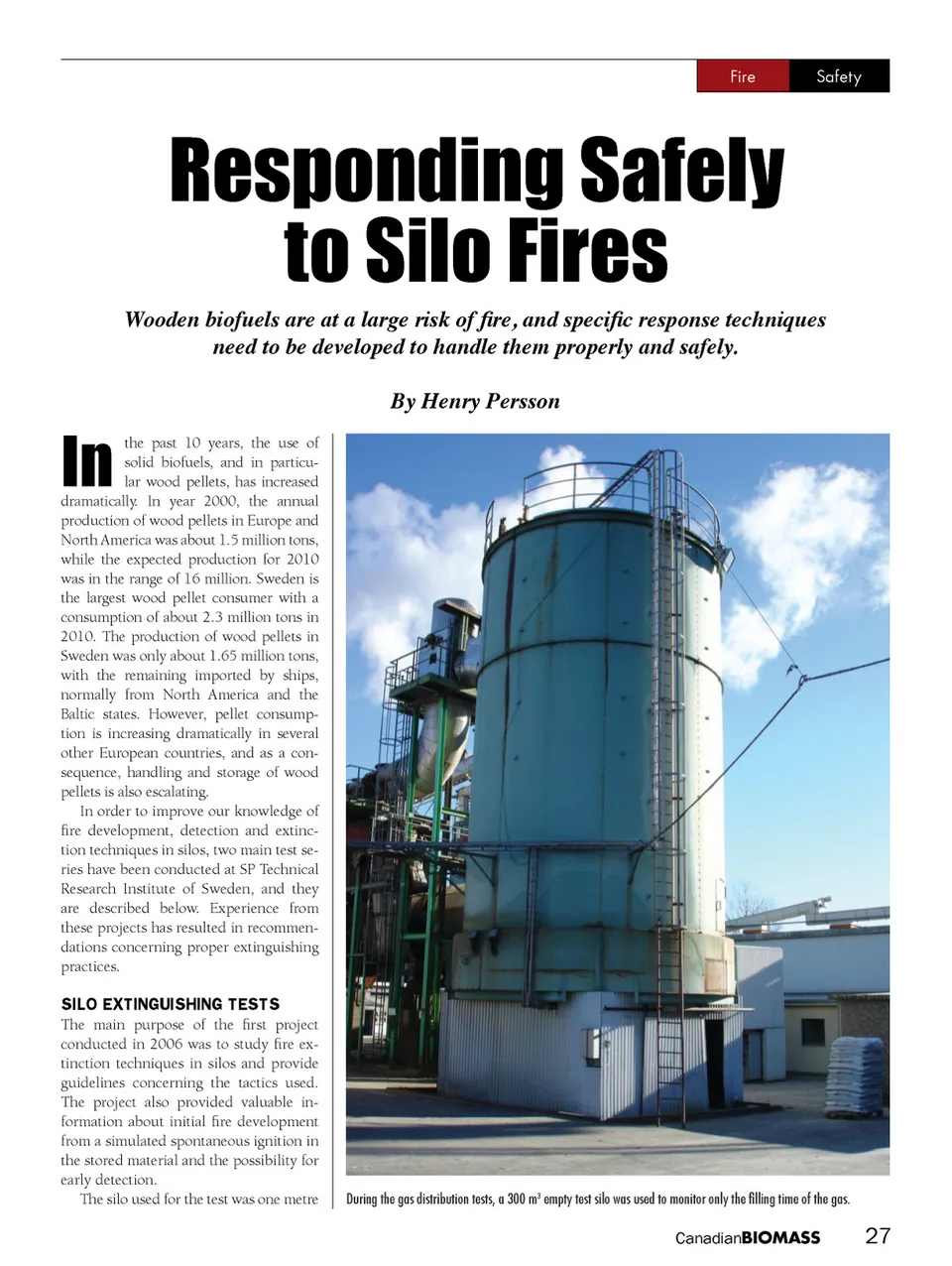
Fire Safety Wooden biofuels are at a large risk of fire, and specific response techniques need to be developed to handle them properly and safely. By Henry Persson Responding Safely to Silo Fires In the past 10 years, the use of solid biofuels, and in particu-lar wood pellets, has increased dramatically. In year 2000, the annual production of wood pellets in Europe and North America was about 1.5 million tons, while the expected production for 2010 was in the range of 16 million. Sweden is the largest wood pellet consumer with a consumption of about 2.3 million tons in 2010. The production of wood pellets in Sweden was only about 1.65 million tons, with the remaining imported by ships, normally from North America and the Baltic states. However, pellet consump-tion is increasing dramatically in several other European countries, and as a con-sequence, handling and storage of wood pellets is also escalating. In order to improve our knowledge of fire development, detection and extinc-tion techniques in silos, two main test se-ries have been conducted at SP Technical Research Institute of Sweden, and they are described below. Experience from these projects has resulted in recommen-dations concerning proper extinguishing practices. silo extinGuisHinG tests The main purpose of the first project conducted in 2006 was to study fire ex-tinction techniques in silos and provide guidelines concerning the tactics used. The project also provided valuable in-formation about initial fire development from a simulated spontaneous ignition in the stored material and the possibility for early detection. The silo used for the test was one metre During the gas distribution tests, a 300 m 3 empty test silo was used to monitor only the filling time of the gas. Canadian BIOMASS 27
Canadian Biomass November/December 2011: Page 27