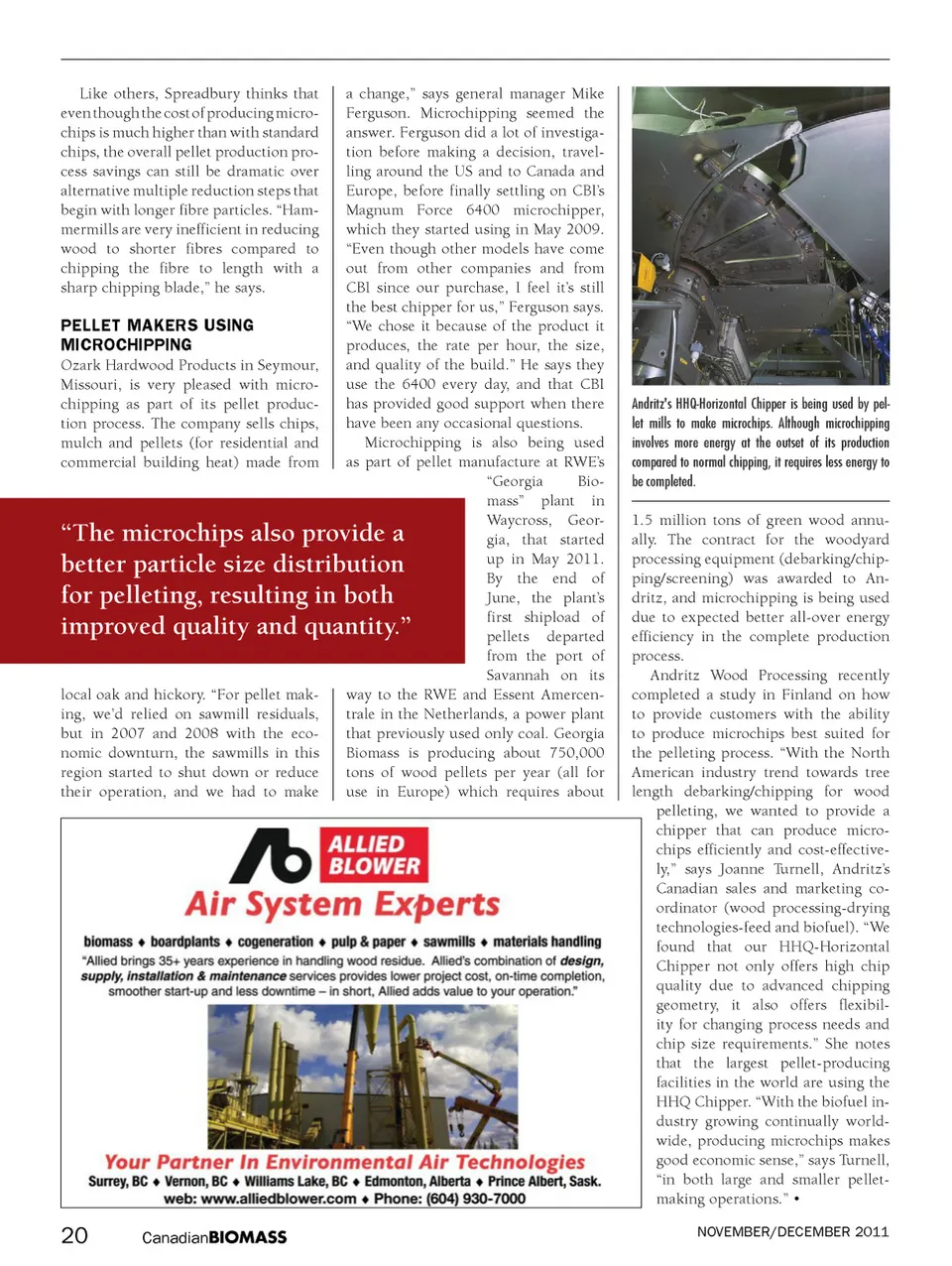
Like others, Spreadbury thinks that even though the cost of producing micro-chips is much higher than with standard chips, the overall pellet production pro-cess savings can still be dramatic over alternative multiple reduction steps that begin with longer fibre particles. “Ham-mermills are very inefficient in reducing wood to shorter fibres compared to chipping the fibre to length with a sharp chipping blade,” he says. pellet makers usinG miCroCHippinG Ozark Hardwood Products in Seymour, Missouri, is very pleased with micro-chipping as part of its pellet produc-tion process. The company sells chips, mulch and pellets (for residential and commercial building heat) made from “The microchips also provide a better particle size distribution for pelleting, resulting in both improved quality and quantity.” local oak and hickory. “For pellet mak-ing, we’d relied on sawmill residuals, but in 2007 and 2008 with the eco-nomic downturn, the sawmills in this region started to shut down or reduce their operation, and we had to make a change,” says general manager Mike Ferguson. Microchipping seemed the answer. Ferguson did a lot of investiga-tion before making a decision, travel-ling around the US and to Canada and Europe, before finally settling on CBI’s Magnum Force 6400 microchipper, which they started using in May 2009. “Even though other models have come out from other companies and from CBI since our purchase, I feel it’s still the best chipper for us,” Ferguson says. “We chose it because of the product it produces, the rate per hour, the size, and quality of the build.” He says they use the 6400 every day, and that CBI has provided good support when there have been any occasional questions. Microchipping is also being used as part of pellet manufacture at RWE’s “Georgia Bio-mass” plant in Waycross, Geor-gia, that started up in May 2011. By the end of June, the plant’s first shipload of pellets departed from the port of Savannah on its way to the RWE and Essent Amercen-trale in the Netherlands, a power plant that previously used only coal. Georgia Biomass is producing about 750,000 tons of wood pellets per year (all for use in Europe) which requires about Andritz's HHQ-Horizontal Chipper is being used by pel-let mills to make microchips. Although microchipping involves more energy at the outset of its production compared to normal chipping, it requires less energy to be completed. 1.5 million tons of green wood annu-ally. The contract for the woodyard processing equipment (debarking/chip-ping/screening) was awarded to An-dritz, and microchipping is being used due to expected better all-over energy efficiency in the complete production process. Andritz Wood Processing recently completed a study in Finland on how to provide customers with the ability to produce microchips best suited for the pelleting process. “With the North American industry trend towards tree length debarking/chipping for wood pelleting, we wanted to provide a chipper that can produce micro-chips efficiently and cost-effective-ly,” says Joanne Turnell, Andritz’s Canadian sales and marketing co-ordinator (wood processing-drying technologies-feed and biofuel). “We found that our HHQ-Horizontal Chipper not only offers high chip quality due to advanced chipping geometry, it also offers flexibil-ity for changing process needs and chip size requirements.” She notes that the largest pellet-producing facilities in the world are using the HHQ Chipper. “With the biofuel in-dustry growing continually world-wide, producing microchips makes good economic sense,” says Turnell, “in both large and smaller pellet-making operations.” • NOVEMBER/DECEMBER 2011 20 Canadian BIOMASS
Canadian Biomass November/December 2011: Page 20