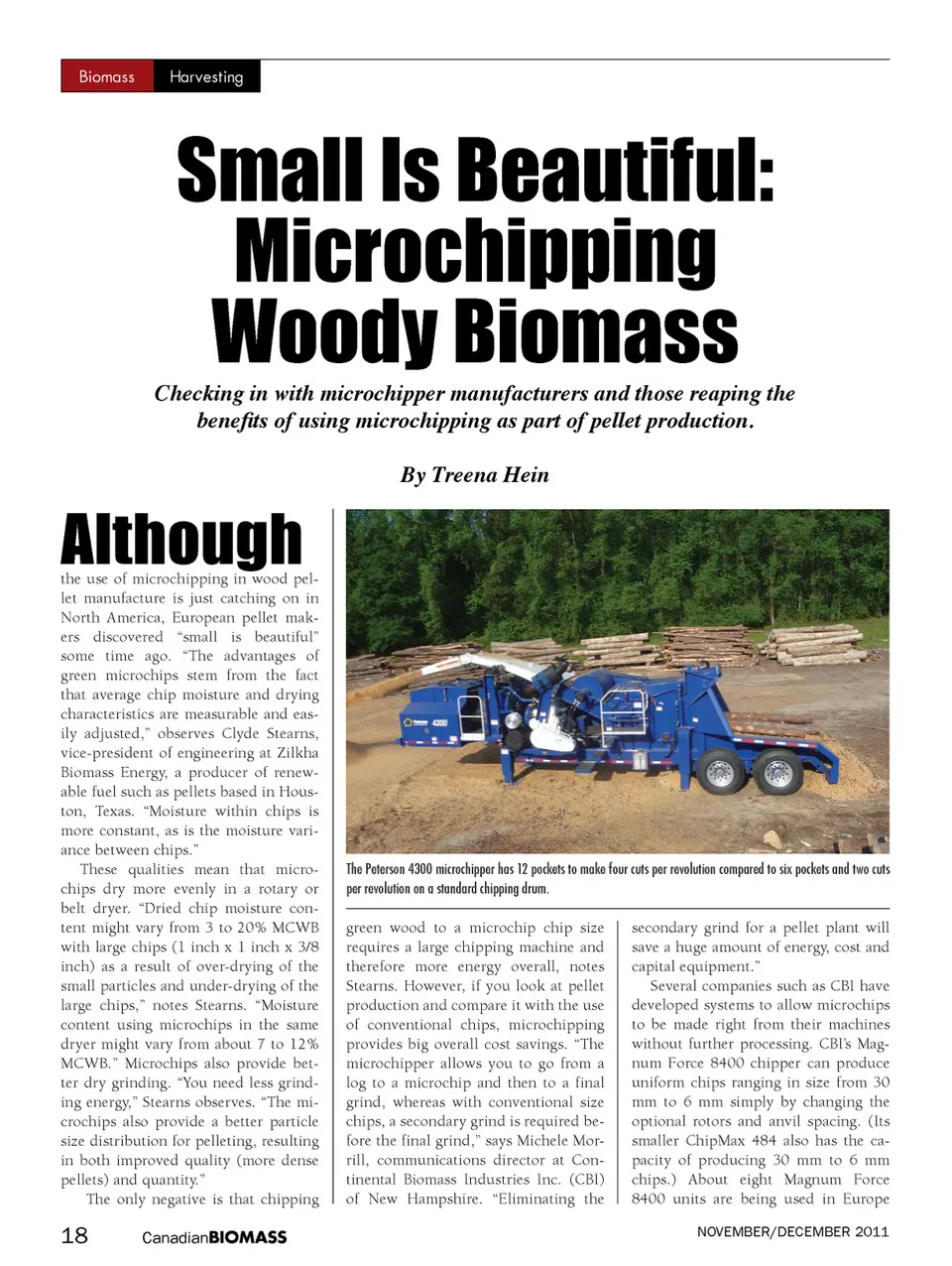
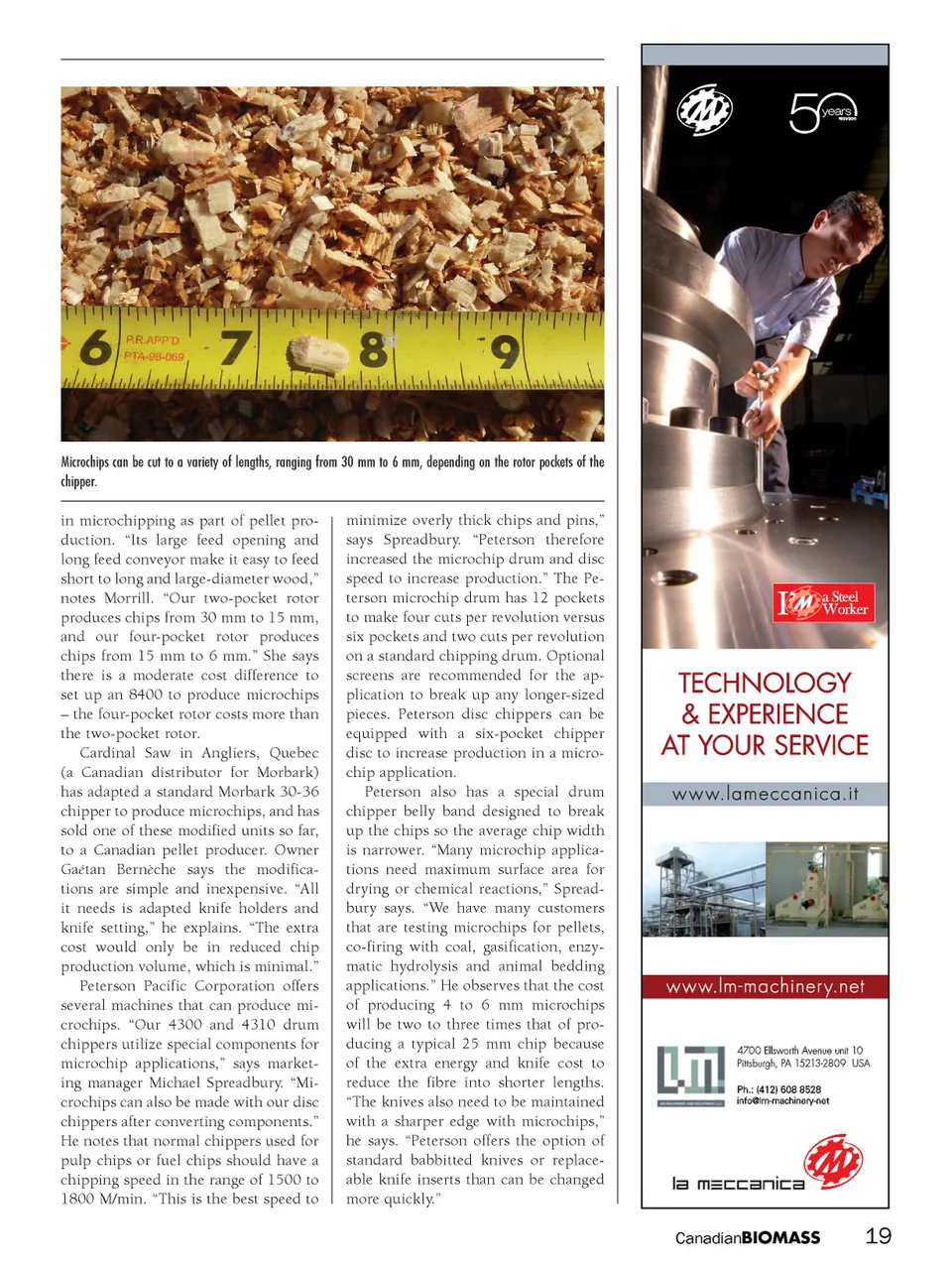
Biomass Harvesting Checking in with microchipper manufacturers and those reaping the benefits of using microchipping as part of pellet production. By Treena Hein Small Is Beautiful: Microchipping Woody Biomass Although the use of microchipping in wood pel-let manufacture is just catching on in North America, European pellet mak-ers discovered “small is beautiful” some time ago. “The advantages of green microchips stem from the fact that average chip moisture and drying characteristics are measurable and eas-ily adjusted,” observes Clyde Stearns, vice-president of engineering at Zilkha Biomass Energy, a producer of renew-able fuel such as pellets based in Hous-ton, Texas. “Moisture within chips is more constant, as is the moisture vari-ance between chips.” These qualities mean that micro-chips dry more evenly in a rotary or belt dryer. “Dried chip moisture con-tent might vary from 3 to 20% MCWB with large chips (1 inch x 1 inch x 3/8 inch) as a result of over-drying of the small particles and under-drying of the large chips,” notes Stearns. “Moisture content using microchips in the same dryer might vary from about 7 to 12% MCWB.” Microchips also provide bet-ter dry grinding. “You need less grind-ing energy,” Stearns observes. “The mi-crochips also provide a better particle size distribution for pelleting, resulting in both improved quality (more dense pellets) and quantity.” The only negative is that chipping The Peterson 4300 microchipper has 12 pockets to make four cuts per revolution compared to six pockets and two cuts per revolution on a standard chipping drum. green wood to a microchip chip size requires a large chipping machine and therefore more energy overall, notes Stearns. However, if you look at pellet production and compare it with the use of conventional chips, microchipping provides big overall cost savings. “The microchipper allows you to go from a log to a microchip and then to a final grind, whereas with conventional size chips, a secondary grind is required be-fore the final grind,” says Michele Mor-rill, communications director at Con-tinental Biomass Industries Inc. (CBI) of New Hampshire. “Eliminating the secondary grind for a pellet plant will save a huge amount of energy, cost and capital equipment.” Several companies such as CBI have developed systems to allow microchips to be made right from their machines without further processing. CBI’s Mag-num Force 8400 chipper can produce uniform chips ranging in size from 30 mm to 6 mm simply by changing the optional rotors and anvil spacing. (Its smaller ChipMax 484 also has the ca-pacity of producing 30 mm to 6 mm chips.) About eight Magnum Force 8400 units are being used in Europe NOVEMBER/DECEMBER 2011 18 Canadian BIOMASS
Canadian Biomass November/December 2011: Page 18