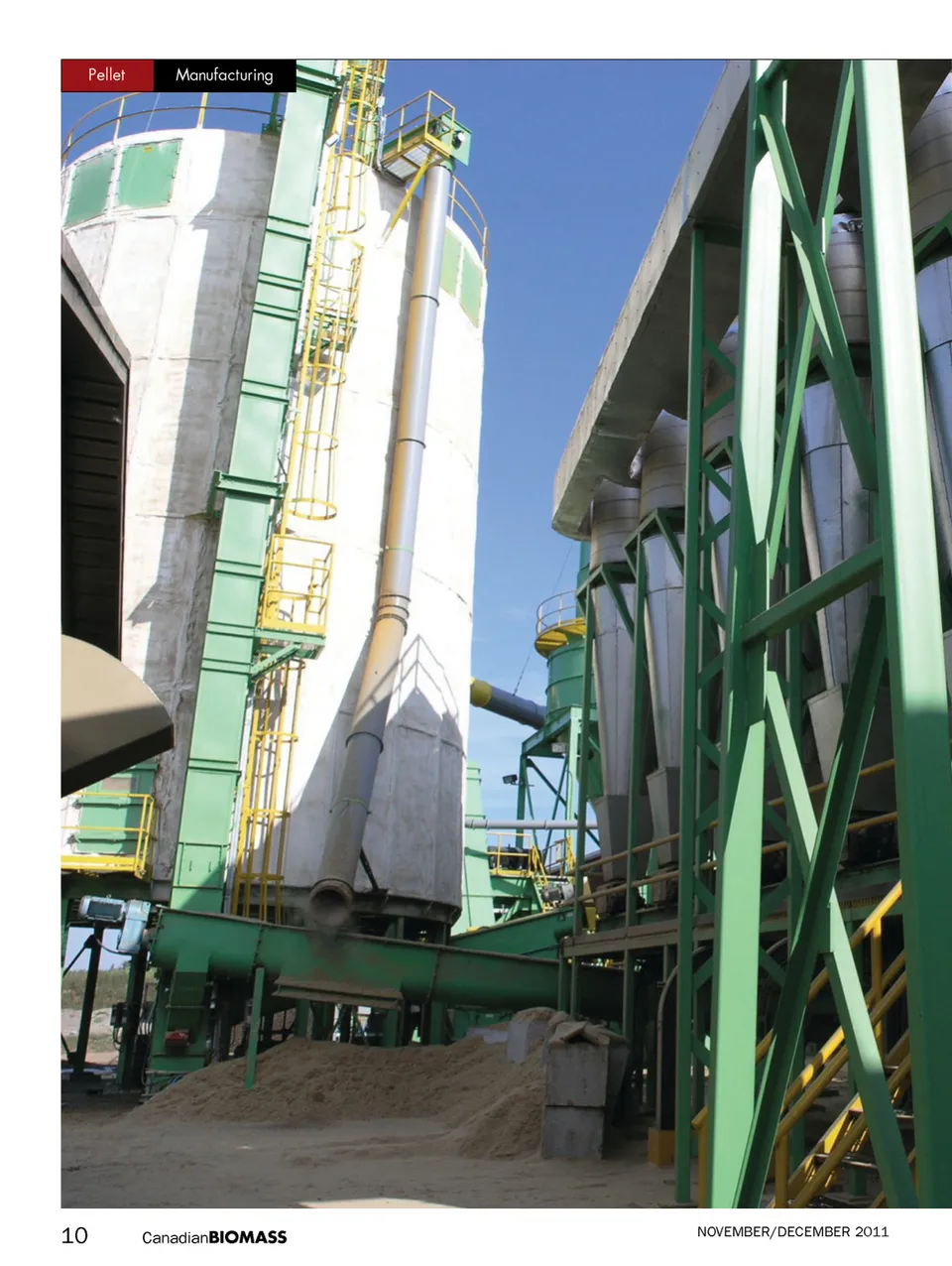
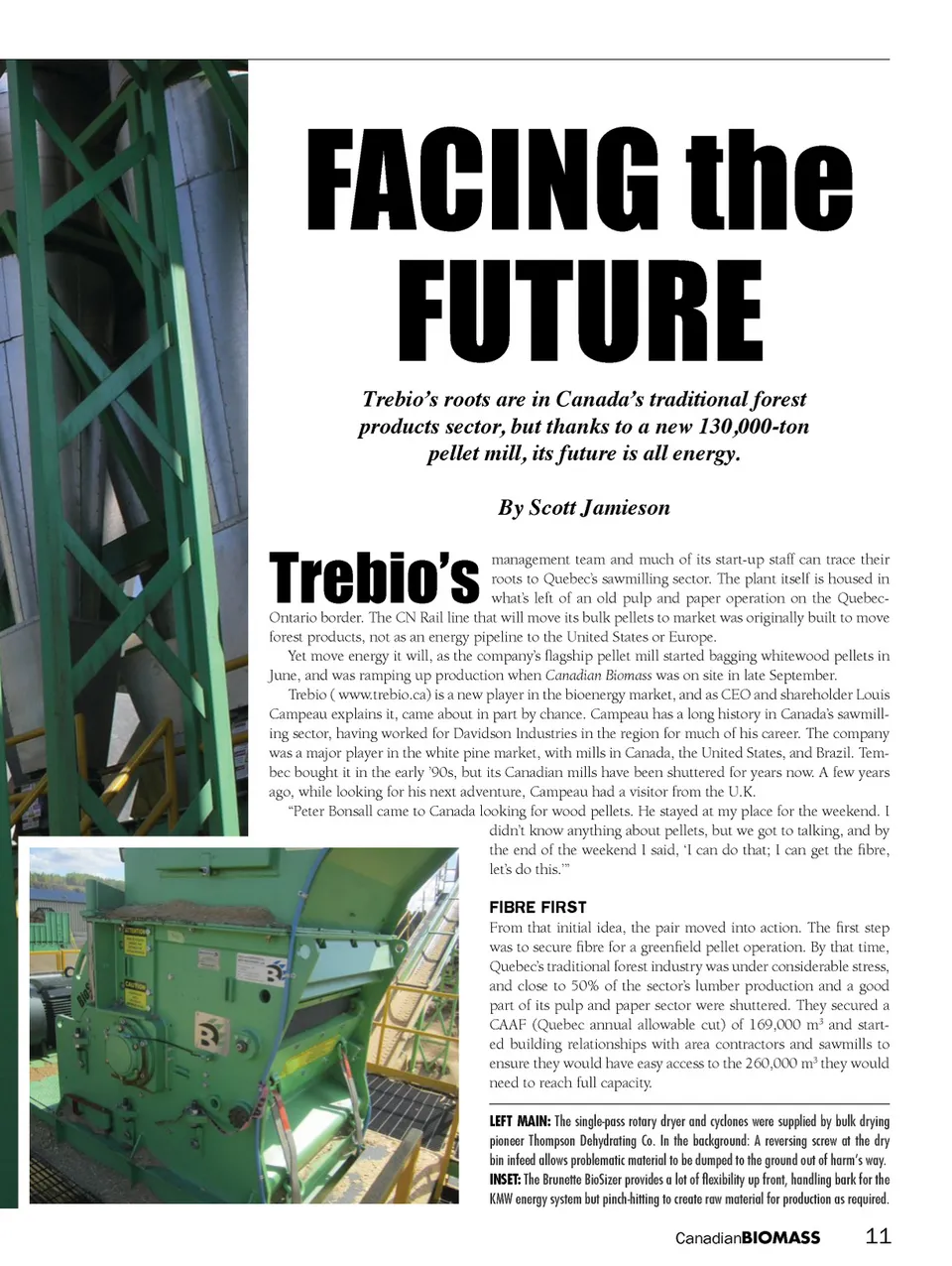
FACING the FUTURE Trebio’s roots are in Canada’s traditional forest products sector, but thanks to a new 130,000-ton pellet mill, its future is all energy. By Scott Jamieson Trebio’s management team and much of its start-up staff can trace their roots to Quebec’s sawmilling sector. The plant itself is housed in what’s left of an old pulp and paper operation on the Quebec-Ontario border. The CN Rail line that will move its bulk pellets to market was originally built to move forest products, not as an energy pipeline to the United States or Europe. Yet move energy it will, as the company’s flagship pellet mill started bagging whitewood pellets in June, and was ramping up production when Canadian Biomass was on site in late September. Trebio ( www.trebio.ca) is a new player in the bioenergy market, and as CEO and shareholder Louis Campeau explains it, came about in part by chance. Campeau has a long history in Canada’s sawmill-ing sector, having worked for Davidson Industries in the region for much of his career. The company was a major player in the white pine market, with mills in Canada, the United States, and Brazil. Tem-bec bought it in the early ’90s, but its Canadian mills have been shuttered for years now. A few years ago, while looking for his next adventure, Campeau had a visitor from the U.K. “Peter Bonsall came to Canada looking for wood pellets. He stayed at my place for the weekend. I didn’t know anything about pellets, but we got to talking, and by the end of the weekend I said, ‘I can do that; I can get the fibre, let’s do this.’” FiBre First From that initial idea, the pair moved into action. The first step was to secure fibre for a greenfield pellet operation. By that time, Quebec’s traditional forest industry was under considerable stress, and close to 50% of the sector’s lumber production and a good part of its pulp and paper sector were shuttered. They secured a CAAF (Quebec annual allowable cut) of 169,000 m 3 and start-ed building relationships with area contractors and sawmills to ensure they would have easy access to the 260,000 m 3 they would need to reach full capacity. LEFT MAIN: The single-pass rotary dryer and cyclones were supplied by bulk drying pioneer Thompson Dehydrating Co. In the background: A reversing screw at the dry bin infeed allows problematic material to be dumped to the ground out of harm’s way. INSET: The Brunette BioSizer provides a lot of flexibility up front, handling bark for the KMW energy system but pinch-hitting to create raw material for production as required. Canadian BIOMASS 11
Canadian Biomass November/December 2011: Page 11