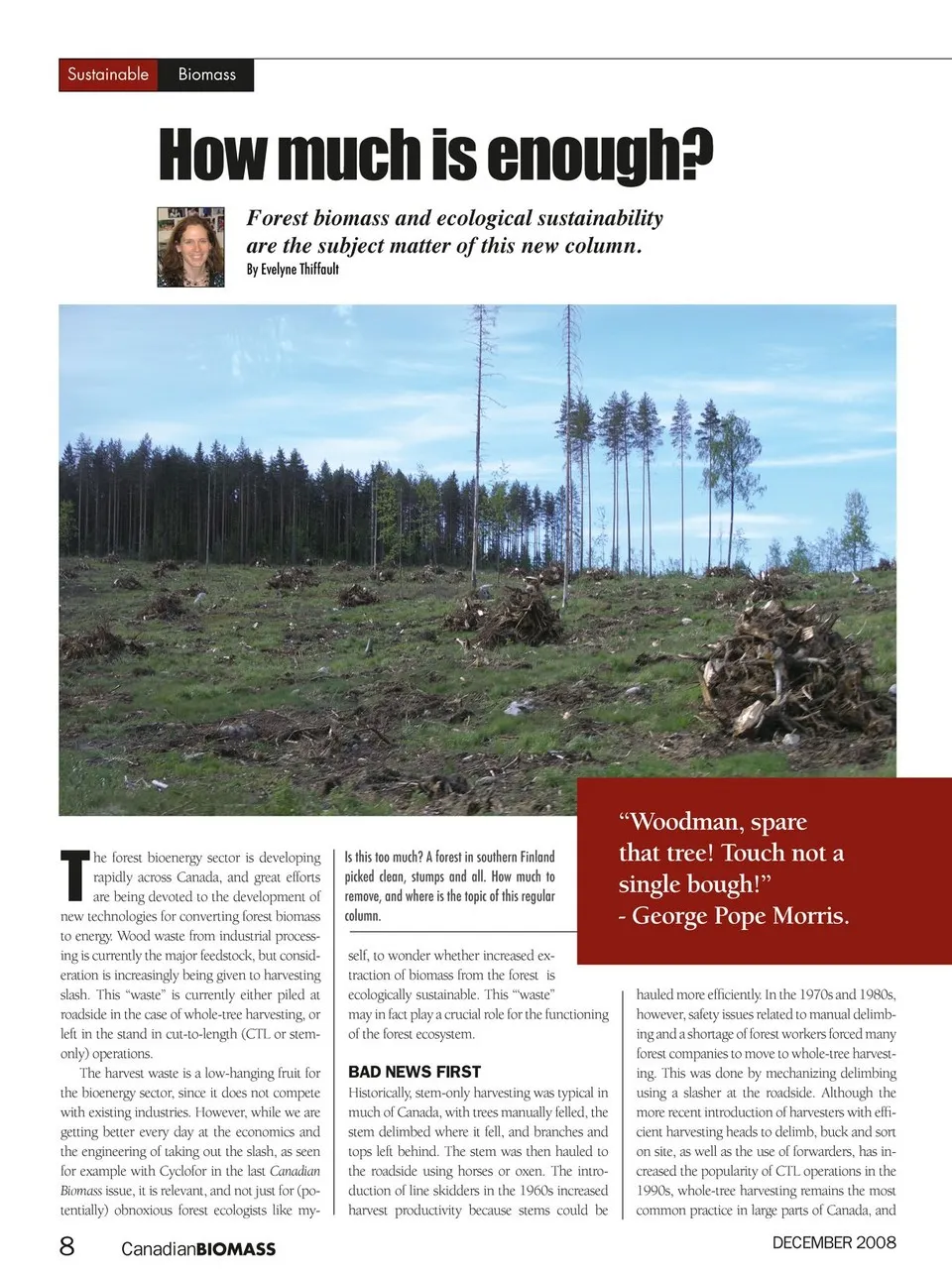
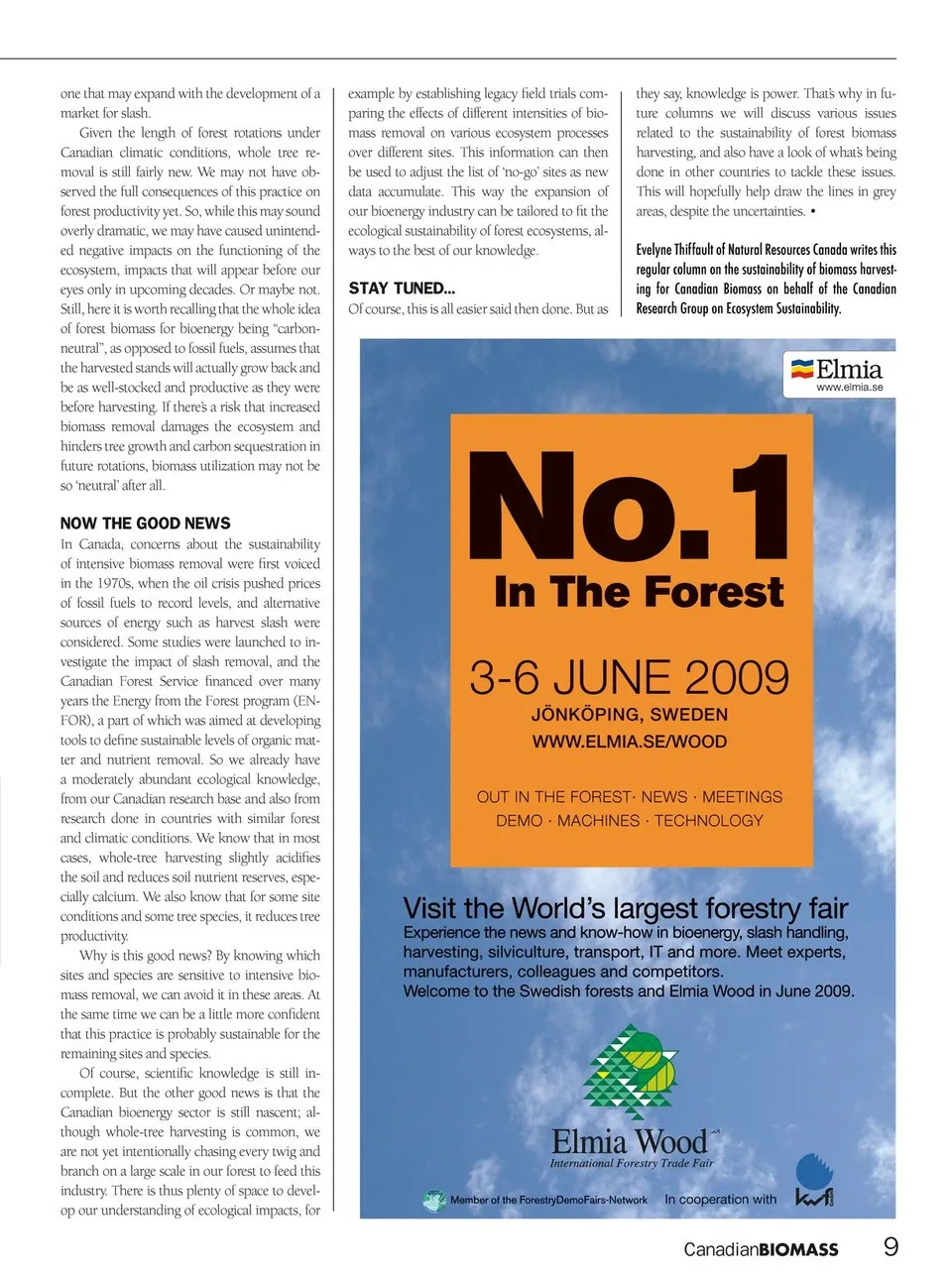
Sustainable Biomass How much is enough? Forest biomass and ecological sustainability are the subject matter of this new column. By Evelyne Thiffault he forest bioenergy sector is developing rapidly across Canada, and great efforts are being devoted to the development of new technologies for converting forest biomass to energy. Wood waste from industrial process- ing is currently the major feedstock, but consid- eration is increasingly being given to harvesting slash. This “waste” is currently either piled at roadside in the case of whole-tree harvesting, or left in the stand in cut-to-length (CTL or stem- only) operations. The harvest waste is a low-hanging fruit for T the bioenergy sector, since it does not compete with existing industries. However, while we are getting better every day at the economics and the engineering of taking out the slash, as seen for example with Cyclofor in the last Canadian Biomass issue, it is relevant, and not just for (po- tentially) obnoxious forest ecologists like my- 8 CanadianBIOMASS Is this too much? A forest in southern Finland picked clean, stumps and all. How much to remove, and where is the topic of this regular column. self, to wonder whether increased ex- traction of biomass from the forest is ecologically sustainable. This “‘waste” may in fact play a crucial role for the functioning of the forest ecosystem. BAD NEWS FIRST Historically, stem-only harvesting was typical in much of Canada, with trees manually felled, the stem delimbed where it fell, and branches and tops left behind. The stem was then hauled to the roadside using horses or oxen. The intro- duction of line skidders in the 1960s increased harvest productivity because stems could be “Woodman, spare that tree! Touch not a single bough!” - George Pope Morris. hauled more effi ciently. In the 1970s and 1980s, however, safety issues related to manual delimb- ing and a shortage of forest workers forced many forest companies to move to whole-tree harvest- ing. This was done by mechanizing delimbing using a slasher at the roadside. Although the more recent introduction of harvesters with effi- cient harvesting heads to delimb, buck and sort on site, as well as the use of forwarders, has in- creased the popularity of CTL operations in the 1990s, whole-tree harvesting remains the most common practice in large parts of Canada, and DECEMBER 2008
Canadian Biomass December 2008: Page 8