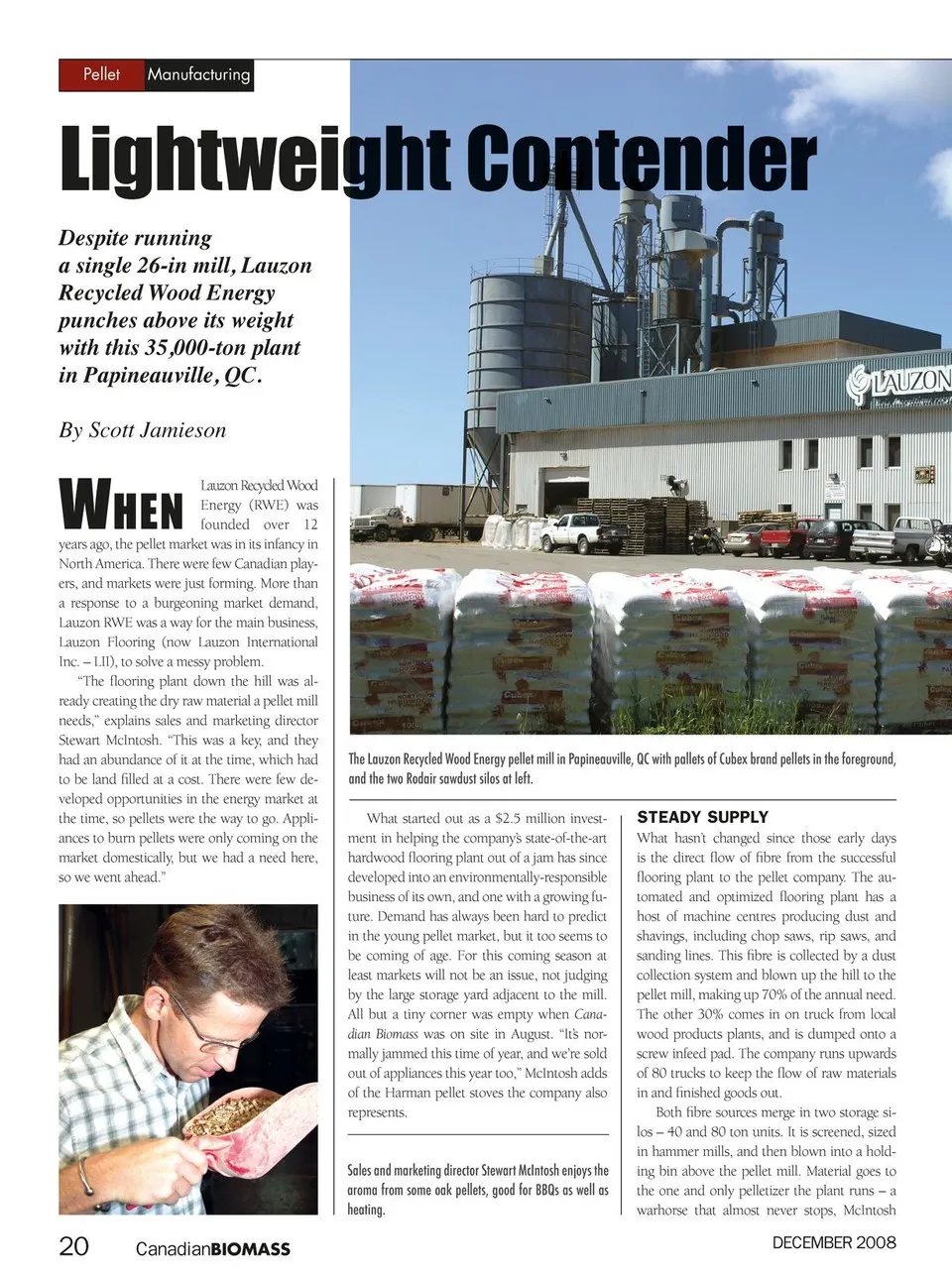
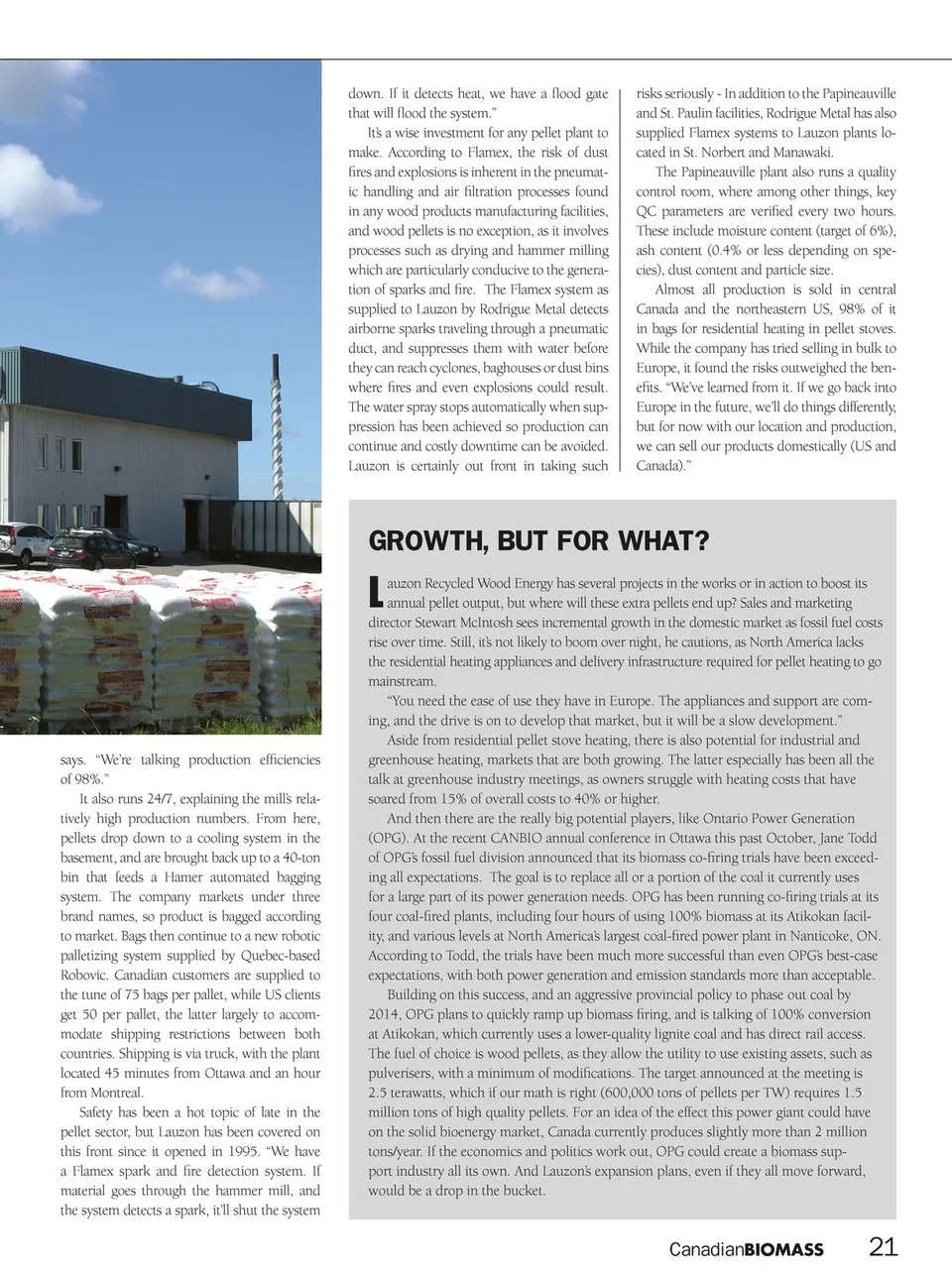
down. If it detects heat, we have a flood gate that will fl ood the system.” It’s a wise investment for any pellet plant to make. According to Flamex, the risk of dust fi res and explosions is inherent in the pneumat- ic handling and air fi ltration processes found in any wood products manufacturing facilities, and wood pellets is no exception, as it involves processes such as drying and hammer milling which are particularly conducive to the genera- tion of sparks and fi re. The Flamex system as supplied to Lauzon by Rodrigue Metal detects airborne sparks traveling through a pneumatic duct, and suppresses them with water before they can reach cyclones, baghouses or dust bins where fi res and even explosions could result. The water spray stops automatically when sup- pression has been achieved so production can continue and costly downtime can be avoided. Lauzon is certainly out front in taking such risks seriously - In addition to the Papineauville and St. Paulin facilities, Rodrigue Metal has also supplied Flamex systems to Lauzon plants lo- cated in St. Norbert and Manawaki. The Papineauville plant also runs a quality control room, where among other things, key QC parameters are verifi ed every two hours. These include moisture content (target of 6%), ash content (0.4% or less depending on spe- cies), dust content and particle size. Almost all production is sold in central Canada and the northeastern US, 98% of it in bags for residential heating in pellet stoves. While the company has tried selling in bulk to Europe, it found the risks outweighed the ben- efi ts. “We’ve learned from it. If we go back into Europe in the future, we’ll do things differently, but for now with our location and production, we can sell our products domestically (US and Canada).” GROWTH, BUT FOR WHAT? L says. “We’re talking production efficiencies of 98%.” It also runs 24/7, explaining the mill’s rela- tively high production numbers. From here, pellets drop down to a cooling system in the basement, and are brought back up to a 40-ton bin that feeds a Hamer automated bagging system. The company markets under three brand names, so product is bagged according to market. Bags then continue to a new robotic palletizing system supplied by Quebec-based Robovic. Canadian customers are supplied to the tune of 75 bags per pallet, while US clients get 50 per pallet, the latter largely to accom- modate shipping restrictions between both countries. Shipping is via truck, with the plant located 45 minutes from Ottawa and an hour from Montreal. Safety has been a hot topic of late in the pellet sector, but Lauzon has been covered on this front since it opened in 1995. “We have a Flamex spark and fi re detection system. If material goes through the hammer mill, and the system detects a spark, it’ll shut the system auzon Recycled Wood Energy has several projects in the works or in action to boost its annual pellet output, but where will these extra pellets end up? Sales and marketing director Stewart McIntosh sees incremental growth in the domestic market as fossil fuel costs rise over time. Still, it’s not likely to boom over night, he cautions, as North America lacks the residential heating appliances and delivery infrastructure required for pellet heating to go mainstream. “You need the ease of use they have in Europe. The appliances and support are com- ing, and the drive is on to develop that market, but it will be a slow development.” Aside from residential pellet stove heating, there is also potential for industrial and greenhouse heating, markets that are both growing. The latter especially has been all the talk at greenhouse industry meetings, as owners struggle with heating costs that have soared from 15% of overall costs to 40% or higher. And then there are the really big potential players, like Ontario Power Generation (OPG). At the recent CANBIO annual conference in Ottawa this past October, Jane Todd of OPG’s fossil fuel division announced that its biomass co-fi ring trials have been exceed- ing all expectations. The goal is to replace all or a portion of the coal it currently uses for a large part of its power generation needs. OPG has been running co-fi ring trials at its four coal-fi red plants, including four hours of using 100% biomass at its Atikokan facil- ity, and various levels at North America’s largest coal-fi red power plant in Nanticoke, ON. According to Todd, the trials have been much more successful than even OPG’s best-case expectations, with both power generation and emission standards more than acceptable. Building on this success, and an aggressive provincial policy to phase out coal by 2014, OPG plans to quickly ramp up biomass fi ring, and is talking of 100% conversion at Atikokan, which currently uses a lower-quality lignite coal and has direct rail access. The fuel of choice is wood pellets, as they allow the utility to use existing assets, such as pulverisers, with a minimum of modifi cations. The target announced at the meeting is 2.5 terawatts, which if our math is right (600,000 tons of pellets per TW) requires 1.5 million tons of high quality pellets. For an idea of the effect this power giant could have on the solid bioenergy market, Canada currently produces slightly more than 2 million tons/year. If the economics and politics work out, OPG could create a biomass sup- port industry all its own. And Lauzon’s expansion plans, even if they all move forward, would be a drop in the bucket. CanadianBIOMASS 21
Canadian Biomass December 2008: Page 21