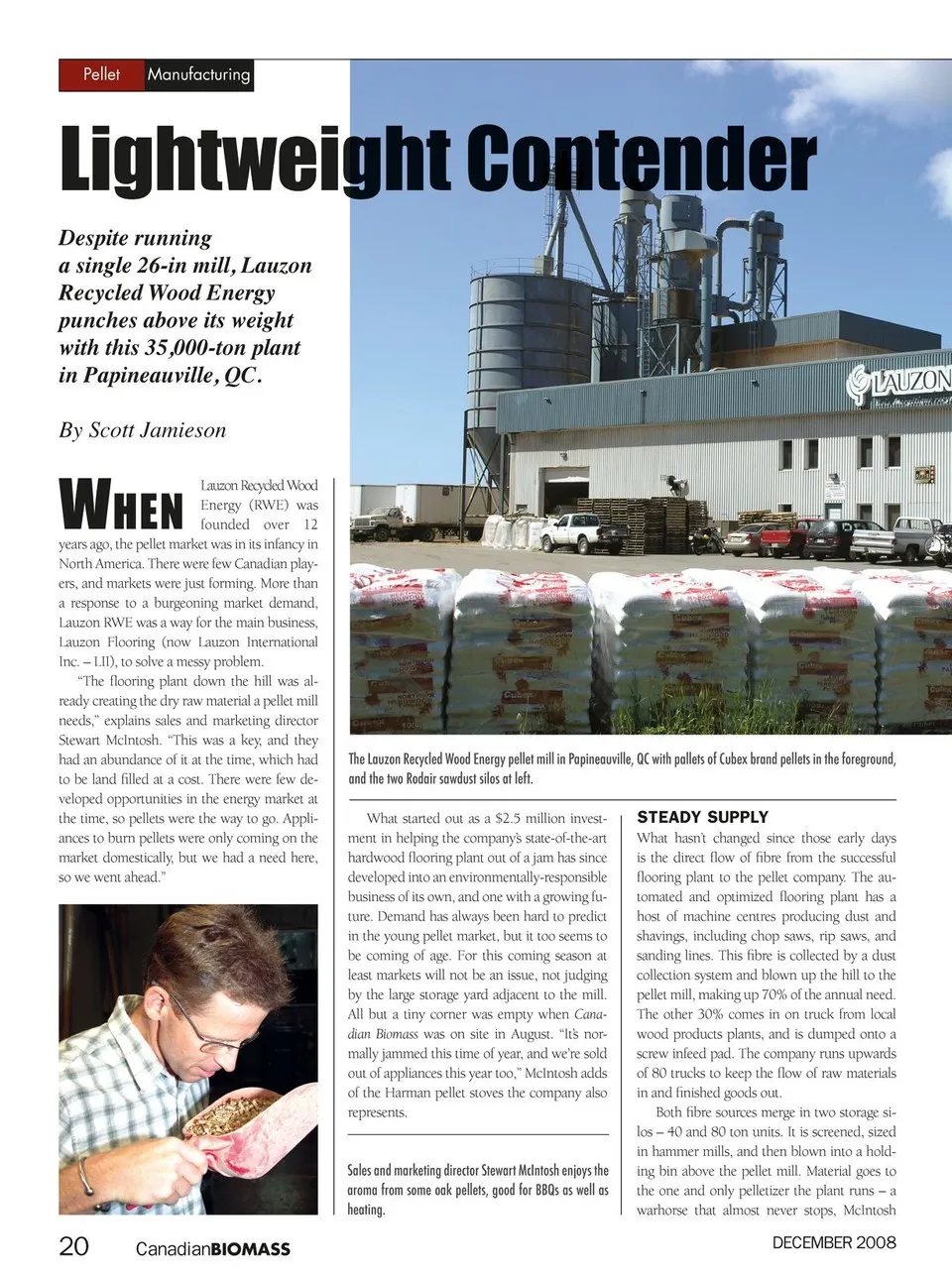
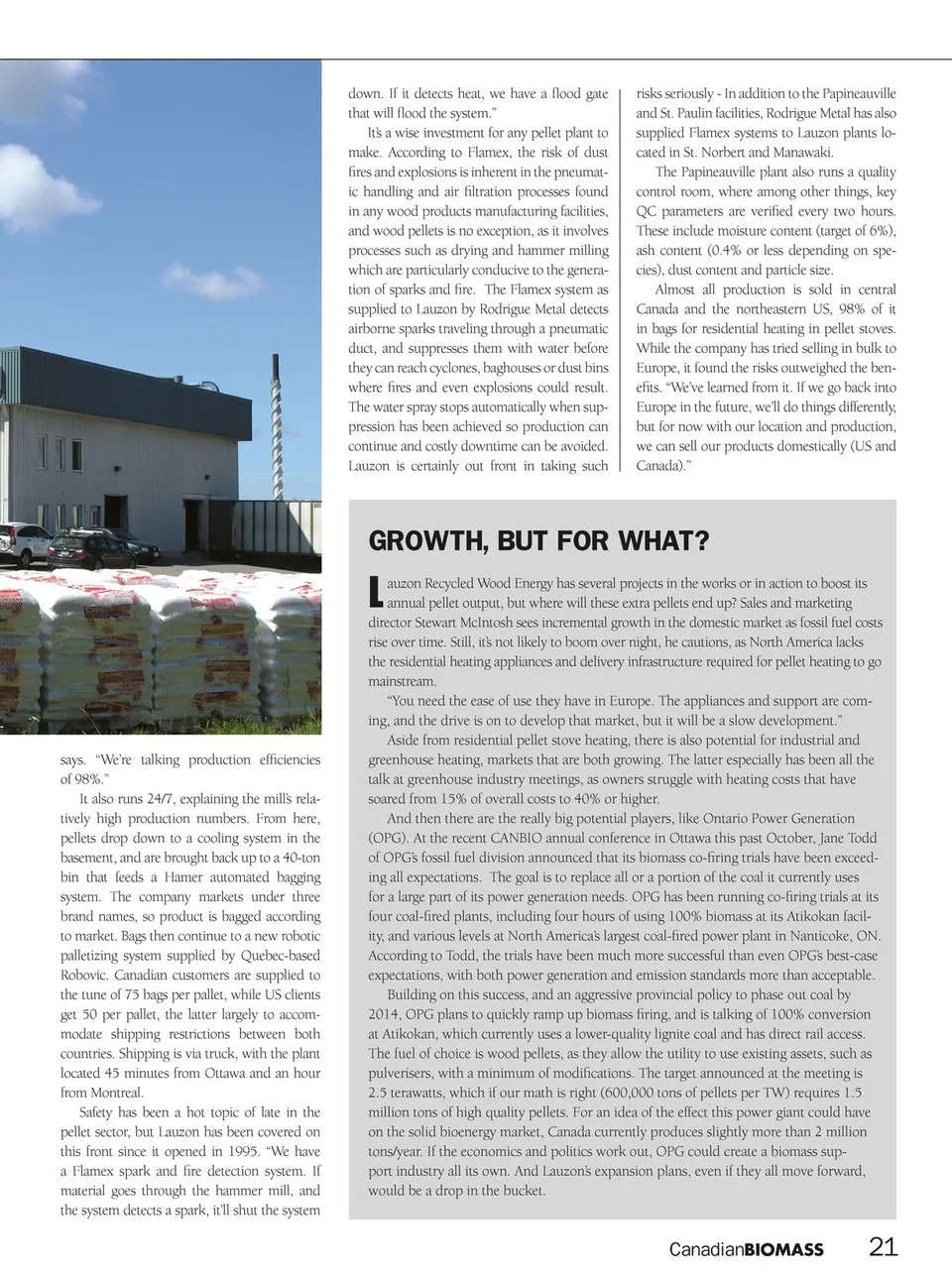
Pellet Manufacturing Lightweight Contender Despite running a single 26-in mill, Lauzon Recycled Wood Energy punches above its weight with this 35,000-ton plant in Papineauville, QC. By Scott Jamieson years ago, the pellet market was in its infancy in North America. There were few Canadian play- ers, and markets were just forming. More than a response to a burgeoning market demand, Lauzon RWE was a way for the main business, Lauzon Flooring (now Lauzon International Inc. – LII), to solve a messy problem. “The fl ooring plant down the hill was al- WHEN ready creating the dry raw material a pellet mill needs,” explains sales and marketing director Stewart McIntosh. “This was a key, and they had an abundance of it at the time, which had to be land fi lled at a cost. There were few de- veloped opportunities in the energy market at the time, so pellets were the way to go. Appli- ances to burn pellets were only coming on the market domestically, but we had a need here, so we went ahead.” Lauzon Recycled Wood Energy (RWE) was founded over 12 The Lauzon Recycled Wood Energy pellet mill in Papineauville, QC with pallets of Cubex brand pellets in the foreground, and the two Rodair sawdust silos at left. What started out as a $2.5 million invest- ment in helping the company’s state-of-the-art hardwood fl ooring plant out of a jam has since developed into an environmentally-responsible business of its own, and one with a growing fu- ture. Demand has always been hard to predict in the young pellet market, but it too seems to be coming of age. For this coming season at least markets will not be an issue, not judging by the large storage yard adjacent to the mill. All but a tiny corner was empty when Cana- dian Biomass was on site in August. “It’s nor- mally jammed this time of year, and we’re sold out of appliances this year too,” McIntosh adds of the Harman pellet stoves the company also represents. Sales and marketing director Stewart McIntosh enjoys the aroma from some oak pellets, good for BBQs as well as heating. 20 CanadianBIOMASS STEADY SUPPLY What hasn’t changed since those early days is the direct fl ow of fi bre from the successful fl ooring plant to the pellet company. The au- tomated and optimized fl ooring plant has a host of machine centres producing dust and shavings, including chop saws, rip saws, and sanding lines. This fi bre is collected by a dust collection system and blown up the hill to the pellet mill, making up 70% of the annual need. The other 30% comes in on truck from local wood products plants, and is dumped onto a screw infeed pad. The company runs upwards of 80 trucks to keep the fl ow of raw materials in and fi nished goods out. Both fi bre sources merge in two storage si- los – 40 and 80 ton units. It is screened, sized in hammer mills, and then blown into a hold- ing bin above the pellet mill. Material goes to the one and only pelletizer the plant runs – a warhorse that almost never stops, McIntosh DECEMBER 2008
Canadian Biomass December 2008: Page 20