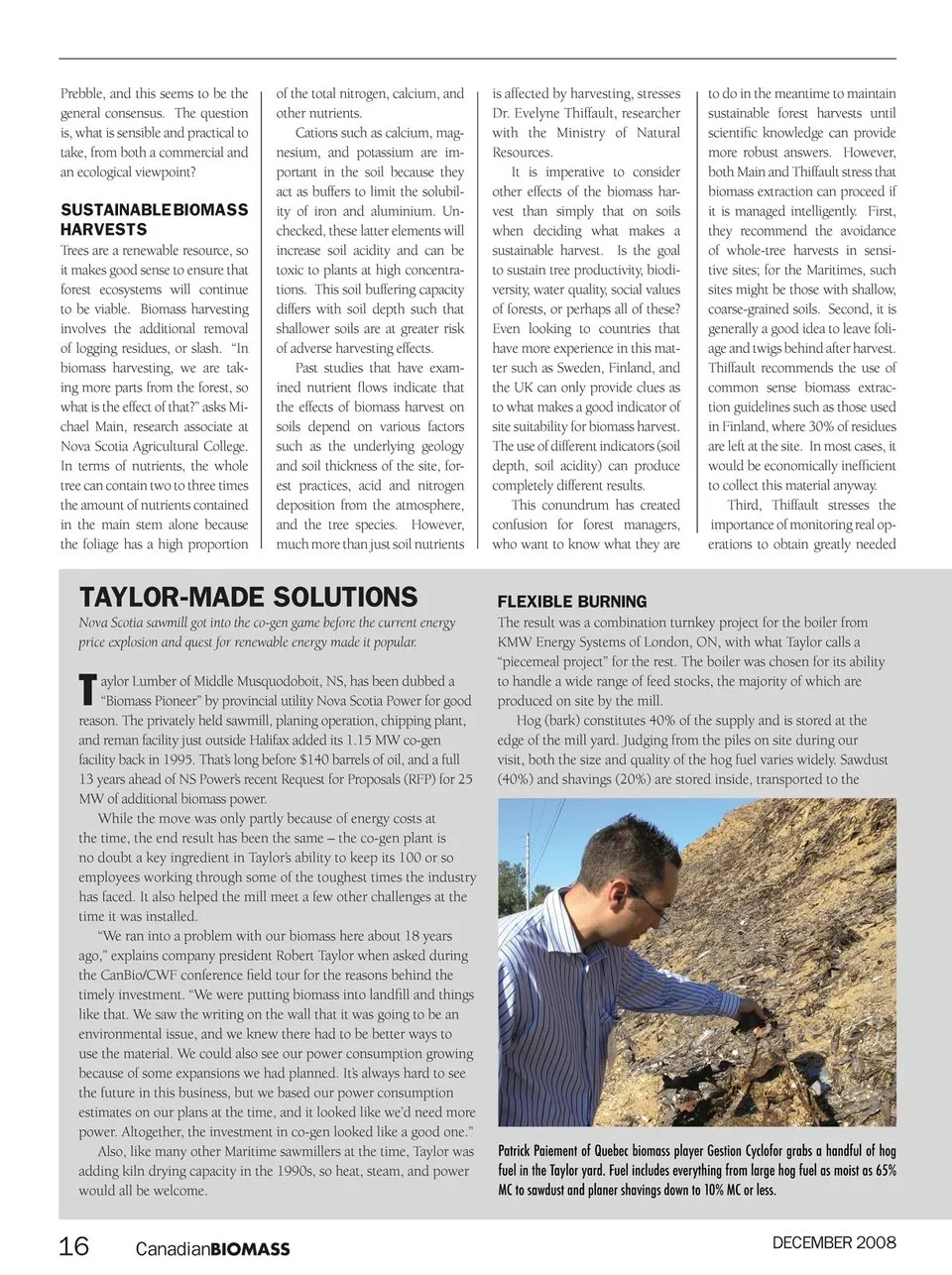
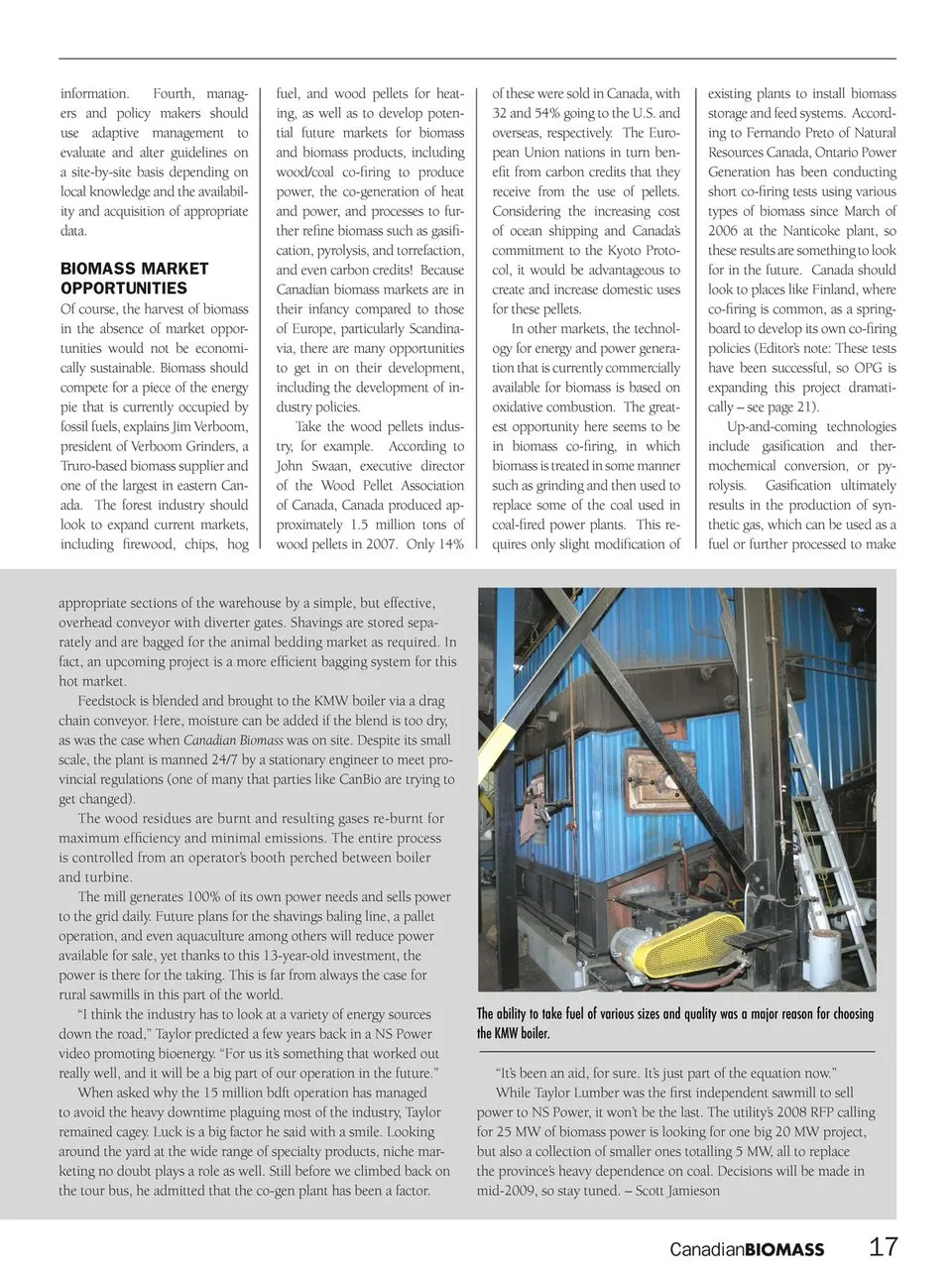
information. Fourth, manag- ers and policy makers should use adaptive management to evaluate and alter guidelines on a site-by-site basis depending on local knowledge and the availabil- ity and acquisition of appropriate data. BIOMASS MARKET OPPORTUNITIES Of course, the harvest of biomass in the absence of market oppor- tunities would not be economi- cally sustainable. Biomass should compete for a piece of the energy pie that is currently occupied by fossil fuels, explains Jim Verboom, president of Verboom Grinders, a Truro-based biomass supplier and one of the largest in eastern Can- ada. The forest industry should look to expand current markets, including fi rewood, chips, hog fuel, and wood pellets for heat- ing, as well as to develop poten- tial future markets for biomass and biomass products, including wood/coal co-fi ring to produce power, the co-generation of heat and power, and processes to fur- ther refine biomass such as gasifi- cation, pyrolysis, and torrefaction, and even carbon credits! Because Canadian biomass markets are in their infancy compared to those of Europe, particularly Scandina- via, there are many opportunities to get in on their development, including the development of in- dustry policies. Take the wood pellets indus- try, for example. According to John Swaan, executive director of the Wood Pellet Association of Canada, Canada produced ap- proximately 1.5 million tons of wood pellets in 2007. Only 14% appropriate sections of the warehouse by a simple, but effective, overhead conveyor with diverter gates. Shavings are stored sepa- rately and are bagged for the animal bedding market as required. In fact, an upcoming project is a more effi cient bagging system for this hot market. Feedstock is blended and brought to the KMW boiler via a drag chain conveyor. Here, moisture can be added if the blend is too dry, as was the case when Canadian Biomass was on site. Despite its small scale, the plant is manned 24/7 by a stationary engineer to meet pro- vincial regulations (one of many that parties like CanBio are trying to get changed). The wood residues are burnt and resulting gases re-burnt for maximum efficiency and minimal emissions. The entire process is controlled from an operator’s booth perched between boiler and turbine. The mill generates 100% of its own power needs and sells power to the grid daily. Future plans for the shavings baling line, a pallet operation, and even aquaculture among others will reduce power available for sale, yet thanks to this 13-year-old investment, the power is there for the taking. This is far from always the case for rural sawmills in this part of the world. “I think the industry has to look at a variety of energy sources down the road,” Taylor predicted a few years back in a NS Power video promoting bioenergy. “For us it’s something that worked out really well, and it will be a big part of our operation in the future.” When asked why the 15 million bdft operation has managed to avoid the heavy downtime plaguing most of the industry, Taylor remained cagey. Luck is a big factor he said with a smile. Looking around the yard at the wide range of specialty products, niche mar- keting no doubt plays a role as well. Still before we climbed back on the tour bus, he admitted that the co-gen plant has been a factor. of these were sold in Canada, with 32 and 54% going to the U.S. and overseas, respectively. The Euro- pean Union nations in turn ben- efi t from carbon credits that they receive from the use of pellets. Considering the increasing cost of ocean shipping and Canada’s commitment to the Kyoto Proto- col, it would be advantageous to create and increase domestic uses for these pellets. In other markets, the technol- ogy for energy and power genera- tion that is currently commercially available for biomass is based on oxidative combustion. The great- est opportunity here seems to be in biomass co-fi ring, in which biomass is treated in some manner such as grinding and then used to replace some of the coal used in coal-fi red power plants. This re- quires only slight modification of existing plants to install biomass storage and feed systems. Accord- ing to Fernando Preto of Natural Resources Canada, Ontario Power Generation has been conducting short co-fi ring tests using various types of biomass since March of 2006 at the Nanticoke plant, so these results are something to look for in the future. Canada should look to places like Finland, where co-fi ring is common, as a spring- board to develop its own co-firing policies (Editor’s note: These tests have been successful, so OPG is expanding this project dramati- cally – see page 21). Up-and-coming technologies include gasifi cation and ther- mochemical conversion, or py- rolysis. Gasification ultimately results in the production of syn- thetic gas, which can be used as a fuel or further processed to make The ability to take fuel of various sizes and quality was a major reason for choosing the KMW boiler. “It’s been an aid, for sure. It’s just part of the equation now.” While Taylor Lumber was the fi rst independent sawmill to sell power to NS Power, it won’t be the last. The utility’s 2008 RFP calling for 25 MW of biomass power is looking for one big 20 MW project, but also a collection of smaller ones totalling 5 MW, all to replace the province’s heavy dependence on coal. Decisions will be made in mid-2009, so stay tuned. – Scott Jamieson CanadianBIOMASS 17
Canadian Biomass December 2008: Page 17