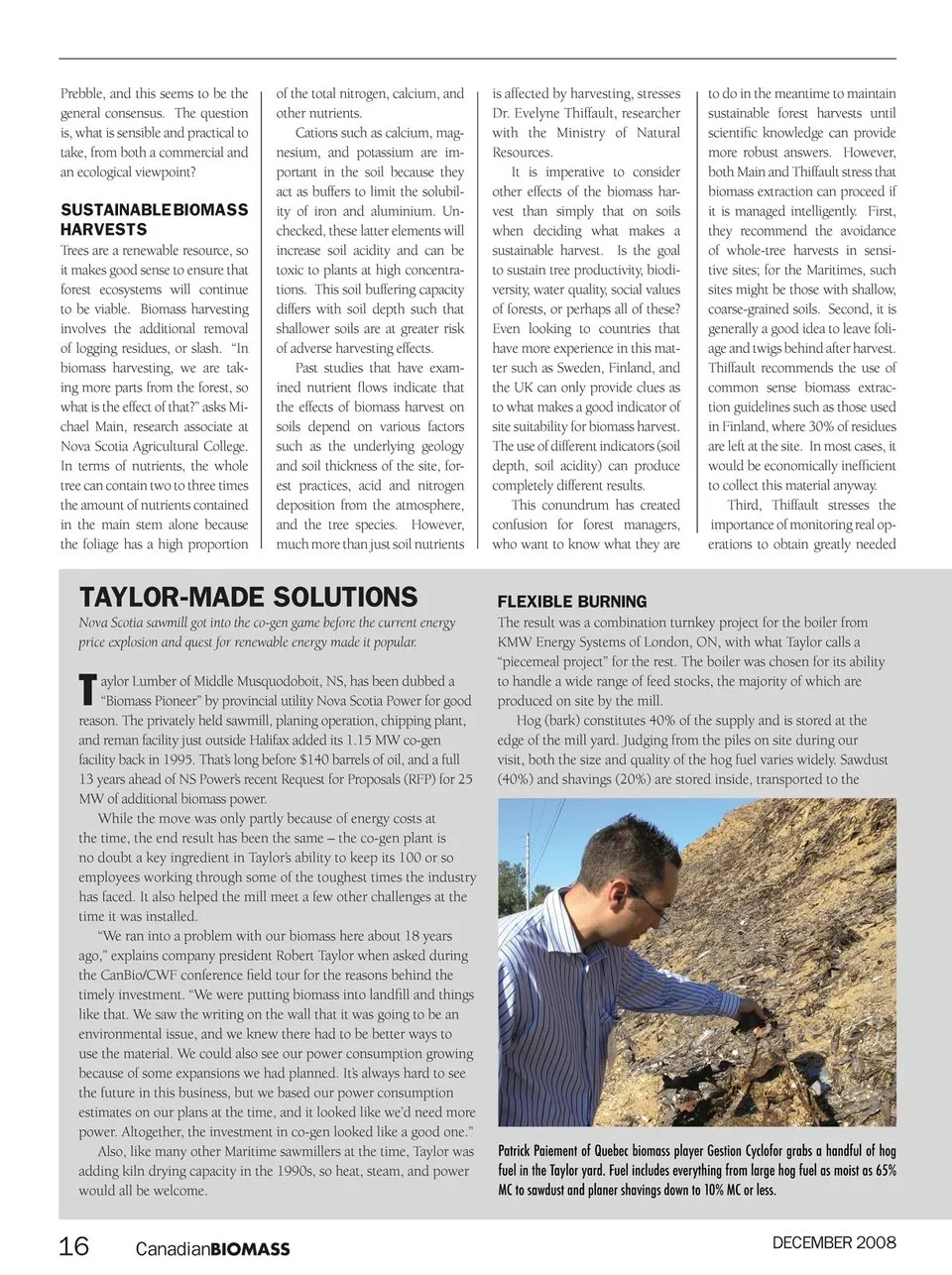
Prebble, and this seems to be the general consensus. The question is, what is sensible and practical to take, from both a commercial and an ecological viewpoint? SUSTAINABLE BIOMASS HARVESTS Trees are a renewable resource, so it makes good sense to ensure that forest ecosystems will continue to be viable. Biomass harvesting involves the additional removal of logging residues, or slash. “In biomass harvesting, we are tak- ing more parts from the forest, so what is the effect of that?” asks Mi- chael Main, research associate at Nova Scotia Agricultural College. In terms of nutrients, the whole tree can contain two to three times the amount of nutrients contained in the main stem alone because the foliage has a high proportion of the total nitrogen, calcium, and other nutrients. Cations such as calcium, mag- nesium, and potassium are im- portant in the soil because they act as buffers to limit the solubil- ity of iron and aluminium. Un- checked, these latter elements will increase soil acidity and can be toxic to plants at high concentra- tions. This soil buffering capacity differs with soil depth such that shallower soils are at greater risk of adverse harvesting effects. Past studies that have exam- ined nutrient fl ows indicate that the effects of biomass harvest on soils depend on various factors such as the underlying geology and soil thickness of the site, for- est practices, acid and nitrogen deposition from the atmosphere, and the tree species. However, much more than just soil nutrients TAYLOR-MADE SOLUTIONS Nova Scotia sawmill got into the co-gen game before the current energy price explosion and quest for renewable energy made it popular. T aylor Lumber of Middle Musquodoboit, NS, has been dubbed a “Biomass Pioneer” by provincial utility Nova Scotia Power for good reason. The privately held sawmill, planing operation, chipping plant, and reman facility just outside Halifax added its 1.15 MW co-gen facility back in 1995. That’s long before $140 barrels of oil, and a full 13 years ahead of NS Power’s recent Request for Proposals (RFP) for 25 MW of additional biomass power. While the move was only partly because of energy costs at the time, the end result has been the same – the co-gen plant is no doubt a key ingredient in Taylor’s ability to keep its 100 or so employees working through some of the toughest times the industry has faced. It also helped the mill meet a few other challenges at the time it was installed. “We ran into a problem with our biomass here about 18 years ago,” explains company president Robert Taylor when asked during the CanBio/CWF conference fi eld tour for the reasons behind the timely investment. “We were putting biomass into landfi ll and things like that. We saw the writing on the wall that it was going to be an environmental issue, and we knew there had to be better ways to use the material. We could also see our power consumption growing because of some expansions we had planned. It’s always hard to see the future in this business, but we based our power consumption estimates on our plans at the time, and it looked like we’d need more power. Altogether, the investment in co-gen looked like a good one.” Also, like many other Maritime sawmillers at the time, Taylor was adding kiln drying capacity in the 1990s, so heat, steam, and power would all be welcome. 16 CanadianBIOMASS is affected by harvesting, stresses Dr. Evelyne Thiffault, researcher with the Ministry of Natural Resources. It is imperative to consider other effects of the biomass har- vest than simply that on soils when deciding what makes a sustainable harvest. Is the goal to sustain tree productivity, biodi- versity, water quality, social values of forests, or perhaps all of these? Even looking to countries that have more experience in this mat- ter such as Sweden, Finland, and the UK can only provide clues as to what makes a good indicator of site suitability for biomass harvest. The use of different indicators (soil depth, soil acidity) can produce completely different results. This conundrum has created confusion for forest managers, who want to know what they are to do in the meantime to maintain sustainable forest harvests until scientifi c knowledge can provide more robust answers. However, both Main and Thiffault stress that biomass extraction can proceed if it is managed intelligently. First, they recommend the avoidance of whole-tree harvests in sensi- tive sites; for the Maritimes, such sites might be those with shallow, coarse-grained soils. Second, it is generally a good idea to leave foli- age and twigs behind after harvest. Thiffault recommends the use of common sense biomass extrac- tion guidelines such as those used in Finland, where 30% of residues are left at the site. In most cases, it would be economically inefficient to collect this material anyway. Third, Thiffault stresses the importance of monitoring real op- erations to obtain greatly needed FLEXIBLE BURNING The result was a combination turnkey project for the boiler from KMW Energy Systems of London, ON, with what Taylor calls a “piecemeal project” for the rest. The boiler was chosen for its ability to handle a wide range of feed stocks, the majority of which are produced on site by the mill. Hog (bark) constitutes 40% of the supply and is stored at the edge of the mill yard. Judging from the piles on site during our visit, both the size and quality of the hog fuel varies widely. Sawdust (40%) and shavings (20%) are stored inside, transported to the Patrick Paiement of Quebec biomass player Gestion Cyclofor grabs a handful of hog fuel in the Taylor yard. Fuel includes everything from large hog fuel as moist as 65% MC to sawdust and planer shavings down to 10% MC or less. DECEMBER 2008
Canadian Biomass December 2008: Page 16