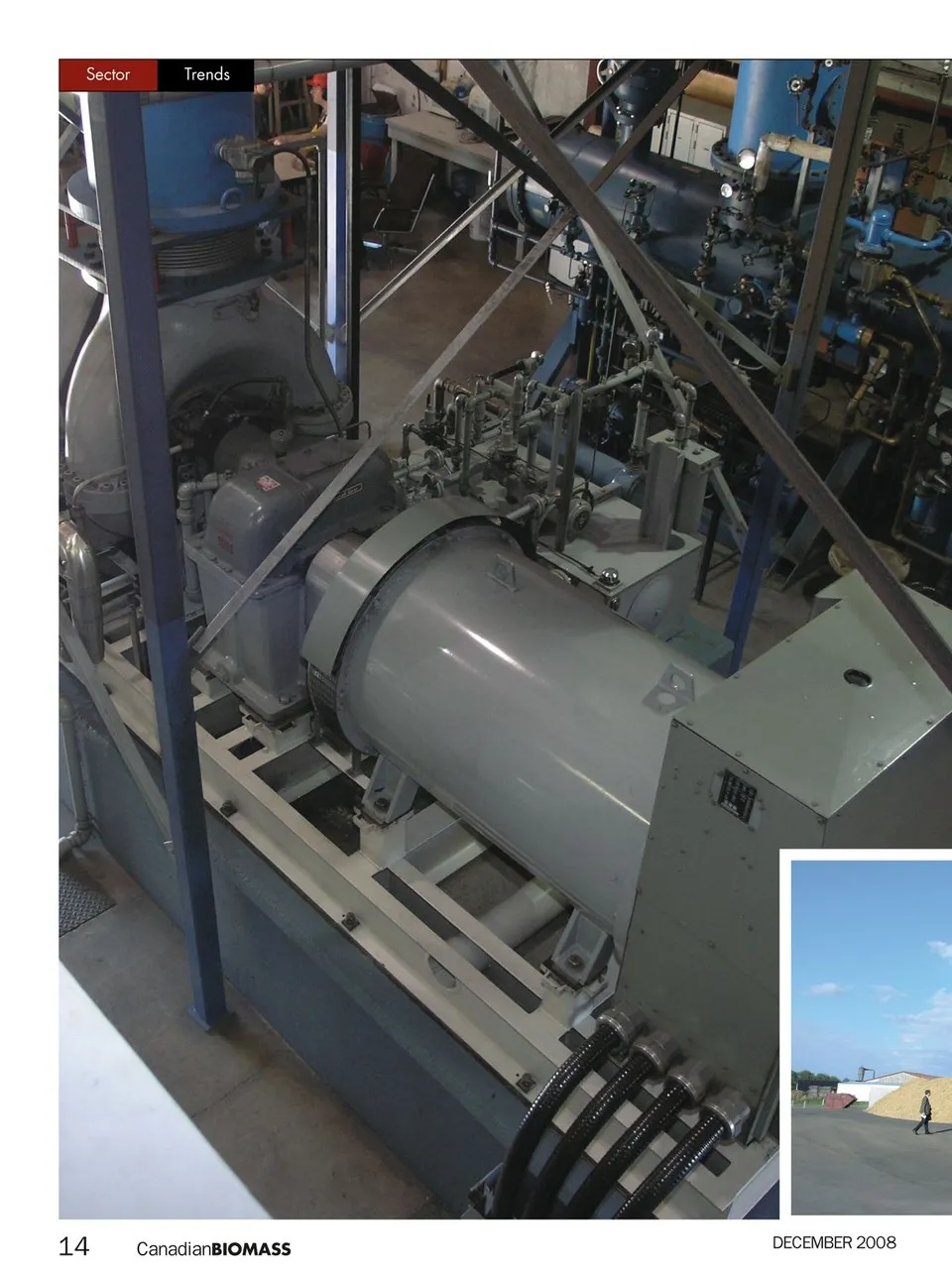
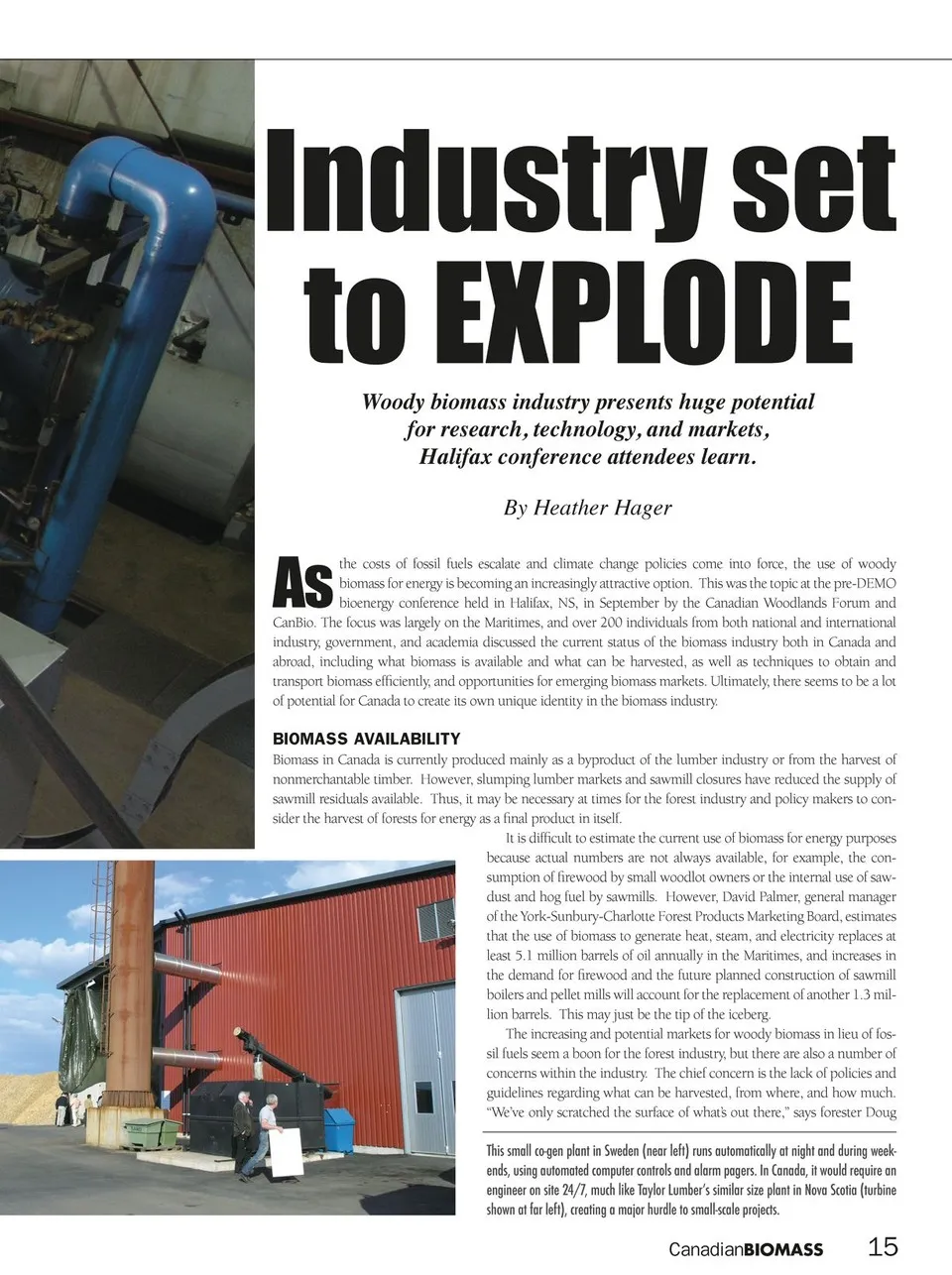
Industry set to EXPLODE Woody biomass industry presents huge potential for research, technology, and markets, Halifax conference attendees learn. By Heather Hager CanBio. The focus was largely on the Maritimes, and over 200 individuals from both national and international industry, government, and academia discussed the current status of the biomass industry both in Canada and abroad, including what biomass is available and what can be harvested, as well as techniques to obtain and transport biomass effi ciently, and opportunities for emerging biomass markets. Ultimately, there seems to be a lot of potential for Canada to create its own unique identity in the biomass industry. As BIOMASS AVAILABILITY Biomass in Canada is currently produced mainly as a byproduct of the lumber industry or from the harvest of nonmerchantable timber. However, slumping lumber markets and sawmill closures have reduced the supply of sawmill residuals available. Thus, it may be necessary at times for the forest industry and policy makers to con- sider the harvest of forests for energy as a fi nal product in itself. It is diffi cult to estimate the current use of biomass for energy purposes because actual numbers are not always available, for example, the con- sumption of fi rewood by small woodlot owners or the internal use of saw- dust and hog fuel by sawmills. However, David Palmer, general manager of the York-Sunbury-Charlotte Forest Products Marketing Board, estimates that the use of biomass to generate heat, steam, and electricity replaces at least 5.1 million barrels of oil annually in the Maritimes, and increases in the demand for fi rewood and the future planned construction of sawmill boilers and pellet mills will account for the replacement of another 1.3 mil- lion barrels. This may just be the tip of the iceberg. The increasing and potential markets for woody biomass in lieu of fos- sil fuels seem a boon for the forest industry, but there are also a number of concerns within the industry. The chief concern is the lack of policies and guidelines regarding what can be harvested, from where, and how much. “We’ve only scratched the surface of what’s out there,” says forester Doug This small co-gen plant in Sweden (near left) runs automatically at night and during week- ends, using automated computer controls and alarm pagers. In Canada, it would require an engineer on site 24/7, much like Taylor Lumberʼs similar size plant in Nova Scotia (turbine shown at far left), creating a major hurdle to small-scale projects. CanadianBIOMASS 15 the costs of fossil fuels escalate and climate change policies come into force, the use of woody biomass for energy is becoming an increasingly attractive option. This was the topic at the pre-DEMO bioenergy conference held in Halifax, NS, in September by the Canadian Woodlands Forum and
Canadian Biomass December 2008: Page 15