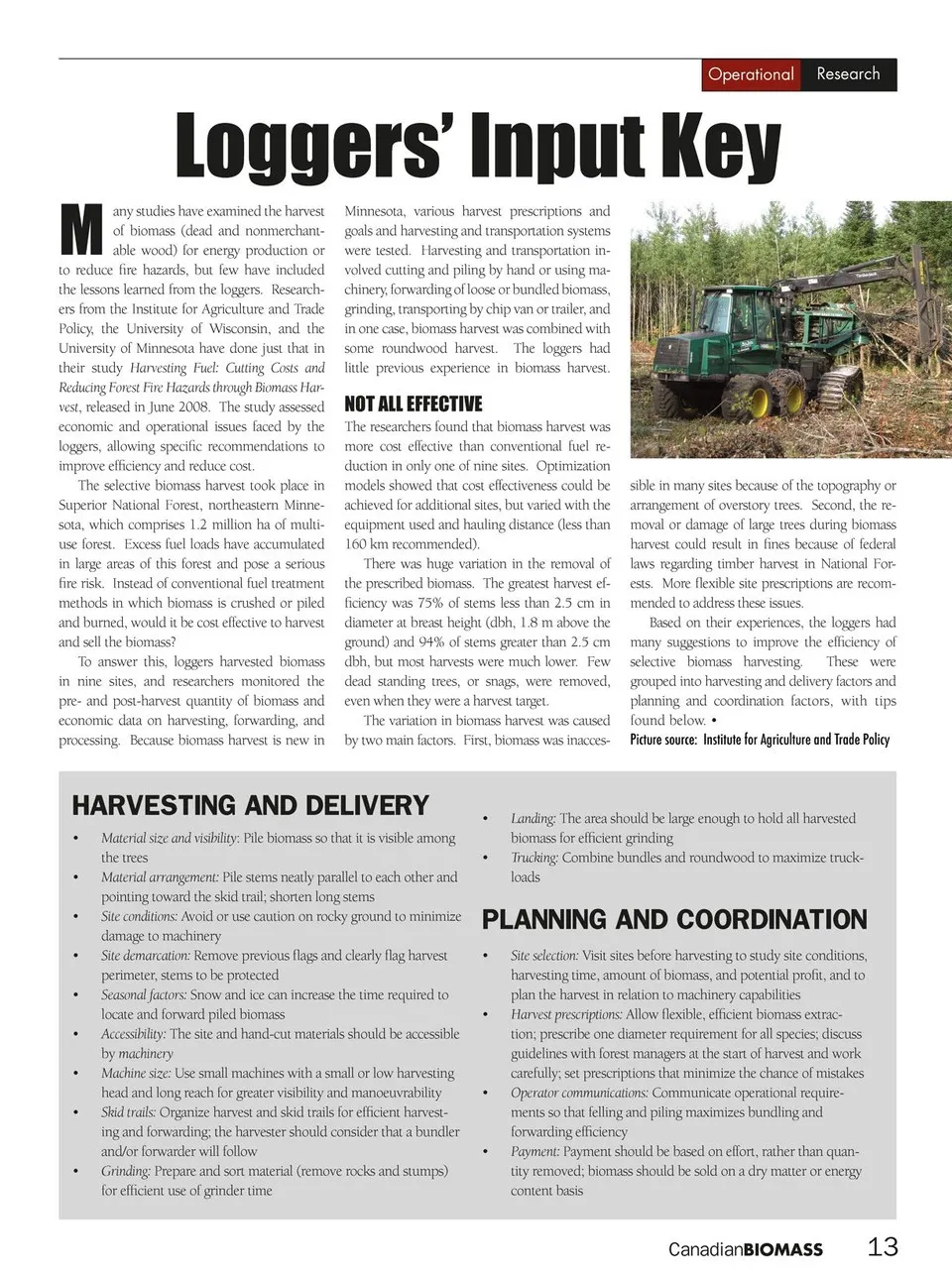
Operational Research Loggers’ Input Key to reduce fi re hazards, but few have included the lessons learned from the loggers. Research- ers from the Institute for Agriculture and Trade Policy, the University of Wisconsin, and the University of Minnesota have done just that in their study Harvesting Fuel: Cutting Costs and Reducing Forest Fire Hazards through Biomass Har- vest, released in June 2008. The study assessed economic and operational issues faced by the loggers, allowing specifi c recommendations to improve effi ciency and reduce cost. The selective biomass harvest took place in Superior National Forest, northeastern Minne- sota, which comprises 1.2 million ha of multi- use forest. Excess fuel loads have accumulated in large areas of this forest and pose a serious fi re risk. Instead of conventional fuel treatment methods in which biomass is crushed or piled and burned, would it be cost effective to harvest and sell the biomass? To answer this, loggers harvested biomass in nine sites, and researchers monitored the pre- and post-harvest quantity of biomass and economic data on harvesting, forwarding, and processing. Because biomass harvest is new in M any studies have examined the harvest of biomass (dead and nonmerchant- able wood) for energy production or Minnesota, various harvest prescriptions and goals and harvesting and transportation systems were tested. Harvesting and transportation in- volved cutting and piling by hand or using ma- chinery, forwarding of loose or bundled biomass, grinding, transporting by chip van or trailer, and in one case, biomass harvest was combined with some roundwood harvest. The loggers had little previous experience in biomass harvest. NOT ALL EFFECTIVE The researchers found that biomass harvest was more cost effective than conventional fuel re- duction in only one of nine sites. Optimization models showed that cost effectiveness could be achieved for additional sites, but varied with the equipment used and hauling distance (less than 160 km recommended). There was huge variation in the removal of the prescribed biomass. The greatest harvest ef- fi ciency was 75% of stems less than 2.5 cm in diameter at breast height (dbh, 1.8 m above the ground) and 94% of stems greater than 2.5 cm dbh, but most harvests were much lower. Few dead standing trees, or snags, were removed, even when they were a harvest target. The variation in biomass harvest was caused by two main factors. First, biomass was inacces- HARVESTING AND DELIVERY • Material size and visibility : Pile biomass so that it is visible among the trees • Material arrangement: Pile stems neatly parallel to each other and pointing toward the skid trail; shorten long stems • Site conditions: Avoid or use caution on rocky ground to minimize damage to machinery • Site demarcation: Remove previous fl ags and clearly flag harvest perimeter, stems to be protected • Seasonal factors: Snow and ice can increase the time required to locate and forward piled biomass • Accessibility: The site and hand-cut materials should be accessible by machinery • Machine size: Use small machines with a small or low harvesting head and long reach for greater visibility and manoeuvrability • Skid trails: Organize harvest and skid trails for efficient harvest- ing and forwarding; the harvester should consider that a bundler and/or forwarder will follow • Grinding: Prepare and sort material (remove rocks and stumps) for effi cient use of grinder time sible in many sites because of the topography or arrangement of overstory trees. Second, the re- moval or damage of large trees during biomass harvest could result in fi nes because of federal laws regarding timber harvest in National For- ests. More fl exible site prescriptions are recom- mended to address these issues. Based on their experiences, the loggers had many suggestions to improve the efficiency of selective biomass harvesting. These were grouped into harvesting and delivery factors and planning and coordination factors, with tips found below. • Picture source: Institute for Agriculture and Trade Policy • Landing: The area should be large enough to hold all harvested biomass for efficient grinding • Trucking: Combine bundles and roundwood to maximize truck- loads PLANNING AND COORDINATION • Site selection: Visit sites before harvesting to study site conditions, harvesting time, amount of biomass, and potential profi t, and to plan the harvest in relation to machinery capabilities • Harvest prescriptions: Allow flexible, effi cient biomass extrac- tion; prescribe one diameter requirement for all species; discuss guidelines with forest managers at the start of harvest and work carefully; set prescriptions that minimize the chance of mistakes • Operator communications: Communicate operational require- ments so that felling and piling maximizes bundling and forwarding efficiency • Payment: Payment should be based on effort, rather than quan- tity removed; biomass should be sold on a dry matter or energy content basis CanadianBIOMASS 13
Canadian Biomass December 2008: Page 13