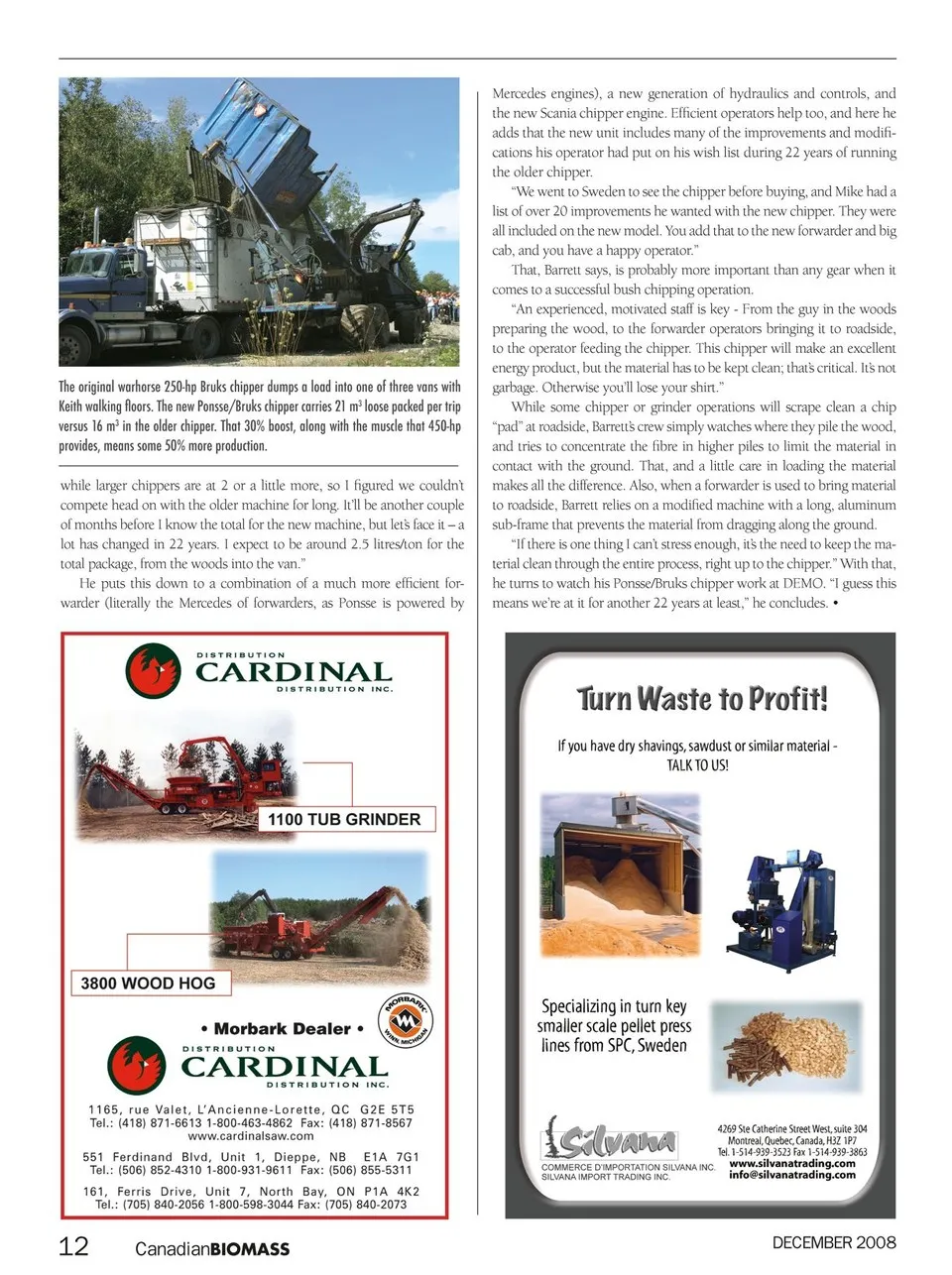
Mercedes engines), a new generation of hydraulics and controls, and the new Scania chipper engine. Effi cient operators help too, and here he adds that the new unit includes many of the improvements and modifi- cations his operator had put on his wish list during 22 years of running the older chipper. “We went to Sweden to see the chipper before buying, and Mike had a list of over 20 improvements he wanted with the new chipper. They were all included on the new model. You add that to the new forwarder and big cab, and you have a happy operator.” That, Barrett says, is probably more important than any gear when it comes to a successful bush chipping operation. “An experienced, motivated staff is key - From the guy in the woods The original warhorse 250-hp Bruks chipper dumps a load into one of three vans with Keith walking fl oors. The new Ponsse/Bruks chipper carries 21 m3 versus 16 m3 loose packed per trip in the older chipper. That 30% boost, along with the muscle that 450-hp provides, means some 50% more production. while larger chippers are at 2 or a little more, so I fi gured we couldn’t compete head on with the older machine for long. It’ll be another couple of months before I know the total for the new machine, but let’s face it – a lot has changed in 22 years. I expect to be around 2.5 litres/ton for the total package, from the woods into the van.” He puts this down to a combination of a much more efficient for- warder (literally the Mercedes of forwarders, as Ponsse is powered by preparing the wood, to the forwarder operators bringing it to roadside, to the operator feeding the chipper. This chipper will make an excellent energy product, but the material has to be kept clean; that’s critical. It’s not garbage. Otherwise you’ll lose your shirt.” While some chipper or grinder operations will scrape clean a chip “pad” at roadside, Barrett’s crew simply watches where they pile the wood, and tries to concentrate the fi bre in higher piles to limit the material in contact with the ground. That, and a little care in loading the material makes all the difference. Also, when a forwarder is used to bring material to roadside, Barrett relies on a modified machine with a long, aluminum sub-frame that prevents the material from dragging along the ground. “If there is one thing I can’t stress enough, it’s the need to keep the ma- terial clean through the entire process, right up to the chipper.” With that, he turns to watch his Ponsse/Bruks chipper work at DEMO. “I guess this means we’re at it for another 22 years at least,” he concludes. • 12 CanadianBIOMASS DECEMBER 2008
Canadian Biomass December 2008: Page 12