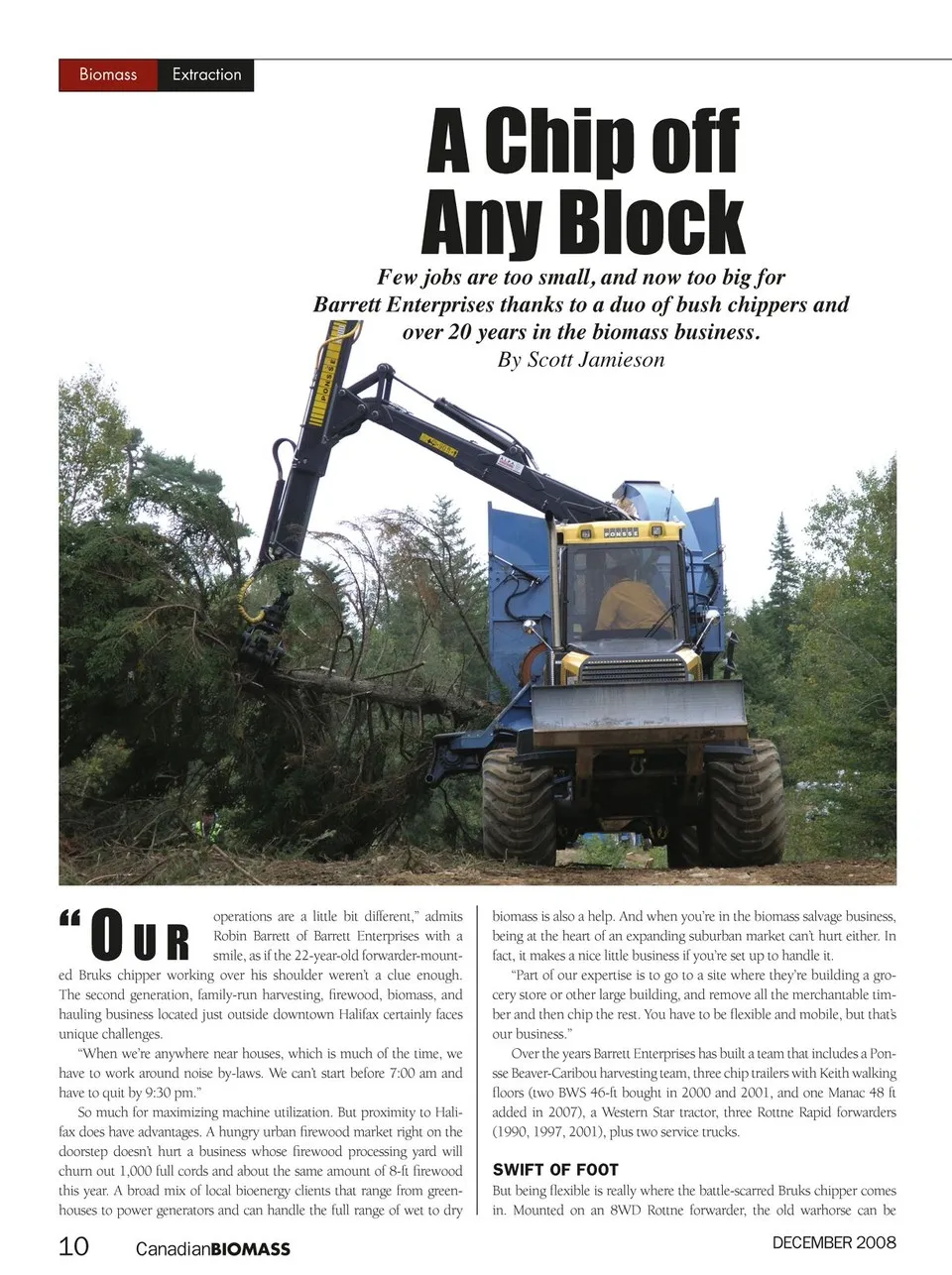
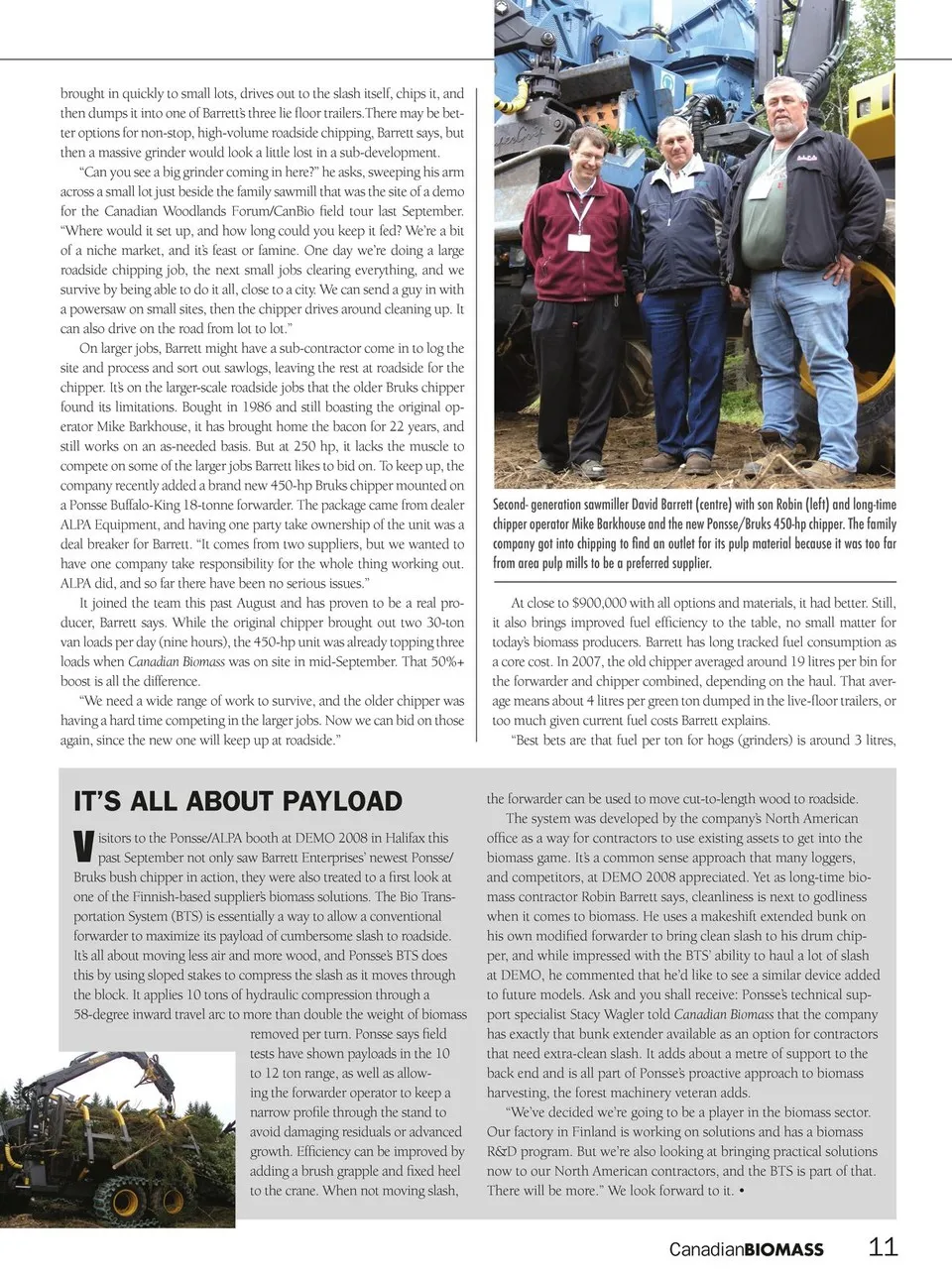
brought in quickly to small lots, drives out to the slash itself, chips it, and then dumps it into one of Barrett’s three lie fl oor trailers.There may be bet- ter options for non-stop, high-volume roadside chipping, Barrett says, but then a massive grinder would look a little lost in a sub-development. “Can you see a big grinder coming in here?” he asks, sweeping his arm across a small lot just beside the family sawmill that was the site of a demo for the Canadian Woodlands Forum/CanBio fi eld tour last September. “Where would it set up, and how long could you keep it fed? We’re a bit of a niche market, and it’s feast or famine. One day we’re doing a large roadside chipping job, the next small jobs clearing everything, and we survive by being able to do it all, close to a city. We can send a guy in with a powersaw on small sites, then the chipper drives around cleaning up. It can also drive on the road from lot to lot.” On larger jobs, Barrett might have a sub-contractor come in to log the site and process and sort out sawlogs, leaving the rest at roadside for the chipper. It’s on the larger-scale roadside jobs that the older Bruks chipper found its limitations. Bought in 1986 and still boasting the original op- erator Mike Barkhouse, it has brought home the bacon for 22 years, and still works on an as-needed basis. But at 250 hp, it lacks the muscle to compete on some of the larger jobs Barrett likes to bid on. To keep up, the company recently added a brand new 450-hp Bruks chipper mounted on a Ponsse Buffalo-King 18-tonne forwarder. The package came from dealer ALPA Equipment, and having one party take ownership of the unit was a deal breaker for Barrett. “It comes from two suppliers, but we wanted to have one company take responsibility for the whole thing working out. ALPA did, and so far there have been no serious issues.” It joined the team this past August and has proven to be a real pro- ducer, Barrett says. While the original chipper brought out two 30-ton van loads per day (nine hours), the 450-hp unit was already topping three loads when Canadian Biomass was on site in mid-September. That 50%+ boost is all the difference. “We need a wide range of work to survive, and the older chipper was having a hard time competing in the larger jobs. Now we can bid on those again, since the new one will keep up at roadside.” IT’S ALL ABOUT PAYLOAD isitors to the Ponsse/ALPA booth at DEMO 2008 in Halifax this past September not only saw Barrett Enterprises’ newest Ponsse/ Bruks bush chipper in action, they were also treated to a fi rst look at one of the Finnish-based supplier’s biomass solutions. The Bio Trans- portation System (BTS) is essentially a way to allow a conventional forwarder to maximize its payload of cumbersome slash to roadside. It’s all about moving less air and more wood, and Ponsse’s BTS does this by using sloped stakes to compress the slash as it moves through the block. It applies 10 tons of hydraulic compression through a 58-degree inward travel arc to more than double the weight of biomass removed per turn. Ponsse says field tests have shown payloads in the 10 to 12 ton range, as well as allow- ing the forwarder operator to keep a narrow profi le through the stand to avoid damaging residuals or advanced growth. Effi ciency can be improved by adding a brush grapple and fixed heel to the crane. When not moving slash, V Second- generation sawmiller David Barrett (centre) with son Robin (left) and long-time chipper operator Mike Barkhouse and the new Ponsse/Bruks 450-hp chipper. The family company got into chipping to fi nd an outlet for its pulp material because it was too far from area pulp mills to be a preferred supplier. At close to $900,000 with all options and materials, it had better. Still, it also brings improved fuel effi ciency to the table, no small matter for today’s biomass producers. Barrett has long tracked fuel consumption as a core cost. In 2007, the old chipper averaged around 19 litres per bin for the forwarder and chipper combined, depending on the haul. That aver- age means about 4 litres per green ton dumped in the live-floor trailers, or too much given current fuel costs Barrett explains. “Best bets are that fuel per ton for hogs (grinders) is around 3 litres, the forwarder can be used to move cut-to-length wood to roadside. The system was developed by the company’s North American offi ce as a way for contractors to use existing assets to get into the biomass game. It’s a common sense approach that many loggers, and competitors, at DEMO 2008 appreciated. Yet as long-time bio- mass contractor Robin Barrett says, cleanliness is next to godliness when it comes to biomass. He uses a makeshift extended bunk on his own modifi ed forwarder to bring clean slash to his drum chip- per, and while impressed with the BTS’ ability to haul a lot of slash at DEMO, he commented that he’d like to see a similar device added to future models. Ask and you shall receive: Ponsse’s technical sup- port specialist Stacy Wagler told Canadian Biomass that the company has exactly that bunk extender available as an option for contractors that need extra-clean slash. It adds about a metre of support to the back end and is all part of Ponsse’s proactive approach to biomass harvesting, the forest machinery veteran adds. “We’ve decided we’re going to be a player in the biomass sector. Our factory in Finland is working on solutions and has a biomass R&D program. But we’re also looking at bringing practical solutions now to our North American contractors, and the BTS is part of that. There will be more.” We look forward to it. • CanadianBIOMASS 11
Canadian Biomass December 2008: Page 11