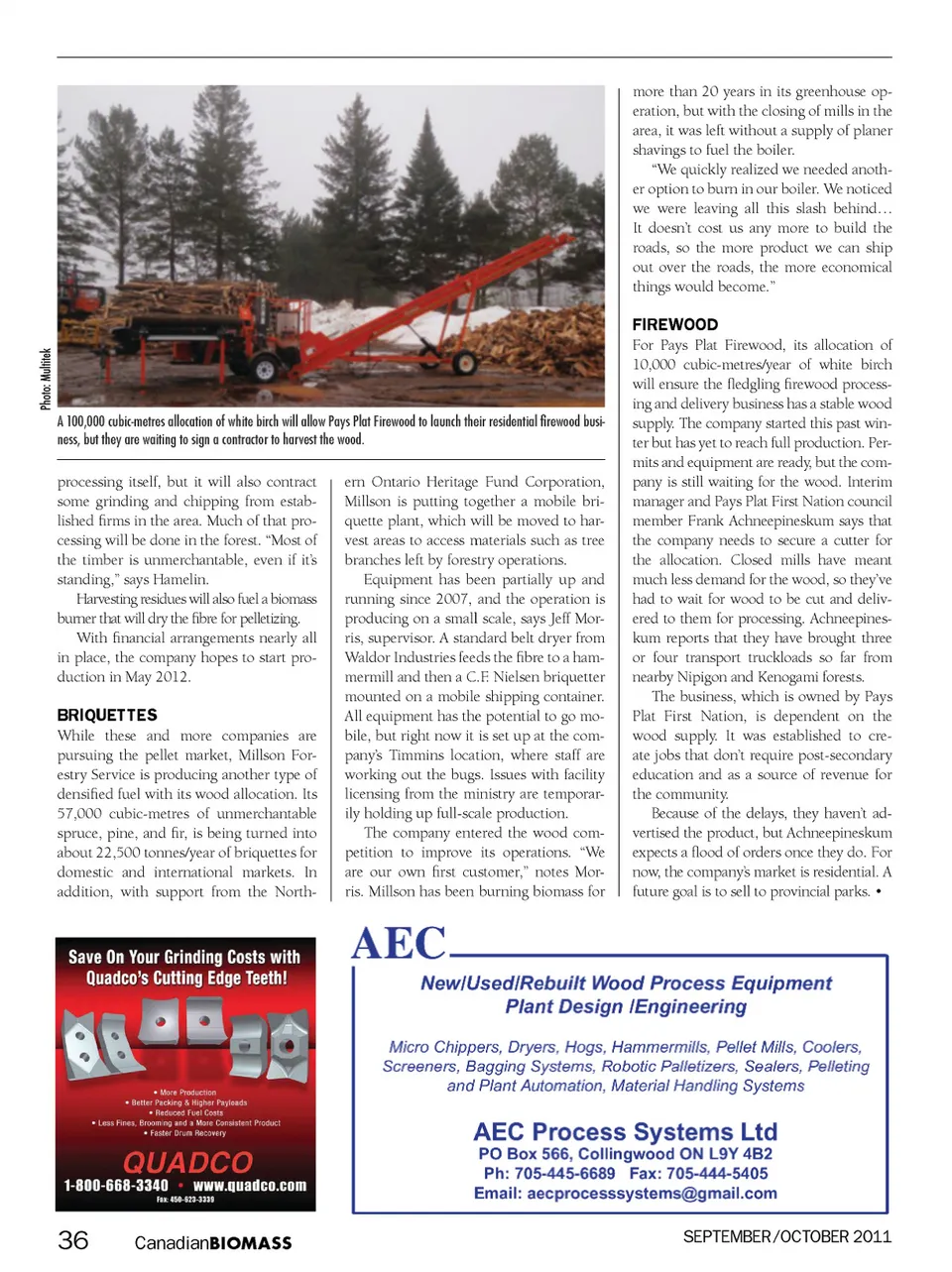
more than 20 years in its greenhouse op-eration, but with the closing of mills in the area, it was left without a supply of planer shavings to fuel the boiler. “We quickly realized we needed anoth-er option to burn in our boiler. We noticed we were leaving all this slash behind… It doesn’t cost us any more to build the roads, so the more product we can ship out over the roads, the more economical things would become.” firewood A 100,000 cubic-metres allocation of white birch will allow Pays Plat Firewood to launch their residential firewood busi -ness, but they are waiting to sign a contractor to harvest the wood. processing itself, but it will also contract some grinding and chipping from estab-lished firms in the area. Much of that pro-cessing will be done in the forest. “Most of the timber is unmerchantable, even if it’s standing,” says Hamelin. Harvesting residues will also fuel a biomass burner that will dry the fibre for pelletizing. With financial arrangements nearly all in place, the company hopes to start pro-duction in May 2012. Briquettes While these and more companies are pursuing the pellet market, Millson For-estry Service is producing another type of densified fuel with its wood allocation. Its 57,000 cubic-metres of unmerchantable spruce, pine, and fir, is being turned into about 22,500 tonnes/year of briquettes for domestic and international markets. In addition, with support from the North-ern Ontario Heritage Fund Corporation, Millson is putting together a mobile bri-quette plant, which will be moved to har-vest areas to access materials such as tree branches left by forestry operations. Equipment has been partially up and running since 2007, and the operation is producing on a small scale, says Jeff Mor-ris, supervisor. A standard belt dryer from Waldor Industries feeds the fibre to a ham-mermill and then a C.F . Nielsen briquetter mounted on a mobile shipping container. All equipment has the potential to go mo-bile, but right now it is set up at the com-pany’s Timmins location, where staff are working out the bugs. Issues with facility licensing from the ministry are temporar-ily holding up full-scale production. The company entered the wood com-petition to improve its operations. “We are our own first customer,” notes Mor-ris. Millson has been burning biomass for For Pays Plat Firewood, its allocation of 10,000 cubic-metres/year of white birch will ensure the fledgling firewood process-ing and delivery business has a stable wood supply. The company started this past win-ter but has yet to reach full production. Per-mits and equipment are ready, but the com-pany is still waiting for the wood. Interim manager and Pays Plat First Nation council member Frank Achneepineskum says that the company needs to secure a cutter for the allocation. Closed mills have meant much less demand for the wood, so they’ve had to wait for wood to be cut and deliv-ered to them for processing. Achneepines-kum reports that they have brought three or four transport truckloads so far from nearby Nipigon and Kenogami forests. The business, which is owned by Pays Plat First Nation, is dependent on the wood supply. It was established to cre-ate jobs that don’t require post-secondary education and as a source of revenue for the community. Because of the delays, they haven’t ad-vertised the product, but Achneepineskum expects a flood of orders once they do. For now, the company’s market is residential. A future goal is to sell to provincial parks. • Photo: Multitek 36 Canadian BIOMASS SEPTEMBER/OCTOBER 2011
Canadian Biomass September/October 2011: Page 36