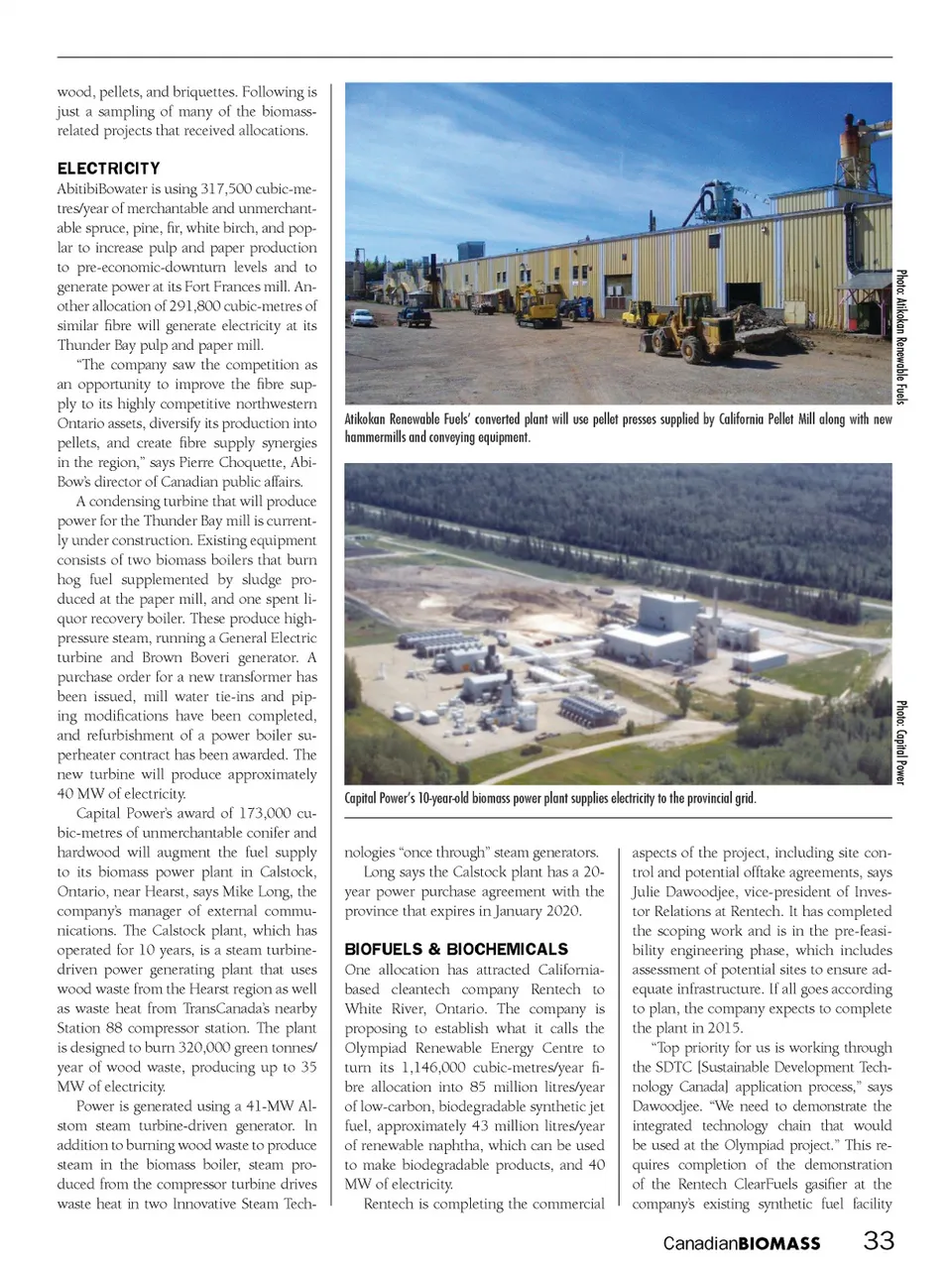
wood, pellets, and briquettes. Following is just a sampling of many of the biomass-related projects that received allocations. electricity AbitibiBowater is using 317,500 cubic-me-tres/year of merchantable and unmerchant-able spruce, pine, fir, white birch, and pop-lar to increase pulp and paper production to pre-economic-downturn levels and to generate power at its Fort Frances mill. An-other allocation of 291,800 cubic-metres of similar fibre will generate electricity at its Thunder Bay pulp and paper mill. “The company saw the competition as an opportunity to improve the fibre sup-ply to its highly competitive northwestern Ontario assets, diversify its production into pellets, and create fibre supply synergies in the region,” says Pierre Choquette, Abi-Bow’s director of Canadian public affairs. A condensing turbine that will produce power for the Thunder Bay mill is current-ly under construction. Existing equipment consists of two biomass boilers that burn hog fuel supplemented by sludge pro-duced at the paper mill, and one spent li-quor recovery boiler. These produce high-pressure steam, running a General Electric turbine and Brown Boveri generator. A purchase order for a new transformer has been issued, mill water tie-ins and pip-ing modifications have been completed, and refurbishment of a power boiler su-perheater contract has been awarded. The new turbine will produce approximately 40 MW of electricity. Capital Power’s award of 173,000 cu-bic-metres of unmerchantable conifer and hardwood will augment the fuel supply to its biomass power plant in Calstock, Ontario, near Hearst, says Mike Long, the company’s manager of external commu-nications. The Calstock plant, which has operated for 10 years, is a steam turbine-driven power generating plant that uses wood waste from the Hearst region as well as waste heat from TransCanada’s nearby Station 88 compressor station. The plant is designed to burn 320,000 green tonnes/ year of wood waste, producing up to 35 MW of electricity. Power is generated using a 41-MW Al-stom steam turbine-driven generator. In addition to burning wood waste to produce steam in the biomass boiler, steam pro-duced from the compressor turbine drives waste heat in two Innovative Steam Tech-Photo: Atikokan Renewable Fuels Atikokan Renewable Fuels’ converted plant will use pellet presses supplied by California Pellet Mill along with new hammermills and conveying equipment. Photo: Capital Power Capital Power’s 10-year-old biomass power plant supplies electricity to the provincial grid. nologies “once through” steam generators. Long says the Calstock plant has a 20-year power purchase agreement with the province that expires in January 2020. Biofuels & Biochemicals One allocation has attracted California-based cleantech company Rentech to White River, Ontario. The company is proposing to establish what it calls the Olympiad Renewable Energy Centre to turn its 1,146,000 cubic-metres/year fi-bre allocation into 85 million litres/year of low-carbon, biodegradable synthetic jet fuel, approximately 43 million litres/year of renewable naphtha, which can be used to make biodegradable products, and 40 MW of electricity. Rentech is completing the commercial aspects of the project, including site con-trol and potential offtake agreements, says Julie Dawoodjee, vice-president of Inves-tor Relations at Rentech. It has completed the scoping work and is in the pre-feasi-bility engineering phase, which includes assessment of potential sites to ensure ad-equate infrastructure. If all goes according to plan, the company expects to complete the plant in 2015. “Top priority for us is working through the SDTC [Sustainable Development Tech-nology Canada] application process,” says Dawoodjee. “We need to demonstrate the integrated technology chain that would be used at the Olympiad project.” This re-quires completion of the demonstration of the Rentech ClearFuels gasifier at the company’s existing synthetic fuel facility Canadian BIOMASS 33
Canadian Biomass September/October 2011: Page 33