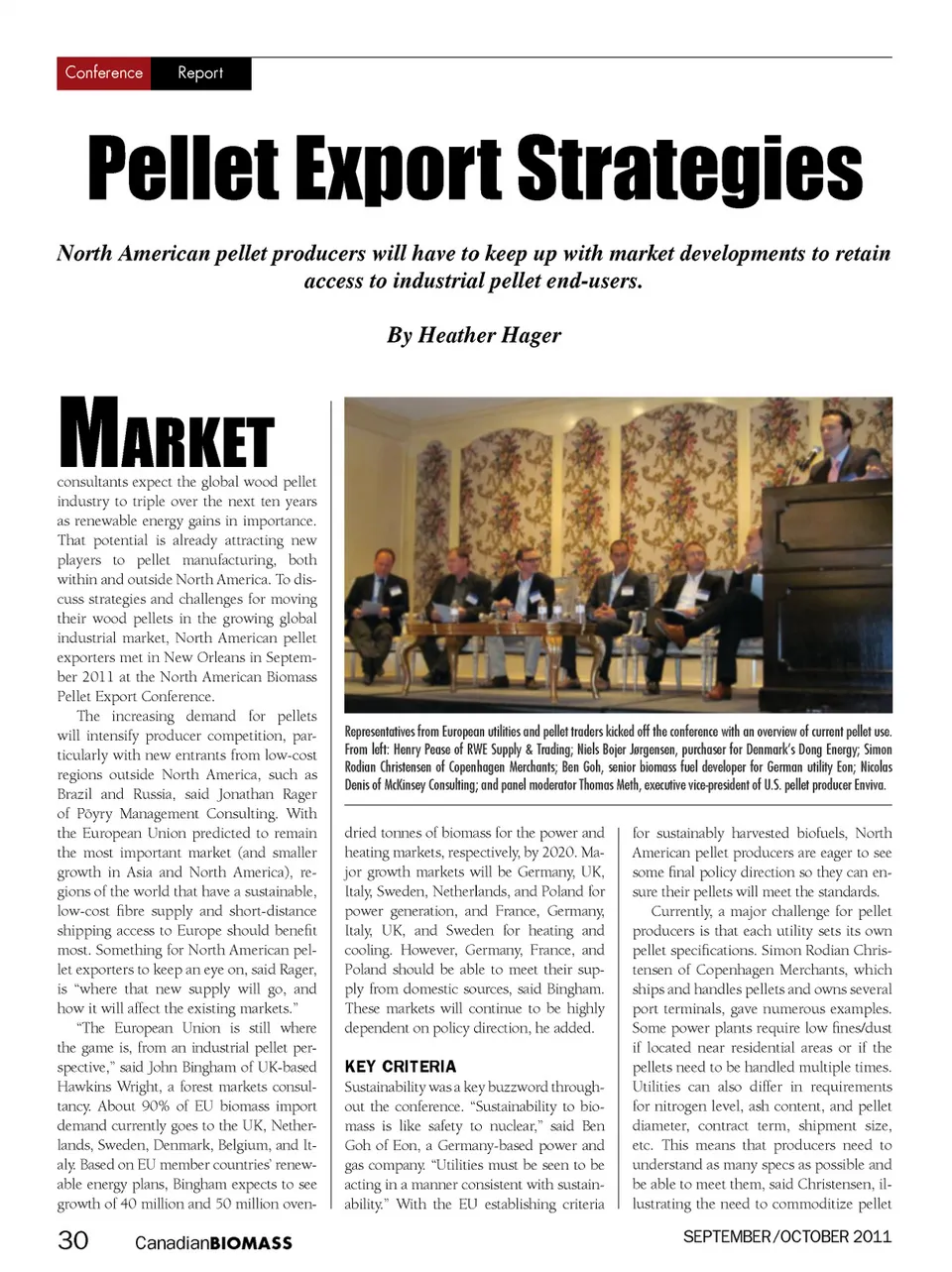
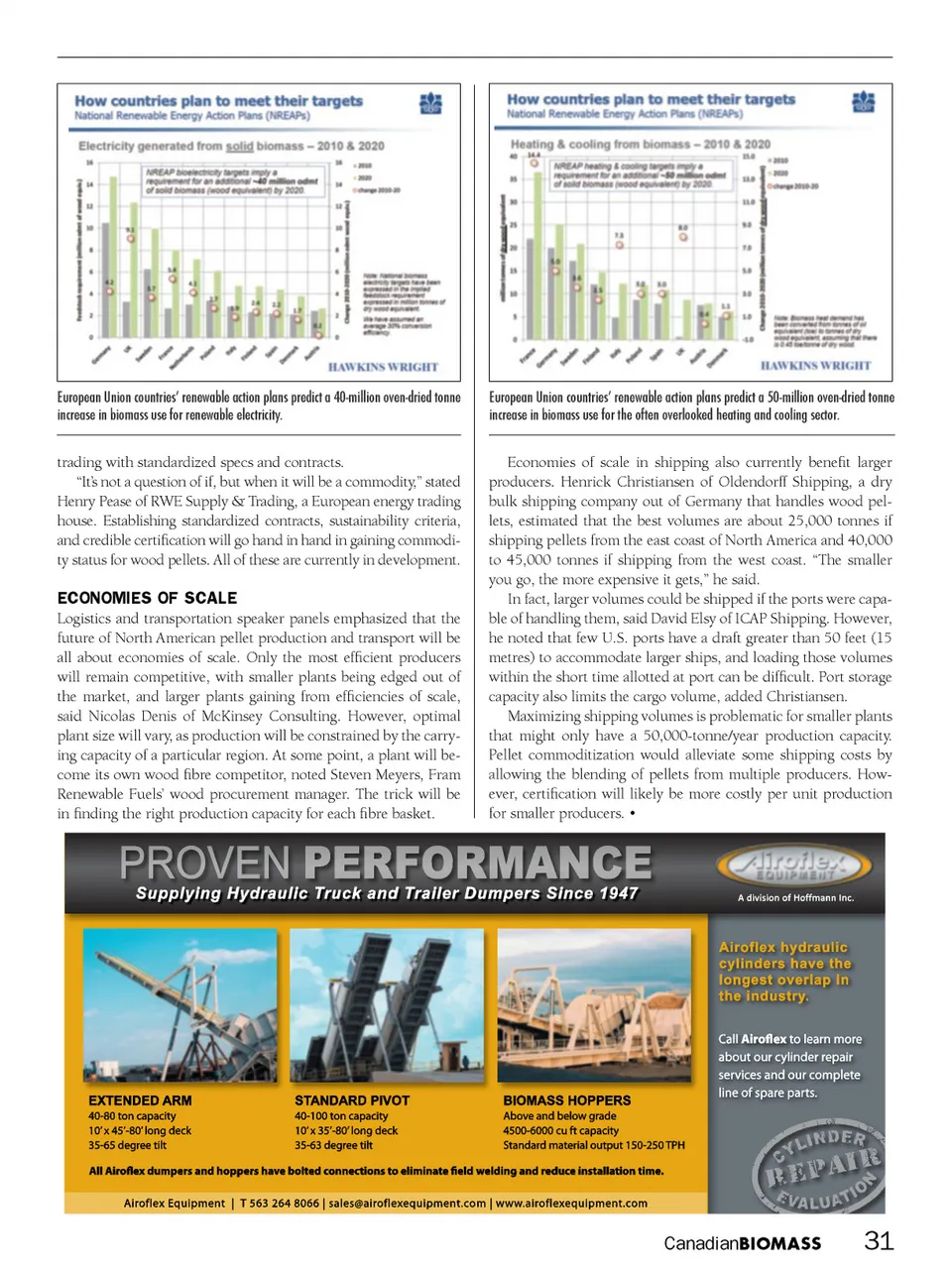
European Union countries’ renewable action plans predict a 40-million oven-dried tonne increase in biomass use for renewable electricity. European Union countries’ renewable action plans predict a 50-million oven-dried tonne increase in biomass use for the often overlooked heating and cooling sector. trading with standardized specs and contracts. “It’s not a question of if, but when it will be a commodity,” stated Henry Pease of RWE Supply & Trading, a European energy trading house. Establishing standardized contracts, sustainability criteria, and credible certification will go hand in hand in gaining commodi-ty status for wood pellets. All of these are currently in development. ecoNomies of scale Logistics and transportation speaker panels emphasized that the future of North American pellet production and transport will be all about economies of scale. Only the most efficient producers will remain competitive, with smaller plants being edged out of the market, and larger plants gaining from efficiencies of scale, said Nicolas Denis of McKinsey Consulting. However, optimal plant size will vary, as production will be constrained by the carry-ing capacity of a particular region. At some point, a plant will be-come its own wood fibre competitor, noted Steven Meyers, Fram Renewable Fuels’ wood procurement manager. The trick will be in finding the right production capacity for each fibre basket. Economies of scale in shipping also currently benefit larger producers. Henrick Christiansen of Oldendorff Shipping, a dry bulk shipping company out of Germany that handles wood pel-lets, estimated that the best volumes are about 25,000 tonnes if shipping pellets from the east coast of North America and 40,000 to 45,000 tonnes if shipping from the west coast. “The smaller you go, the more expensive it gets,” he said. In fact, larger volumes could be shipped if the ports were capa-ble of handling them, said David Elsy of ICAP Shipping. However, he noted that few U.S. ports have a draft greater than 50 feet (15 metres) to accommodate larger ships, and loading those volumes within the short time allotted at port can be difficult. Port storage capacity also limits the cargo volume, added Christiansen. Maximizing shipping volumes is problematic for smaller plants that might only have a 50,000-tonne/year production capacity. Pellet commoditization would alleviate some shipping costs by allowing the blending of pellets from multiple producers. How-ever, certification will likely be more costly per unit production for smaller producers. • Canadian BIOMASS 31
Canadian Biomass September/October 2011: Page 31