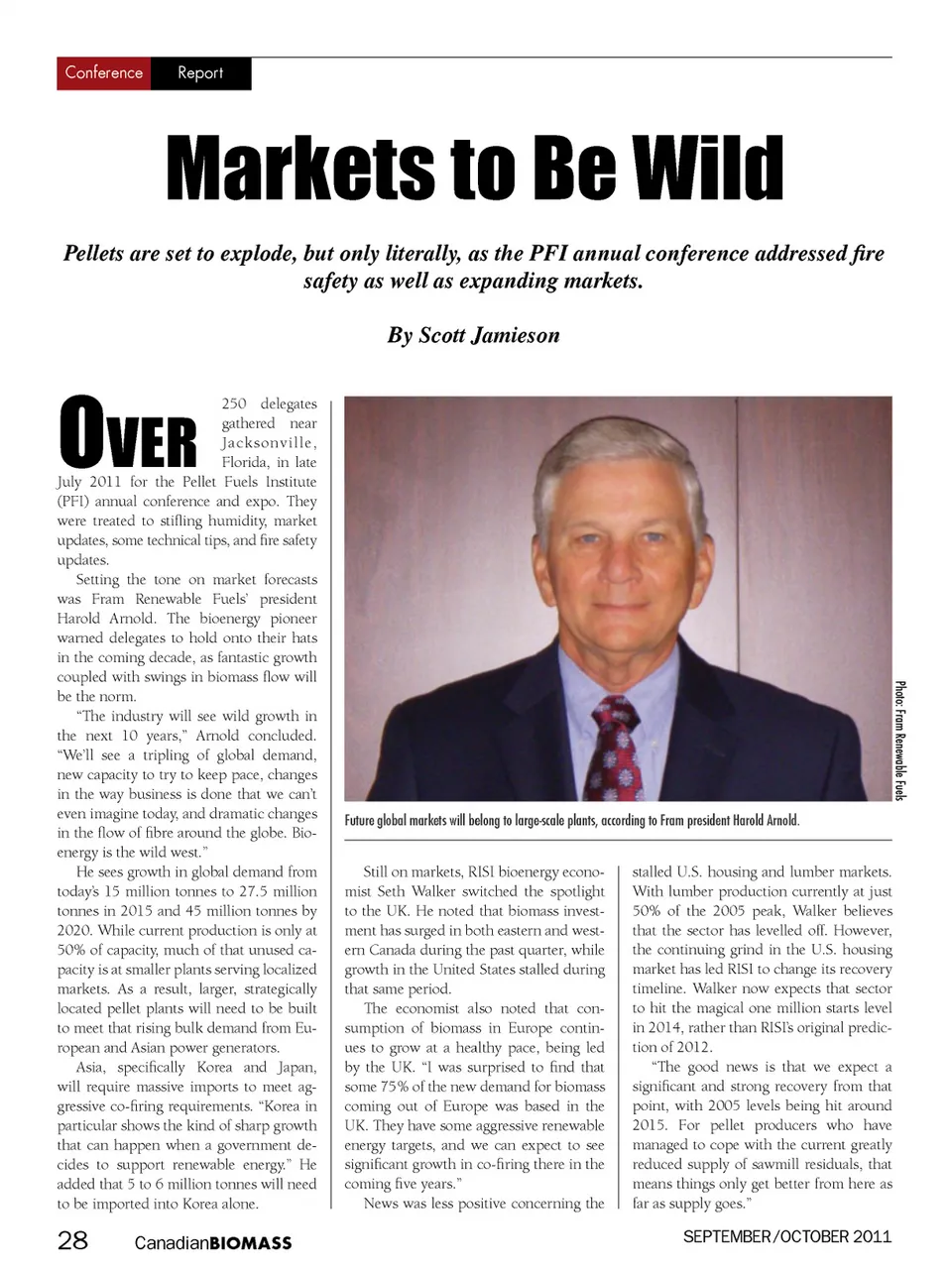
turNiNg techNical The program also included a healthy dose of technical content. Pellet expert Clyde Stearns, a wood products efficiency veteran who is currently helping pellet start-up Zilkha Biomass Energy build greenfield mills in the United States and Canada, treated delegates to a shopping list of design and operating tips to get the most production and best quality from their plants. In par-ticular, he extolled the virtues of microchips, created by station-ary chippers or the new generation of mobile horizontal grinders, which give the consistent size distribution typically seen in pulp chips, with 100% sizing less than 3/8 inch. Benefits include the relative ease of adjusting and measuring moisture content (MC), more consistent MC within and between chips, increased grind-ing capacity and drying efficiency, and an overall boost in plant production using the same equipment. Stearns also discussed the benefits of adding more surge capac-ity at two key points in the production process: after the dryer and between the grinder and pelletizers. “If you have eight hours’ surge capacity after the dryer, the moisture content in the chips will completely equalize, which will really enhance the down-stream process. That’s not practical, but even an hour will make a significant difference,” he said. About 30 to 60 minutes of storage time after the fine grinders will have a similar effect, he added. “The result of focusing on raw material -size distribution, vari-ability, moisture -is a more stable operation. Overall, your pel-leting process should become routine if you can supply a more consistent raw material. Often when there is an issue at the pel-letizer, you’ll see a lot of people standing around it trying to solve the problem. They would likely be better off going back to the raw material and trying to improve that.” Several speakers, including Stearns, discussed fire safety. Gord Murray, executive director of the Wood Pellet Association of Canada (WPAC), and Stephen Chaplin, director of training and program development for the BC Forest Safety Council, gave at-tendees a sneak peek at a new system being developed to promote and improve pellet mill safety. “We have members who have been denied insurance,” Murray explained. “We have insurance providers simply getting out of the pellet insurance market. We’ve seen WCB [Worker’s Compen-sation Board] rates increase by 54% in just three years. It’s not sustainable.” To combat this disturbing trend, WPAC has joined forces with the BC Forest Safety Council, a non-profit, industry-funded organiza-tion that started tackling timber harvesting safety after the disastrous fatality numbers in 2005. The pellet program is in the fact-finding and consultation phase, with the goal of rolling out a SAFE Certifica-tion system similar to that developed for harvesting operations. That system has been credited with a 45% drop in incident rates and a 25% drop in WCB rates in the harvesting sector. Look for pilot au-dits this fall. “Our desire is to improve safety for pellet manufacturers across the industry,” Murray said in response to a question from a U.S.-based pellet manufacturer. “The system is in its early days, and we’re basing it on the BC Forest Safety Council model used for log-ging. We think it will transfer well to the pellet process, and when we’re done, we’ll have an audit system that fits any pellet mill. Once we do, we’d be delighted to help roll it out in other areas.” • treBio pellet plaNt rampiNg up firefly EXIMIO Canadian Biomass’ Scott Jamieson was on site at Trebio’s 130,000 tonne/year pellet plant in Portage-du-Fort, QC, in late September to report on the facility’s commissioning and production ramp up. The plant is jointly owned by GF Energy and Trebio’s management team, and features North America’s first Promill-Stolz pellet mills (four of the five shown above). See the complete story in our next issue, or look for highlights today at www.canadianbiomassmagazine.ca. Setting new StandardS in Spark detection www.firefly.se Canadian BIOMASS 29
Canadian Biomass September/October 2011: Page 29