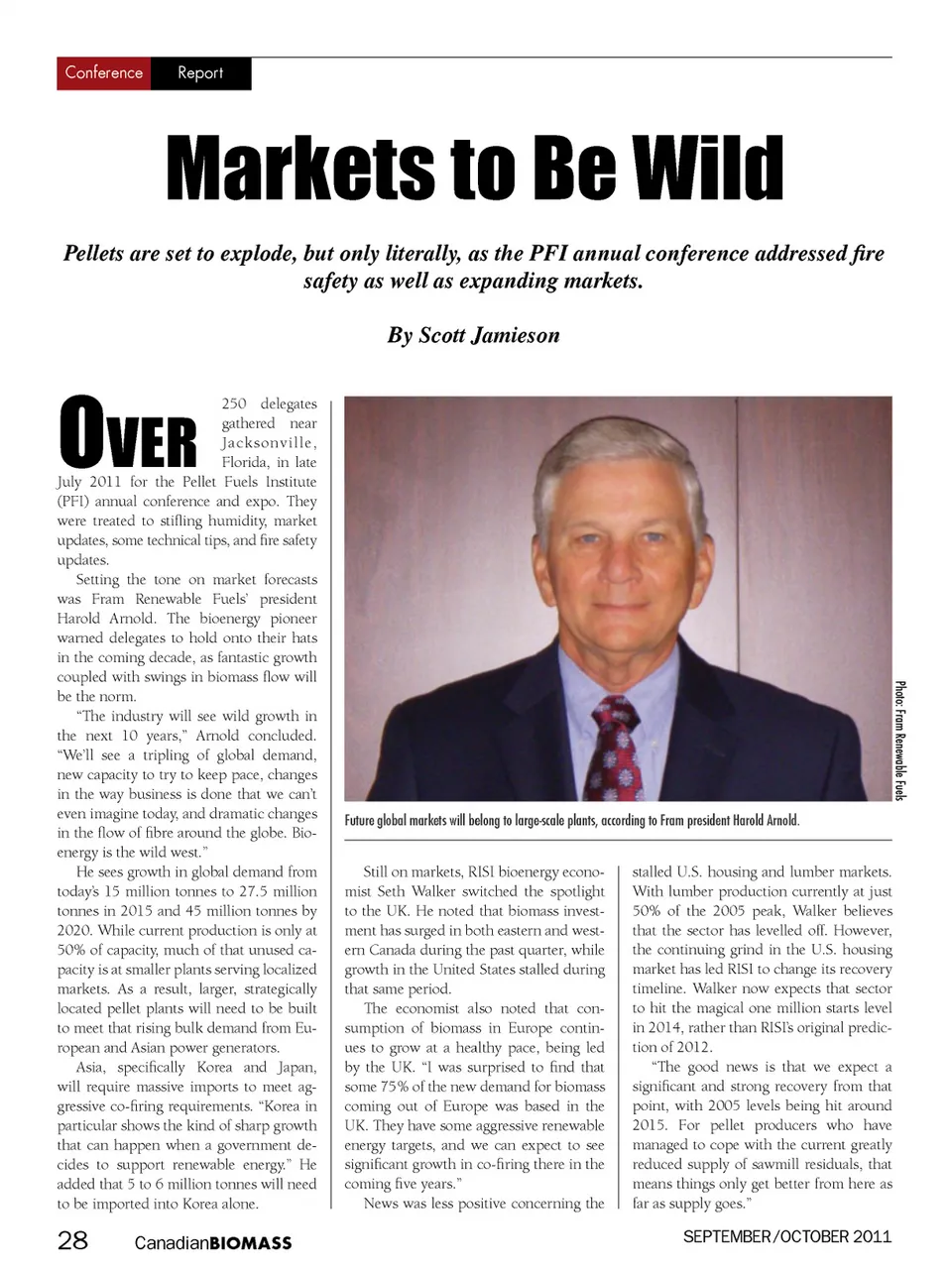
Conference Report Markets to Be Wild Pellets are set to explode, but only literally, as the PFI annual conference addressed fire safety as well as expanding markets. By Scott Jamieson o ver 250 delegates gathered near Jacksonville, Florida, in late July 2011 for the Pellet Fuels Institute (PFI) annual conference and expo. They were treated to stifling humidity, market updates, some technical tips, and fire safety updates. Setting the tone on market forecasts was Fram Renewable Fuels’ president Harold Arnold. The bioenergy pioneer warned delegates to hold onto their hats in the coming decade, as fantastic growth coupled with swings in biomass flow will be the norm. “The industry will see wild growth in the next 10 years,” Arnold concluded. “We’ll see a tripling of global demand, new capacity to try to keep pace, changes in the way business is done that we can’t even imagine today, and dramatic changes in the flow of fibre around the globe. Bio-energy is the wild west.” He sees growth in global demand from today’s 15 million tonnes to 27.5 million tonnes in 2015 and 45 million tonnes by 2020. While current production is only at 50% of capacity, much of that unused ca-pacity is at smaller plants serving localized markets. As a result, larger, strategically located pellet plants will need to be built to meet that rising bulk demand from Eu-ropean and Asian power generators. Asia, specifically Korea and Japan, will require massive imports to meet ag-gressive co-firing requirements. “Korea in particular shows the kind of sharp growth that can happen when a government de-cides to support renewable energy.” He added that 5 to 6 million tonnes will need to be imported into Korea alone. Photo: Fram Renewable Fuels Future global markets will belong to large-scale plants, according to Fram president Harold Arnold. Still on markets, RISI bioenergy econo-mist Seth Walker switched the spotlight to the UK. He noted that biomass invest-ment has surged in both eastern and west-ern Canada during the past quarter, while growth in the United States stalled during that same period. The economist also noted that con-sumption of biomass in Europe contin-ues to grow at a healthy pace, being led by the UK. “I was surprised to find that some 75% of the new demand for biomass coming out of Europe was based in the UK. They have some aggressive renewable energy targets, and we can expect to see significant growth in co-firing there in the coming five years.” News was less positive concerning the stalled U.S. housing and lumber markets. With lumber production currently at just 50% of the 2005 peak, Walker believes that the sector has levelled off. However, the continuing grind in the U.S. housing market has led RISI to change its recovery timeline. Walker now expects that sector to hit the magical one million starts level in 2014, rather than RISI’s original predic-tion of 2012. “The good news is that we expect a significant and strong recovery from that point, with 2005 levels being hit around 2015. For pellet producers who have managed to cope with the current greatly reduced supply of sawmill residuals, that means things only get better from here as far as supply goes.” SEPTEMBER/OCTOBER 2011 28 Canadian BIOMASS
Canadian Biomass September/October 2011: Page 28