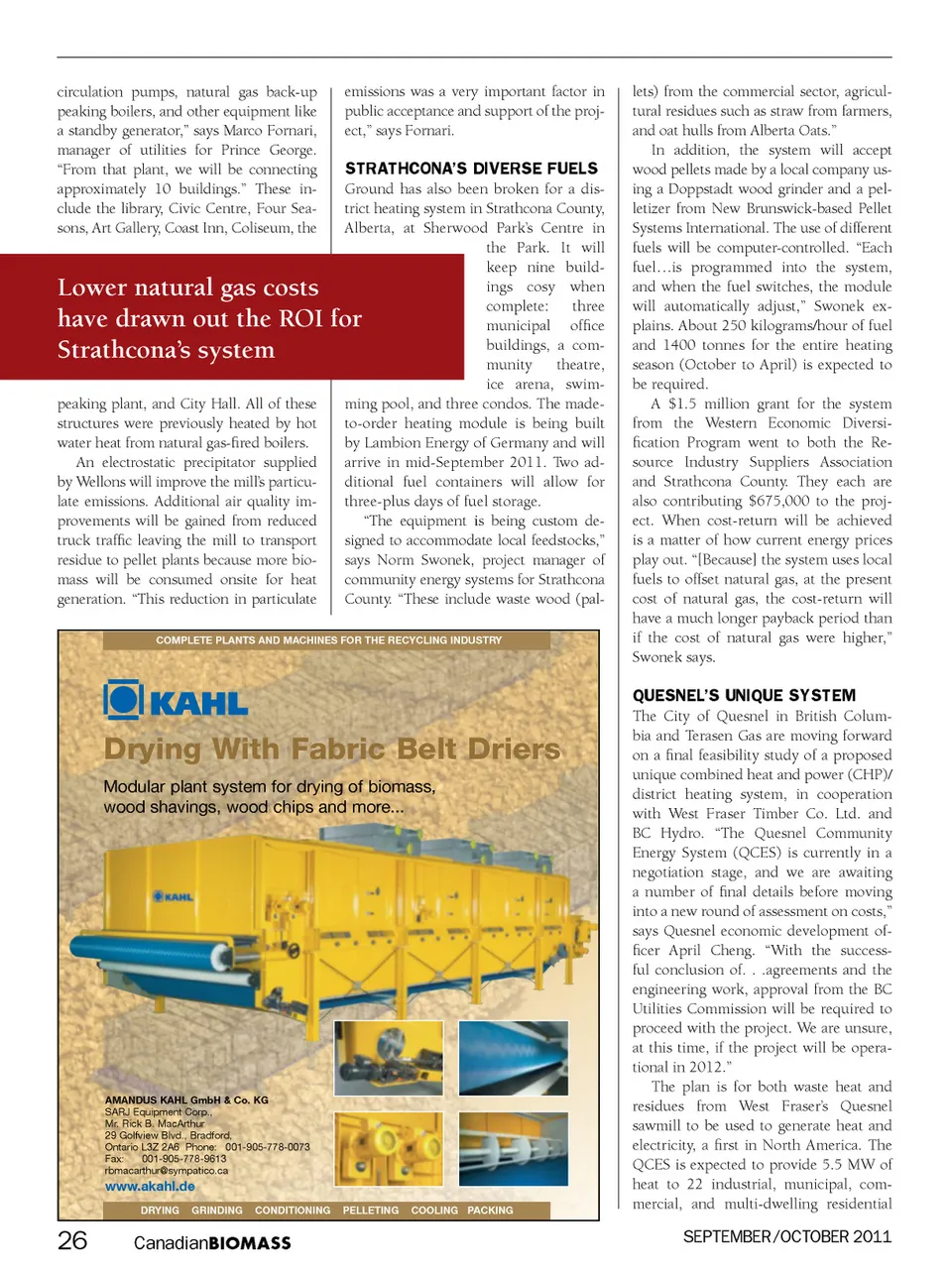
® Pipe work in Prince George has been timed around road repair work. buildings, as well as up to 1.7 MW of electricity, to be purchased by BC Hydro. About 40% of all energy used in the sys-tem will be from recovered waste heat, with an overall planned energy efficiency of 90%. An estimated 9,000 tonnes/year of wood waste from milling operations will be burned. Cheng says the partners are continu-ing to press forward in finding funds for the project, which had an initial estimated capital cost of $14 million. Quesnel’s Eco-nomic Development Corporation secured a grant of $4.13 million through B.C.’s In-novative Clean Energy Fund, with Terasen Gas providing funds as well. Western Eco-nomic Diversification Canada, the Green Municipal Fund, BC Hydro, and BC Bio-energy Network are also involved. advice, please Who better to ask for advice and in-sights into how to handle challenges in navigating a district heating project than those on the front line? Swonek says the list of challenges in Strathcona included funding, selection of the best available technology, securing local sustainable feedstocks, and transportation and pro-cessing logistics. “District heating sys-tems require large initial capital invest-ments, which requires funding by either grants or borrowed funds,” he notes, adding, “Securing customers to deliver the energy to is key.” Two challenges stood out in Prince George. The first was the need to over-come public misconception that bioener-gy systems are high emitters of pollutants. “The emissions from modern bioenergy plants are in fact similar to emissions from natural gas boiler systems,” Davis explains. The city got this message out in the proposal stage through holding pub-lic engagement sessions; notes from these meetings were included in the mandatory Federal Environmental Assessment. This was part of an overall communications plan to share information that will con-tinue throughout construction. The City highlighted positive aspects such as the fact that the system will be paid for in 10 years and has a positive net present value of $2.8 million over 25 years. However, at the same time, Davis says the other major challenge was how to maintain the finan-cial viability of a biomass-based energy supply utility in the face of historically low natural gas prices. “We are effectively competing against natural gas in the mar-ket place for heat customers,” says Davis. Although the Quesnel project is still at the stage of working out funding and other details, Cheng shares some advice, “Patience. These projects take time, and some of [our] early mistakes were on the suggested amount of time.” She also ad-vises, “Take the figures lightly. Cost esti-mates and revenues can change based on any one single factor, and partners need to be prepared for change on projects of this scale and complexity.” •
Canadian Biomass September/October 2011: Page 27