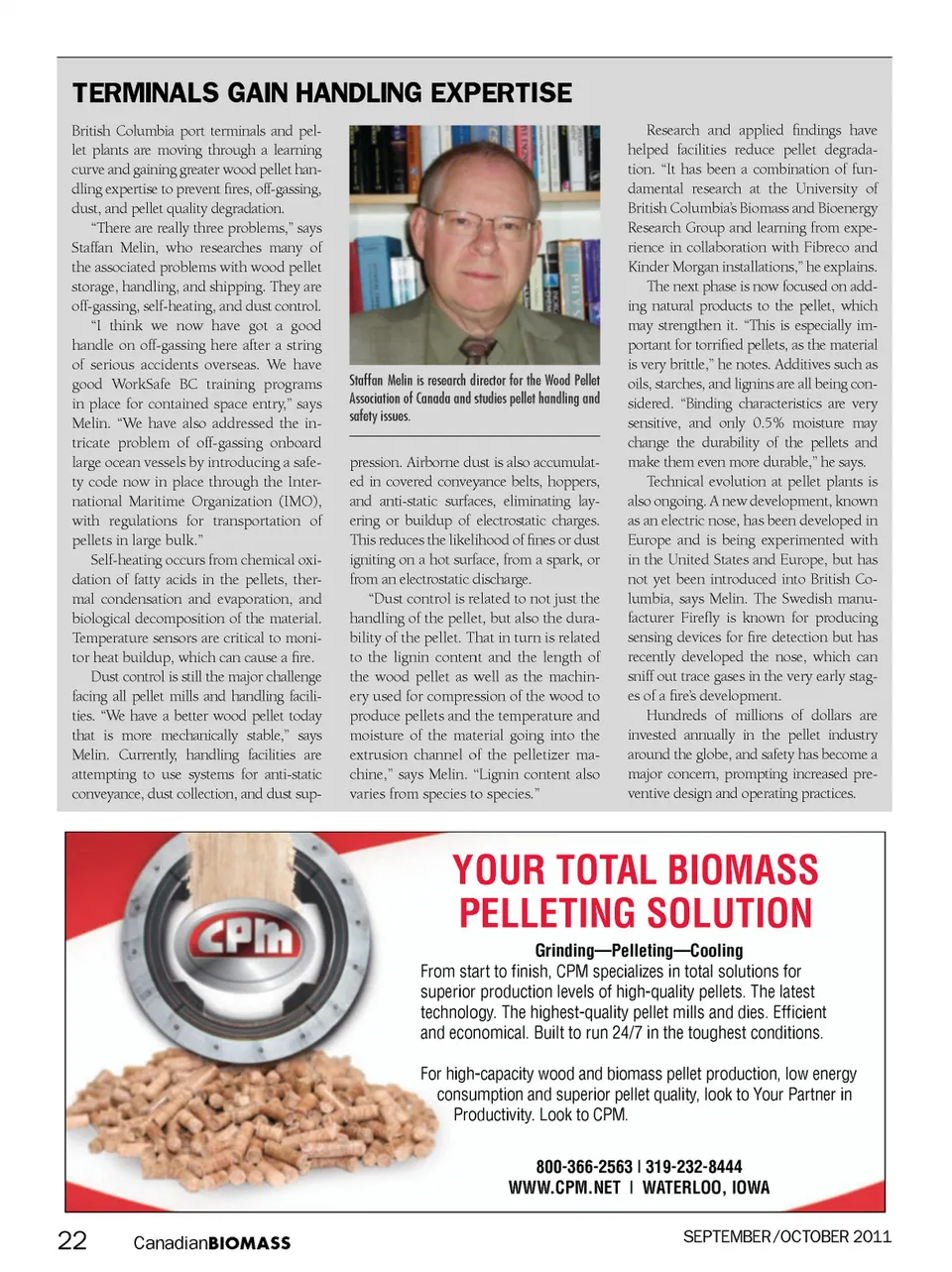
termiNals gaiN haNdliNg expertise British Columbia port terminals and pel-let plants are moving through a learning curve and gaining greater wood pellet han-dling expertise to prevent fires, off-gassing, dust, and pellet quality degradation. “There are really three problems,” says Staffan Melin, who researches many of the associated problems with wood pellet storage, handling, and shipping. They are off-gassing, self-heating, and dust control. “I think we now have got a good handle on off-gassing here after a string of serious accidents overseas. We have good WorkSafe BC training programs in place for contained space entry,” says Melin. “We have also addressed the in-tricate problem of off-gassing onboard large ocean vessels by introducing a safe-ty code now in place through the Inter-national Maritime Organization (IMO), with regulations for transportation of pellets in large bulk.” Self-heating occurs from chemical oxi-dation of fatty acids in the pellets, ther-mal condensation and evaporation, and biological decomposition of the material. Temperature sensors are critical to moni-tor heat buildup, which can cause a fire. Dust control is still the major challenge facing all pellet mills and handling facili-ties. “We have a better wood pellet today that is more mechanically stable,” says Melin. Currently, handling facilities are attempting to use systems for anti-static conveyance, dust collection, and dust sup-Research and applied findings have helped facilities reduce pellet degrada-tion. “It has been a combination of fun-damental research at the University of British Columbia’s Biomass and Bioenergy Research Group and learning from expe-rience in collaboration with Fibreco and Kinder Morgan installations,” he explains. The next phase is now focused on add-ing natural products to the pellet, which may strengthen it. “This is especially im-portant for torrified pellets, as the material is very brittle,” he notes. Additives such as oils, starches, and lignins are all being con-sidered. “Binding characteristics are very sensitive, and only 0.5% moisture may change the durability of the pellets and make them even more durable,” he says. Technical evolution at pellet plants is also ongoing. A new development, known as an electric nose, has been developed in Europe and is being experimented with in the United States and Europe, but has not yet been introduced into British Co-lumbia, says Melin. The Swedish manu-facturer Firefly is known for producing sensing devices for fire detection but has recently developed the nose, which can sniff out trace gases in the very early stag-es of a fire’s development. Hundreds of millions of dollars are invested annually in the pellet industry around the globe, and safety has become a major concern, prompting increased pre-ventive design and operating practices. Staffan Melin is research director for the Wood Pellet Association of Canada and studies pellet handling and safety issues. pression. Airborne dust is also accumulat-ed in covered conveyance belts, hoppers, and anti-static surfaces, eliminating lay-ering or buildup of electrostatic charges. This reduces the likelihood of fines or dust igniting on a hot surface, from a spark, or from an electrostatic discharge. “Dust control is related to not just the handling of the pellet, but also the dura-bility of the pellet. That in turn is related to the lignin content and the length of the wood pellet as well as the machin-ery used for compression of the wood to produce pellets and the temperature and moisture of the material going into the extrusion channel of the pelletizer ma-chine,” says Melin. “Lignin content also varies from species to species.” YOuR TOTAL BIOMAss PELLETING sOLuTION Grinding—Pelleting—Cooling From start to finish, CPM specializes in total solutions for superior production levels of high-quality pellets. The latest technology. The highest-quality pellet mills and dies. Efficient and economical. Built to run 24/7 in the toughest conditions. For high-capacity wood and biomass pellet production, low energy consumption and superior pellet quality, look to Your Partner in Productivity. Look to CPM. 800-366-2563 | 319-232-8444 WWW.CPM.NET | WATERLOO, IOWA 22 Canadian BIOMASS SEPTEMBER/OCTOBER 2011
Canadian Biomass September/October 2011: Page 22