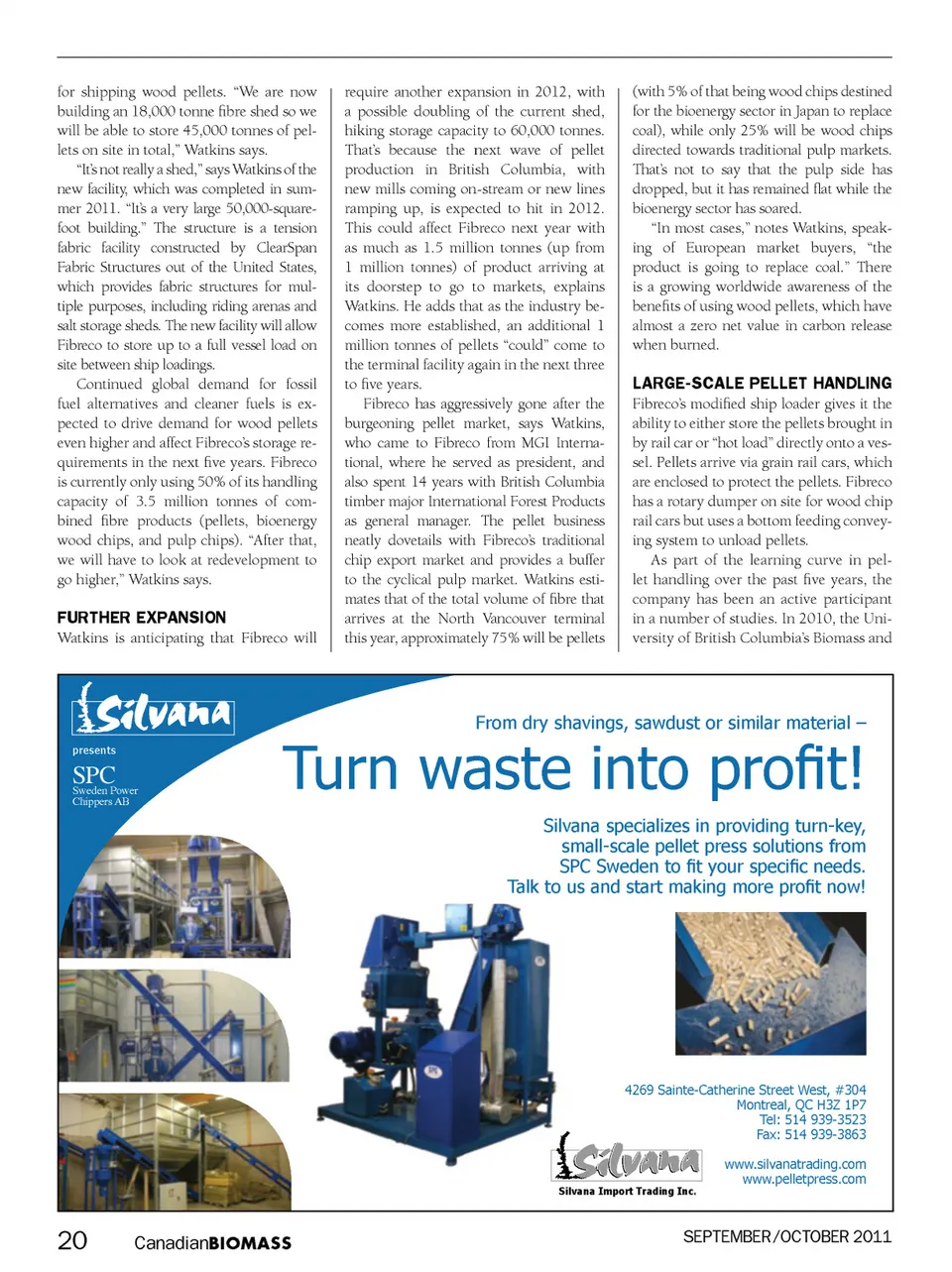
Wood pellets are stored in several 4,500-tonne capacity silos and then loaded onto ships via covered conveyors. The Fibreco facility also handles wood chips, which are stored in massive outdoor piles. Bioenergy Research Group published a report titled Quality of Wood Pellets Pro-duced in B.C. for Export, which was a re-sult of pellet sampling over an 18-month window performed in 2007–2008 on pellets between storage and loading at the Fibreco facility. The report concluded that British Columbia’s pellets for export meet European grades and the grades set out by the Pellet Fuels Institute for the United States. Fibreco’s facility is located in Vancou-ver’s scenic inner harbour and close to large population bases. As a result, it is susceptible to complaints such as dust, plus it must adhere to stringent work safety, fire, and carbon monoxide require-ments. “We have done extensive amounts of work for both fire and dust abatement,” says Watkins. Fires from explosions, dust, and over-heating in silos are ongoing concerns, both at pellet plants and at terminal load-ing sites such as Fibreco, as well as at dis-charging sites overseas. Pacific BioEnergy’s pellet plant in Prince George suffered a fire in December 2010, and Armstrong Pellets (part of Pinnacle Pellets) also suffered a fire in April 2011. “There are other more dan-gerous materials than pellets handled in the Port of Vancouver every day through various export terminals that have the re-quired equipment and procedures in place to operate safely and efficiently,” says Wat-kins. He says that the silos on the Fibreco site have thermal probes by OPI Systems Inc. that monitor constantly. The sensors and monitors are on site, and off-site data logging serves as a backup supervisory system for alarm and failure detection. If the temperature rises, automatic fans lo-cated below the silos blow cool air through to reduce the temperature. Fibreco’s safety policy also restricts smoking on site. Cool air infused into the silos also re-duces the incidence of carbon monoxide buildup in silos, which can occur with off-gassing. Fibreco’s safety regulations re-quire that all employees who work on the conveying system at the top or in the tun-nel beneath the silos carry a carbon mon-oxide monitor. Incidents caused by car-bon monoxide buildup from off-gassing have not been a problem at the Fibreco storage facility, says Watkins. Located next door to Fibreco is one of the world’s largest terminal operators, Kinder Morgan. Kinder Morgan assistant general manager Dave Klitch says that once the contract concluded with Pinna-cle in 2010, the berth that was converted to handle wood pellets is now being used to handle canola meal pellets and peas, which are higher-value commodities. “But who knows,” he says, adding that Kinder Morgan may gain business back in the future as demand for wood pellets increases. The facility has the capacity to handle up to 1 million tonnes, but Kinder Morgan tends to pursue mainly volume business. When it first revamped a berth to handle wood pellets, it installed tem-perature monitors, a GreCon spark detec-tion and extinguishing system, and spark detection equipment on the conveying belts, says Klitch. • Canadian BIOMASS 21
Canadian Biomass September/October 2011: Page 21