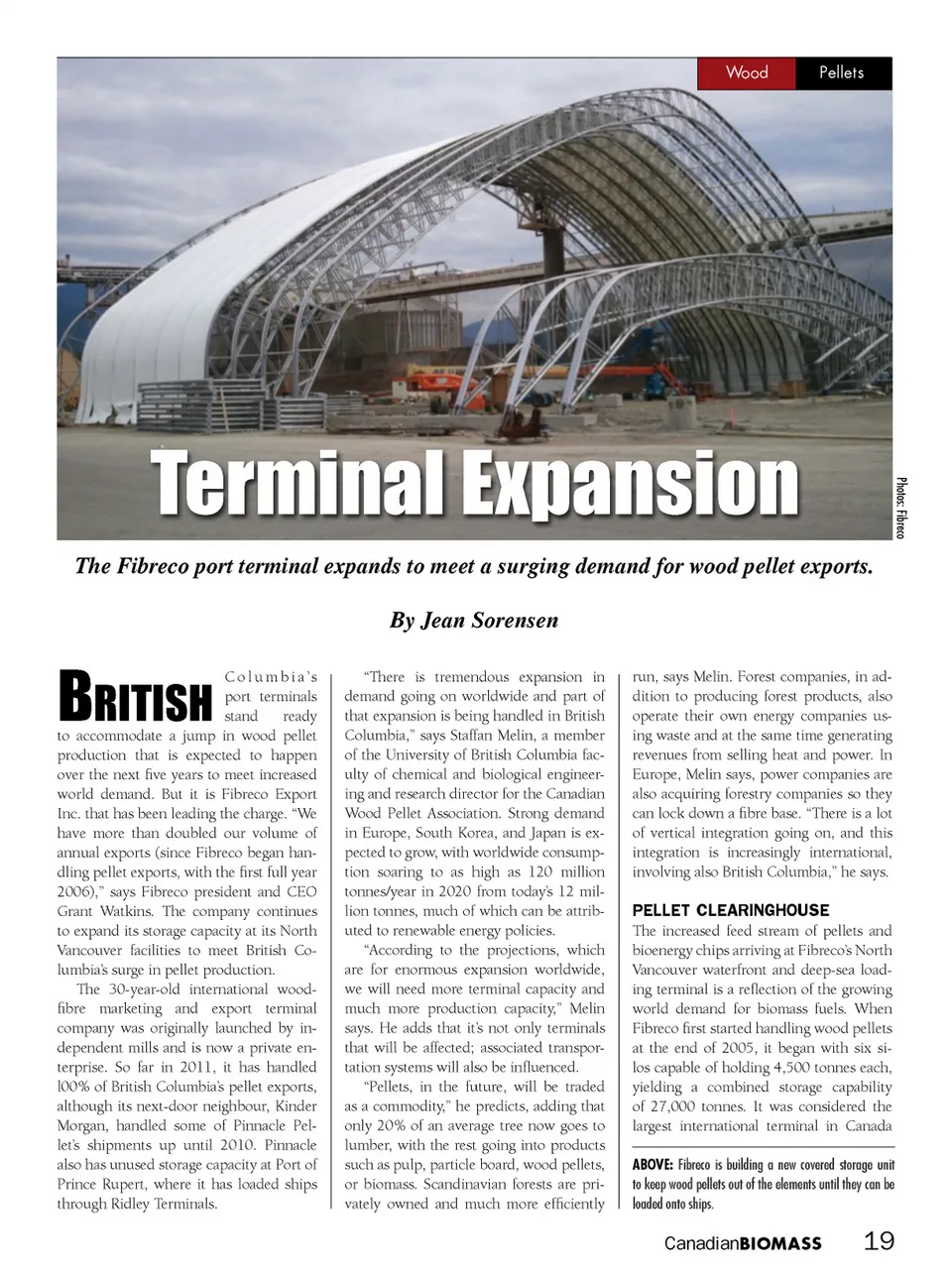
Wood Pellets Terminal Expansion The Fibreco port terminal expands to meet a surging demand for wood pellet exports. By Jean Sorensen Photos: Fibreco b riTish C o lu m b i a ’s port terminals stand ready to accommodate a jump in wood pellet production that is expected to happen over the next five years to meet increased world demand. But it is Fibreco Export Inc. that has been leading the charge. “We have more than doubled our volume of annual exports (since Fibreco began han-dling pellet exports, with the first full year 2006),” says Fibreco president and CEO Grant Watkins. The company continues to expand its storage capacity at its North Vancouver facilities to meet British Co-lumbia’s surge in pellet production. The 30-year-old international wood-fibre marketing and export terminal company was originally launched by in-dependent mills and is now a private en-terprise. So far in 2011, it has handled l00% of British Columbia’s pellet exports, although its next-door neighbour, Kinder Morgan, handled some of Pinnacle Pel-let’s shipments up until 2010. Pinnacle also has unused storage capacity at Port of Prince Rupert, where it has loaded ships through Ridley Terminals. “There is tremendous expansion in demand going on worldwide and part of that expansion is being handled in British Columbia,” says Staffan Melin, a member of the University of British Columbia fac-ulty of chemical and biological engineer-ing and research director for the Canadian Wood Pellet Association. Strong demand in Europe, South Korea, and Japan is ex-pected to grow, with worldwide consump-tion soaring to as high as 120 million tonnes/year in 2020 from today’s 12 mil-lion tonnes, much of which can be attrib-uted to renewable energy policies. “According to the projections, which are for enormous expansion worldwide, we will need more terminal capacity and much more production capacity,” Melin says. He adds that it’s not only terminals that will be affected; associated transpor-tation systems will also be influenced. “Pellets, in the future, will be traded as a commodity,” he predicts, adding that only 20% of an average tree now goes to lumber, with the rest going into products such as pulp, particle board, wood pellets, or biomass. Scandinavian forests are pri-vately owned and much more efficiently run, says Melin. Forest companies, in ad-dition to producing forest products, also operate their own energy companies us-ing waste and at the same time generating revenues from selling heat and power. In Europe, Melin says, power companies are also acquiring forestry companies so they can lock down a fibre base. “There is a lot of vertical integration going on, and this integration is increasingly international, involving also British Columbia,” he says. pellet cleariNghouse The increased feed stream of pellets and bioenergy chips arriving at Fibreco’s North Vancouver waterfront and deep-sea load-ing terminal is a reflection of the growing world demand for biomass fuels. When Fibreco first started handling wood pellets at the end of 2005, it began with six si-los capable of holding 4,500 tonnes each, yielding a combined storage capability of 27,000 tonnes. It was considered the largest international terminal in Canada ABOVE: Fibreco is building a new covered storage unit to keep wood pellets out of the elements until they can be loaded onto ships. Canadian BIOMASS 19
Canadian Biomass September/October 2011: Page 19