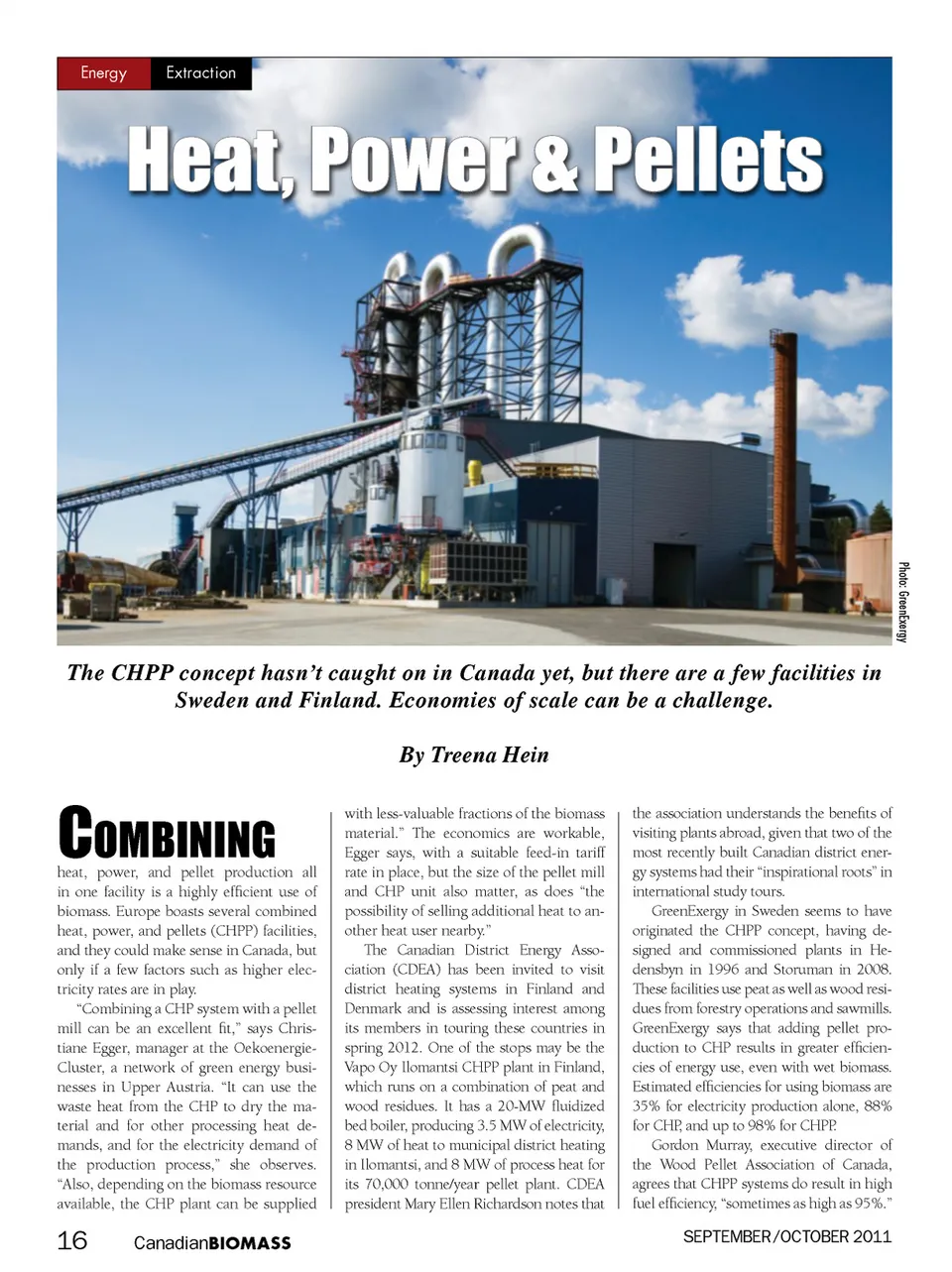
LEFT: GreenExergy’s Storuman plant has a 32-MW boiler, 8-MW steam turbine, and produces 16 tons/hour of pellets. However, he says, “the downside is that at a small scale it has not yet proven economic.” The CHP plant at the CHPP in Hedens-byn was built for wet biofuels and has two fluidized bed boilers. Its pellet plant has an additional steam turbine that recycles and uses the energy that goes through the drying process, providing an additional 25–30 GWh/year of power. In fact, both of GreenExergy’s CHPP plants boast a pressurized steam circuit with feedstock drying and a steam turbine. The company says the process is based on innovative technology for drying raw materials, tech-nology which considerably improves the energy efficiency of the production com-pared to alternatives. “At the heart of the process is the so-called SSD dryer (superheated steam dryer),” says Rolf Lindgren, GreenExergy vice-president. “This dryer operates in an enclosed environment at 170°C and 4 bar pressure. The wet fuel, let’s say wood with 50% moisture, is injected into the closed loop of the dryer. It will dry in about 20 to 30 seconds and is then taken out of the loop through cyclones. The water that came in with the wet wood creates, at the same time, a ‘dirty steam’ at the operating pressure.” This steam is taken out of the dryer and to a heat exchanger to produce clean steam by condensing out the impu-rities. The clean steam is then used in a turbine to produce electricity. “All in all, we only need 140 kWh/ton of evaporated water for drying compared to conventional drying systems (rotary and belt dryers) that take 10 times more energy,” notes Lindgren. “In a so-called bioenergy combine, we have three outgo-ing products: electricity, district heating, and wood pellets.” He says the propor-tions of end product among these three can change depending on the profitability of each, with the entire system being most profitable when fuel prices are high. Murray agrees. “Fossil fuel prices are much higher in Europe than here, and there is also much stronger policy sup-port there to cut greenhouse gases and use renewable fuels,” he says. “This means that CHP systems, let alone CHPP sys-tems, have to compete with fossil fuels here in Canada on price alone.” Murray observes that CHP has really only so far been financially feasible at pulp and paper mills, which are intensive power users. “Sawmills have added biomass heat for kiln drying, but adding power generation takes more investment,” he says. “Current rates the utilities are willing to pay will not allow sawmills to generate sufficient return on capital to justify the investment. Alternatively, CHP would be good to add at a pellet plant if there could be sufficient return for capital.” Murray notes that pres-ently, pellet producers use biomass boilers to create heat for the drying process, but not electricity. “At [current rates], there is insufficient profitability to incent pellet producers to add electrical generating capacity,” Murray says. “Until there is more pressure and a stronger political will to support renew-able energy systems in Canada, we will not see CHPP move forward here. But they are a great example of what could be achieved with full use of Canadian biomass.” • THE COMPLETE SOLUTION TO BIOMASS FEEDSTOCK MANAGEMENT From Concept To Completion Alternative Fuel Solutions From Vecoplan A worldwide leader in size reduction technology, Vecoplan designs, engineers, manufactures, and implements complete biomass feedstock preparation systems, including pre-shredding, separation, screening, air classification, re-shredding, storage, unloading, sampling, and fuel delivery. Working with individual customers, Vecoplan delivers technologically advanced, material specific, and application specific shredding, ferrous and non-ferrous removal, size and density separation, screening and classification technologies and extremely efficient conveyor and bulk material handling, metering, storage and unloading technologies. Contact Vecoplan today to learn more about our existing systems or to arrange a visit to one, or several, of our installations. Phone: (336) 861-6070 • Fax: (336) 861-4329 vecoplanllc.com Canadian BIOMASS 17
Canadian Biomass September/October 2011: Page 17