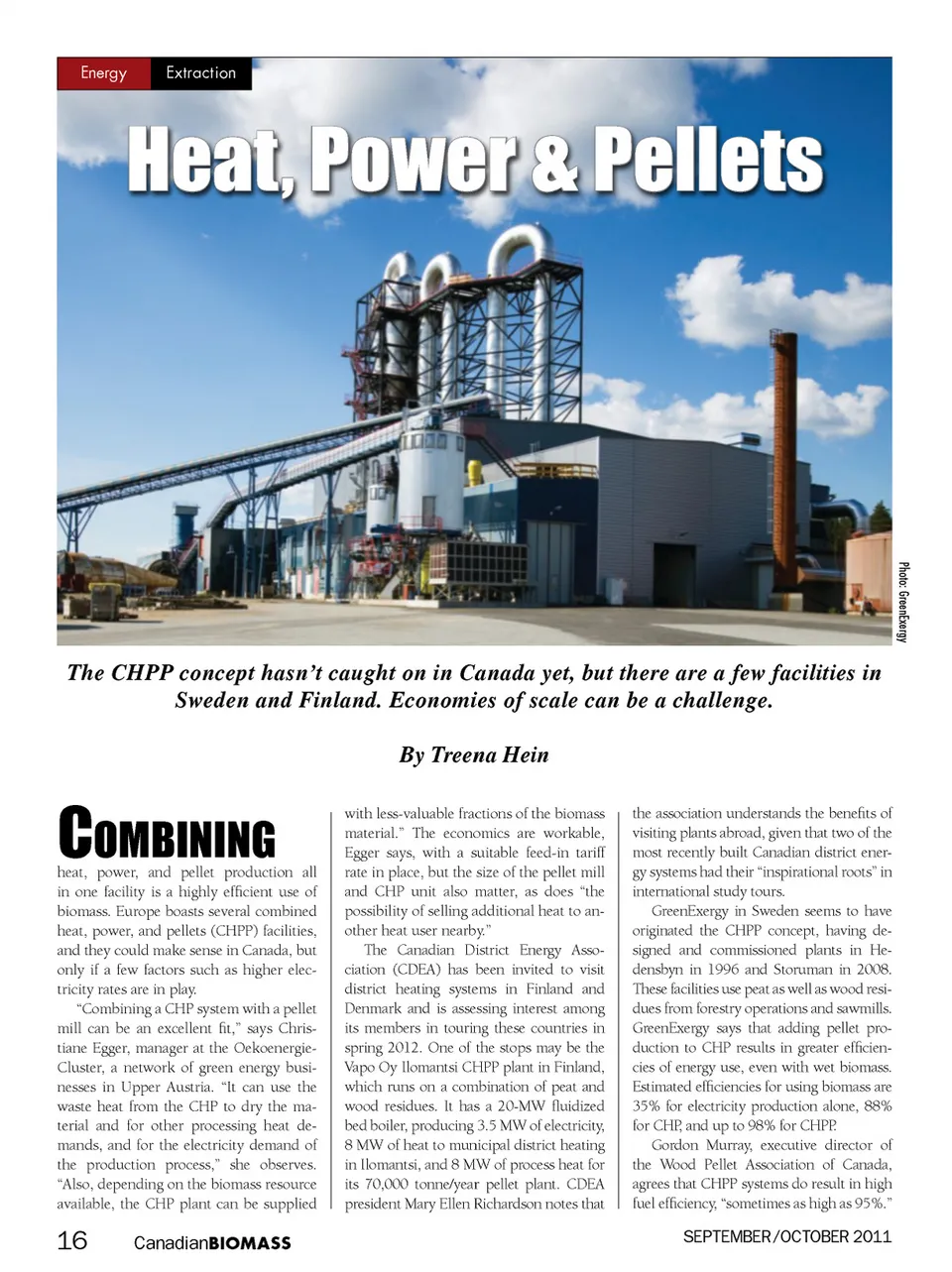
Energy Extraction Heat, Power & Pellets Photo: GreenExergy The CHPP concept hasn’t caught on in Canada yet, but there are a few facilities in Sweden and Finland. Economies of scale can be a challenge. By Treena Hein C ombining heat, power, and pellet production all in one facility is a highly efficient use of biomass. Europe boasts several combined heat, power, and pellets (CHPP) facilities, and they could make sense in Canada, but only if a few factors such as higher elec-tricity rates are in play. “Combining a CHP system with a pellet mill can be an excellent fit,” says Chris-tiane Egger, manager at the Oekoenergie-Cluster, a network of green energy busi-nesses in Upper Austria. “It can use the waste heat from the CHP to dry the ma-terial and for other processing heat de-mands, and for the electricity demand of the production process,” she observes. “Also, depending on the biomass resource available, the CHP plant can be supplied with less-valuable fractions of the biomass material.” The economics are workable, Egger says, with a suitable feed-in tariff rate in place, but the size of the pellet mill and CHP unit also matter, as does “the possibility of selling additional heat to an-other heat user nearby.” The Canadian District Energy Asso-ciation (CDEA) has been invited to visit district heating systems in Finland and Denmark and is assessing interest among its members in touring these countries in spring 2012. One of the stops may be the Vapo Oy Ilomantsi CHPP plant in Finland, which runs on a combination of peat and wood residues. It has a 20-MW fluidized bed boiler, producing 3.5 MW of electricity, 8 MW of heat to municipal district heating in Ilomantsi, and 8 MW of process heat for its 70,000 tonne/year pellet plant. CDEA president Mary Ellen Richardson notes that the association understands the benefits of visiting plants abroad, given that two of the most recently built Canadian district ener-gy systems had their “inspirational roots” in international study tours. GreenExergy in Sweden seems to have originated the CHPP concept, having de-signed and commissioned plants in He-densbyn in 1996 and Storuman in 2008. These facilities use peat as well as wood resi-dues from forestry operations and sawmills. GreenExergy says that adding pellet pro-duction to CHP results in greater efficien-cies of energy use, even with wet biomass. Estimated efficiencies for using biomass are 35% for electricity production alone, 88% for CHP , and up to 98% for CHPP . Gordon Murray, executive director of the Wood Pellet Association of Canada, agrees that CHPP systems do result in high fuel efficiency, “sometimes as high as 95%.” SEPTEMBER/OCTOBER 2011 16 Canadian BIOMASS
Canadian Biomass September/October 2011: Page 16