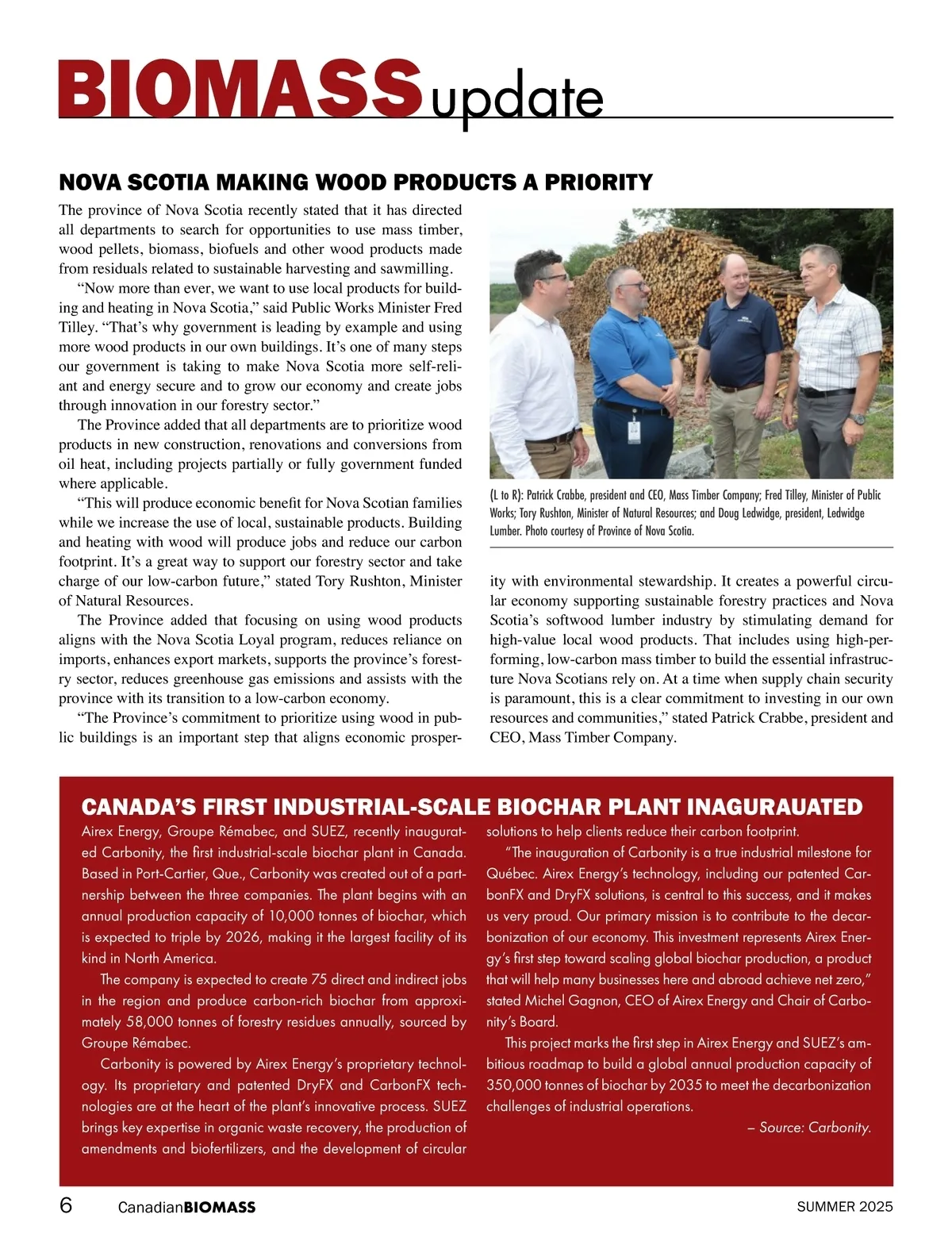
NOVA SCOTIA MAKING WOOD PRODUCTS A PRIORITY The province of Nova Scotia recently stated that it has directed all departments to search for opportunities to use mass timber, wood pellets, biomass, biofuels and other wood products made from residuals related to sustainable harvesting and sawmilling. “Now more than ever, we want to use local products for build-ing and heating in Nova Scotia,” said Public Works Minister Fred Tilley. “That’s why government is leading by example and using more wood products in our own buildings. It’s one of many steps our government is taking to make Nova Scotia more self-reli-ant and energy secure and to grow our economy and create jobs through innovation in our forestry sector.” The Province added that all departments are to prioritize wood products in new construction, renovations and conversions from oil heat, including projects partially or fully government funded where applicable. “This will produce economic benefit for Nova Scotian families while we increase the use of local, sustainable products. Building and heating with wood will produce jobs and reduce our carbon footprint. It’s a great way to support our forestry sector and take charge of our low-carbon future,” stated Tory Rushton, Minister of Natural Resources. The Province added that focusing on using wood products aligns with the Nova Scotia Loyal program, reduces reliance on imports, enhances export markets, supports the province’s forest-ry sector, reduces greenhouse gas emissions and assists with the province with its transition to a low-carbon economy. “The Province’s commitment to prioritize using wood in pub-lic buildings is an important step that aligns economic prosper-(L to R): Patrick Crabbe, president and CEO, Mass Timber Company; Fred Tilley, Minister of Public Works; Tory Rushton, Minister of Natural Resources; and Doug Ledwidge, president, Ledwidge Lumber. Photo courtesy of Province of Nova Scotia. ity with environmental stewardship. It creates a powerful circu-lar economy supporting sustainable forestry practices and Nova Scotia’s softwood lumber industry by stimulating demand for high-value local wood products. That includes using high-per-forming, low-carbon mass timber to build the essential infrastruc-ture Nova Scotians rely on. At a time when supply chain security is paramount, this is a clear commitment to investing in our own resources and communities,” stated Patrick Crabbe, president and CEO, Mass Timber Company. CANADA’S FIRST INDUSTRIAL-SCALE BIOCHAR PLANT INAGURAUATED Airex Energy, Groupe Rémabec, and SUEZ, recently inaugurat-ed Carbonity, the first industrial-scale biochar plant in Canada. Based in Port-Cartier, Que., Carbonity was created out of a part-nership between the three companies. The plant begins with an annual production capacity of 10,000 tonnes of biochar, which is expected to triple by 2026, making it the largest facility of its kind in North America. The company is expected to create 75 direct and indirect jobs in the region and produce carbon-rich biochar from approxi-mately 58,000 tonnes of forestry residues annually, sourced by Groupe Rémabec. Carbonity is powered by Airex Energy’s proprietary technol-ogy. Its proprietary and patented DryFX and CarbonFX tech-nologies are at the heart of the plant’s innovative process. SUEZ brings key expertise in organic waste recovery, the production of amendments and biofertilizers, and the development of circular solutions to help clients reduce their carbon footprint. “The inauguration of Carbonity is a true industrial milestone for Québec. Airex Energy’s technology, including our patented Car-bonFX and DryFX solutions, is central to this success, and it makes us very proud. Our primary mission is to contribute to the decar-bonization of our economy. This investment represents Airex Ener-gy’s first step toward scaling global biochar production, a product that will help many businesses here and abroad achieve net zero,” stated Michel Gagnon, CEO of Airex Energy and Chair of Carbo-nity’s Board. This project marks the first step in Airex Energy and SUEZ’s am-bitious roadmap to build a global annual production capacity of 350,000 tonnes of biochar by 2035 to meet the decarbonization challenges of industrial operations. – Source: Carbonity. 6 Canadian BIOMASS SUMMER 2025
Canadian Biomass Summer 2025: Page 6