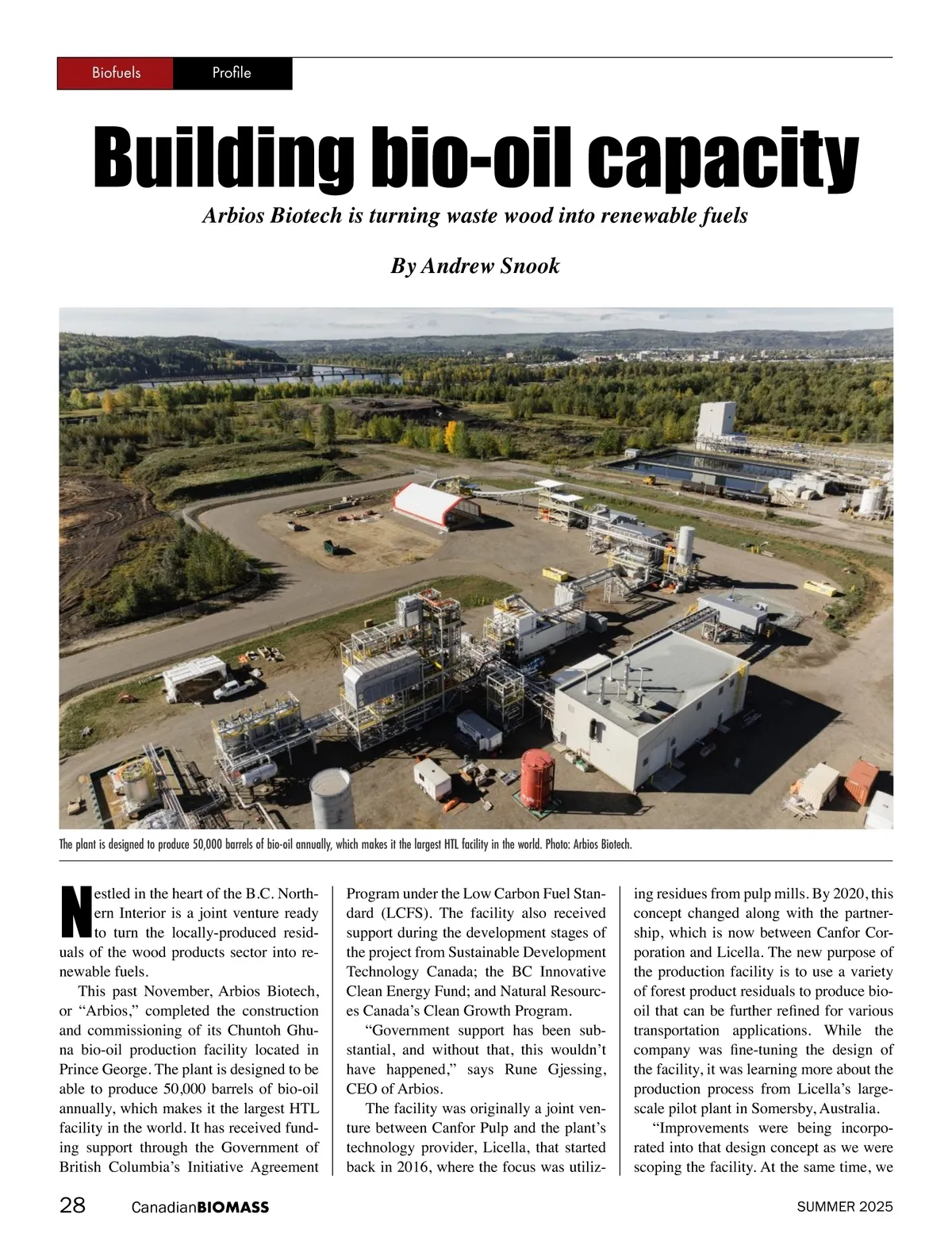
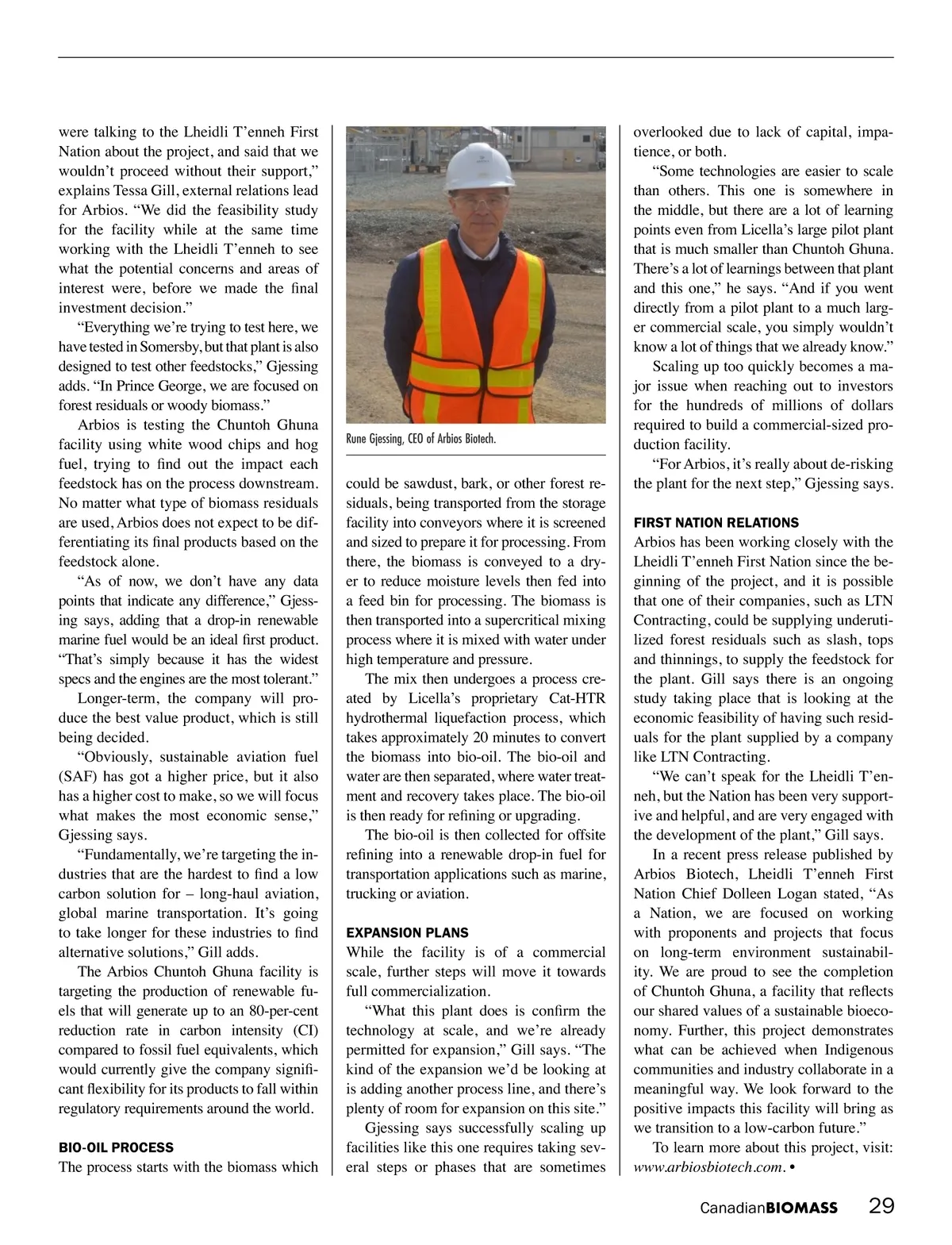
were talking to the Lheidli T’enneh First Nation about the project, and said that we wouldn’t proceed without their support,” explains Tessa Gill, external relations lead for Arbios. “We did the feasibility study for the facility while at the same time working with the Lheidli T’enneh to see what the potential concerns and areas of interest were, before we made the final investment decision.” “Everything we’re trying to test here, we have tested in Somersby, but that plant is also designed to test other feedstocks,” Gjessing adds. “In Prince George, we are focused on forest residuals or woody biomass.” Arbios is testing the Chuntoh Ghuna facility using white wood chips and hog fuel, trying to find out the impact each feedstock has on the process downstream. No matter what type of biomass residuals are used, Arbios does not expect to be dif-ferentiating its final products based on the feedstock alone. “As of now, we don’t have any data points that indicate any difference,” Gjess-ing says, adding that a drop-in renewable marine fuel would be an ideal first product. “That’s simply because it has the widest specs and the engines are the most tolerant.” Longer-term, the company will pro-duce the best value product, which is still being decided. “Obviously, sustainable aviation fuel (SAF) has got a higher price, but it also has a higher cost to make, so we will focus what makes the most economic sense,” Gjessing says. “Fundamentally, we’re targeting the in-dustries that are the hardest to find a low carbon solution for – long-haul aviation, global marine transportation. It’s going to take longer for these industries to find alternative solutions,” Gill adds. The Arbios Chuntoh Ghuna facility is targeting the production of renewable fu-els that will generate up to an 80-per-cent reduction rate in carbon intensity (CI) compared to fossil fuel equivalents, which would currently give the company signifi -cant flexibility for its products to fall within regulatory requirements around the world. BIO-OIL PROCESS Rune Gjessing, CEO of Arbios Biotech. could be sawdust, bark, or other forest re-siduals, being transported from the storage facility into conveyors where it is screened and sized to prepare it for processing. From there, the biomass is conveyed to a dry-er to reduce moisture levels then fed into a feed bin for processing. The biomass is then transported into a supercritical mixing process where it is mixed with water under high temperature and pressure. The mix then undergoes a process cre-ated by Licella’s proprietary Cat-HTR hydrothermal liquefaction process, which takes approximately 20 minutes to convert the biomass into bio-oil. The bio-oil and water are then separated, where water treat-ment and recovery takes place. The bio-oil is then ready for refining or upgrading. The bio-oil is then collected for offsite refining into a renewable drop-in fuel for transportation applications such as marine, trucking or aviation. EXPANSION PLANS overlooked due to lack of capital, impa-tience, or both. “Some technologies are easier to scale than others. This one is somewhere in the middle, but there are a lot of learning points even from Licella’s large pilot plant that is much smaller than Chuntoh Ghuna. There’s a lot of learnings between that plant and this one,” he says. “And if you went directly from a pilot plant to a much larg-er commercial scale, you simply wouldn’t know a lot of things that we already know.” Scaling up too quickly becomes a ma-jor issue when reaching out to investors for the hundreds of millions of dollars required to build a commercial-sized pro-duction facility. “For Arbios, it’s really about de-risking the plant for the next step,” Gjessing says. FIRST NATION RELATIONS The process starts with the biomass which While the facility is of a commercial scale, further steps will move it towards full commercialization. “What this plant does is confirm the technology at scale, and we’re already permitted for expansion,” Gill says. “The kind of the expansion we’d be looking at is adding another process line, and there’s plenty of room for expansion on this site.” Gjessing says successfully scaling up facilities like this one requires taking sev-eral steps or phases that are sometimes Arbios has been working closely with the Lheidli T’enneh First Nation since the be-ginning of the project, and it is possible that one of their companies, such as LTN Contracting, could be supplying underuti-lized forest residuals such as slash, tops and thinnings, to supply the feedstock for the plant. Gill says there is an ongoing study taking place that is looking at the economic feasibility of having such resid-uals for the plant supplied by a company like LTN Contracting. “We can’t speak for the Lheidli T’en-neh, but the Nation has been very support-ive and helpful, and are very engaged with the development of the plant,” Gill says. In a recent press release published by Arbios Biotech, Lheidli T’enneh First Nation Chief Dolleen Logan stated, “As a Nation, we are focused on working with proponents and projects that focus on long-term environment sustainabil-ity. We are proud to see the completion of Chuntoh Ghuna, a facility that reflects our shared values of a sustainable bioeco-nomy. Further, this project demonstrates what can be achieved when Indigenous communities and industry collaborate in a meaningful way. We look forward to the positive impacts this facility will bring as we transition to a low-carbon future.” To learn more about this project, visit: www.arbiosbiotech.com. • Canadian BIOMASS 29
Canadian Biomass Summer 2025: Page 29