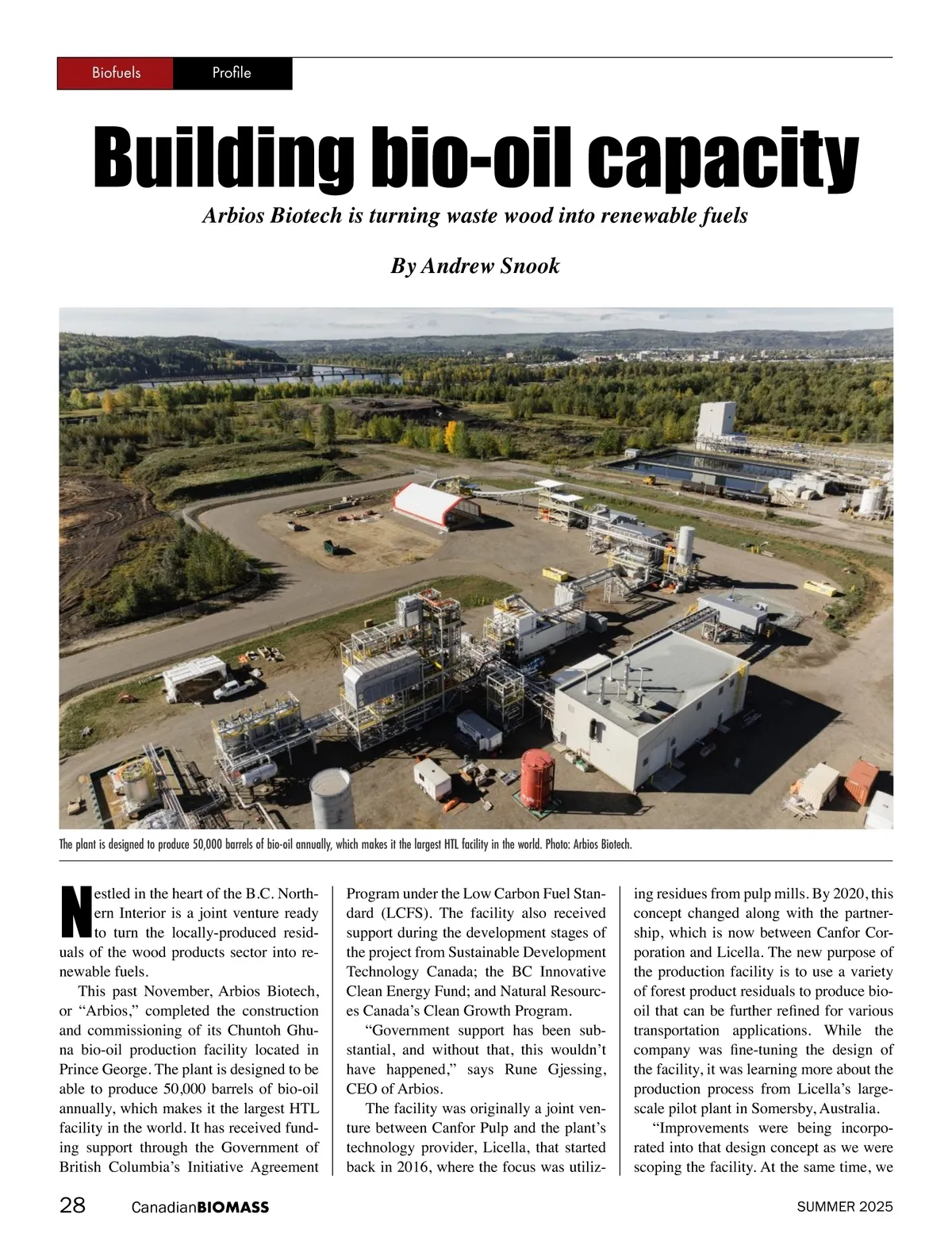
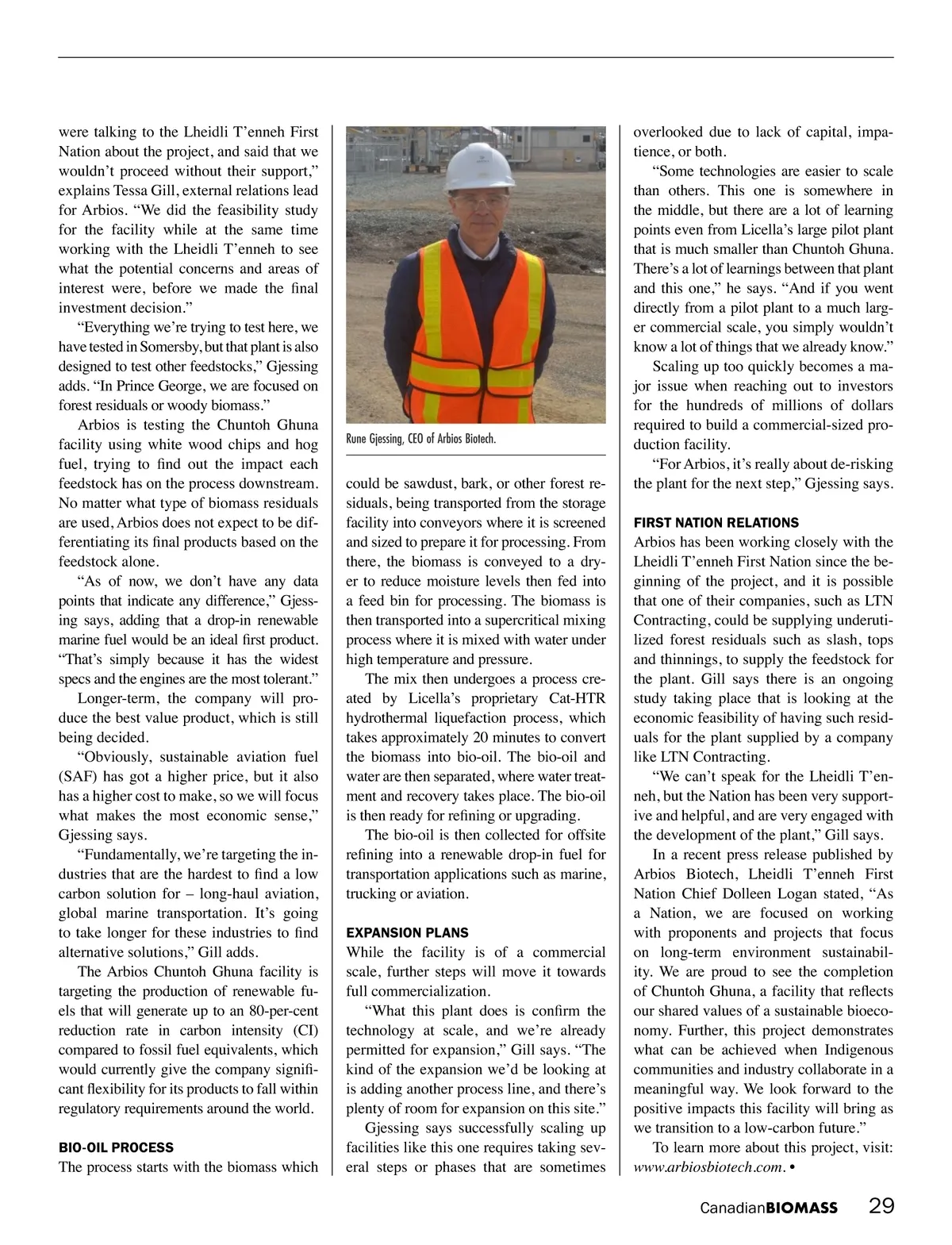
Biofuels Profile Building bio-oil capacity Arbios Biotech is turning waste wood into renewable fuels By Andrew Snook The plant is designed to produce 50,000 barrels of bio-oil annually, which makes it the largest HTL facility in the world. Photo: Arbios Biotech. N estled in the heart of the B.C. North-ern Interior is a joint venture ready to turn the locally-produced resid-uals of the wood products sector into re-newable fuels. This past November, Arbios Biotech, or “Arbios,” completed the construction and commissioning of its Chuntoh Ghu-na bio-oil production facility located in Prince George. The plant is designed to be able to produce 50,000 barrels of bio-oil annually, which makes it the largest HTL facility in the world. It has received fund-ing support through the Government of British Columbia’s Initiative Agreement Program under the Low Carbon Fuel Stan-dard (LCFS). The facility also received support during the development stages of the project from Sustainable Development Technology Canada; the BC Innovative Clean Energy Fund; and Natural Resourc-es Canada’s Clean Growth Program. “Government support has been sub-stantial, and without that, this wouldn’t have happened,” says Rune Gjessing, CEO of Arbios. The facility was originally a joint ven-ture between Canfor Pulp and the plant’s technology provider, Licella, that started back in 2016, where the focus was utiliz-ing residues from pulp mills. By 2020, this concept changed along with the partner-ship, which is now between Canfor Cor-poration and Licella. The new purpose of the production facility is to use a variety of forest product residuals to produce bio-oil that can be further refined for various transportation applications. While the company was fine-tuning the design of the facility, it was learning more about the production process from Licella’s large-scale pilot plant in Somersby, Australia. “Improvements were being incorpo-rated into that design concept as we were scoping the facility. At the same time, we SUMMER 2025 28 Canadian BIOMASS
Canadian Biomass Summer 2025: Page 28