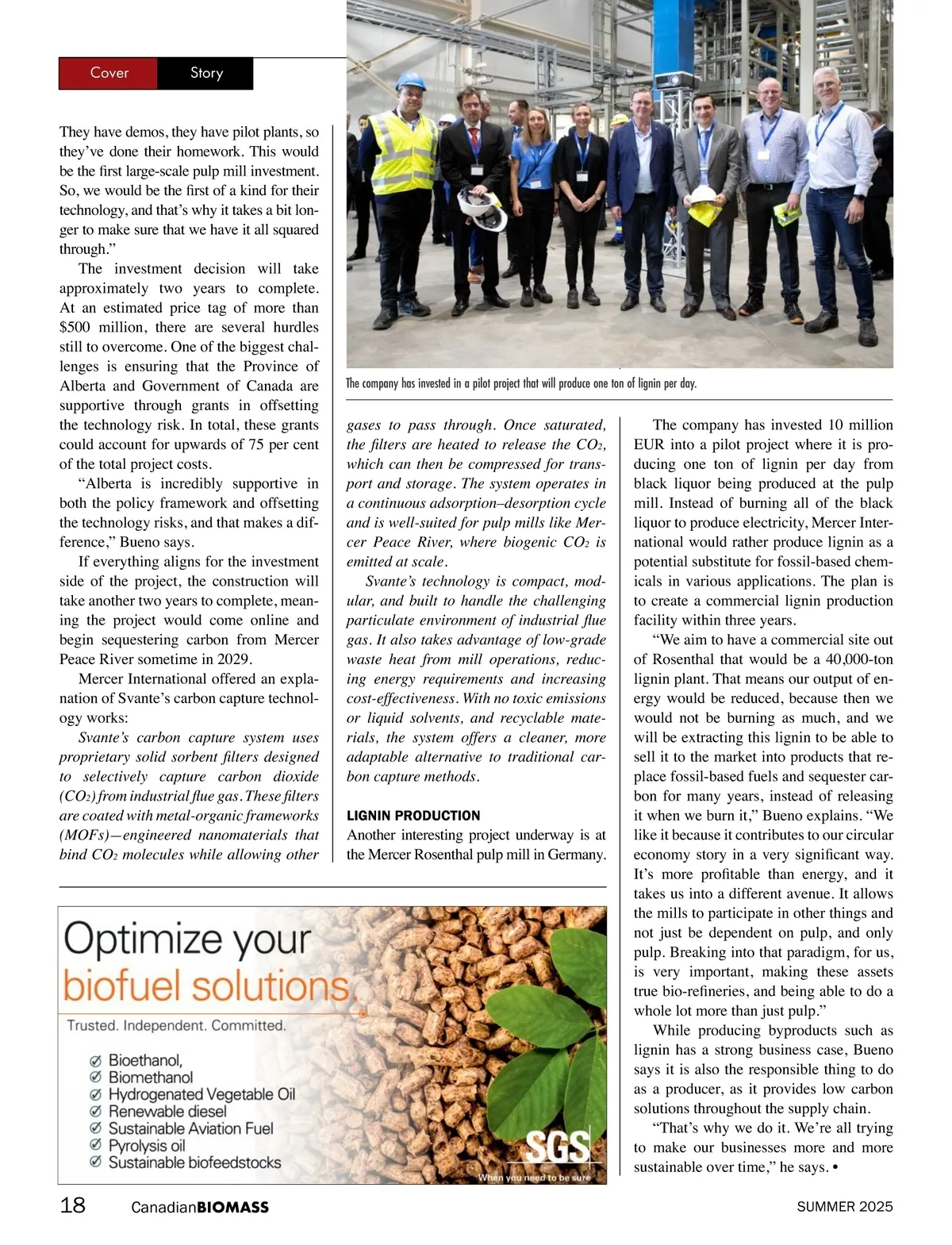
Cover Story They have demos, they have pilot plants, so they’ve done their homework. This would be the first large-scale pulp mill investment. So, we would be the first of a kind for their technology, and that’s why it takes a bit lon-ger to make sure that we have it all squared through.” The investment decision will take approximately two years to complete. At an estimated price tag of more than $500 million, there are several hurdles still to overcome. One of the biggest chal-lenges is ensuring that the Province of Alberta and Government of Canada are supportive through grants in offsetting the technology risk. In total, these grants could account for upwards of 75 per cent of the total project costs. “Alberta is incredibly supportive in both the policy framework and offsetting the technology risks, and that makes a dif-ference,” Bueno says. If everything aligns for the investment side of the project, the construction will take another two years to complete, mean-ing the project would come online and begin sequestering carbon from Mercer Peace River sometime in 2029. Mercer International offered an expla-nation of Svante’s carbon capture technol-ogy works: Svante’s carbon capture system uses proprietary solid sorbent filters designed to selectively capture carbon dioxide (CO 2 ) from industrial flue gas. These filters are coated with metal-organic frameworks (MOFs)—engineered nanomaterials that bind CO 2 molecules while allowing other The company has invested in a pilot project that will produce one ton of lignin per day. gases to pass through. Once saturated, the filters are heated to release the CO 2 , which can then be compressed for trans-port and storage. The system operates in a continuous adsorption–desorption cycle and is well-suited for pulp mills like Mer-cer Peace River, where biogenic CO 2 is emitted at scale. Svante’s technology is compact, mod-ular, and built to handle the challenging particulate environment of industrial flue gas. It also takes advantage of low-grade waste heat from mill operations, reduc-ing energy requirements and increasing cost-effectiveness. With no toxic emissions or liquid solvents, and recyclable mate-rials, the system offers a cleaner, more adaptable alternative to traditional car-bon capture methods. LIGNIN PRODUCTION Another interesting project underway is at the Mercer Rosenthal pulp mill in Germany. The company has invested 10 million EUR into a pilot project where it is pro-ducing one ton of lignin per day from black liquor being produced at the pulp mill. Instead of burning all of the black liquor to produce electricity, Mercer Inter-national would rather produce lignin as a potential substitute for fossil-based chem-icals in various applications. The plan is to create a commercial lignin production facility within three years. “We aim to have a commercial site out of Rosenthal that would be a 40,000-ton lignin plant. That means our output of en-ergy would be reduced, because then we would not be burning as much, and we will be extracting this lignin to be able to sell it to the market into products that re-place fossil-based fuels and sequester car-bon for many years, instead of releasing it when we burn it,” Bueno explains. “We like it because it contributes to our circular economy story in a very significant way. It’s more profitable than energy, and it takes us into a different avenue. It allows the mills to participate in other things and not just be dependent on pulp, and only pulp. Breaking into that paradigm, for us, is very important, making these assets true bio-refineries, and being able to do a whole lot more than just pulp.” While producing byproducts such as lignin has a strong business case, Bueno says it is also the responsible thing to do as a producer, as it provides low carbon solutions throughout the supply chain. “That’s why we do it. We’re all trying to make our businesses more and more sustainable over time,” he says. • SUMMER 2025 18 CB_SGS_Summer24_CSA.indd 1 Canadian BIOMASS 2024-07-05 9:09 AM
Canadian Biomass Summer 2025: Page 18