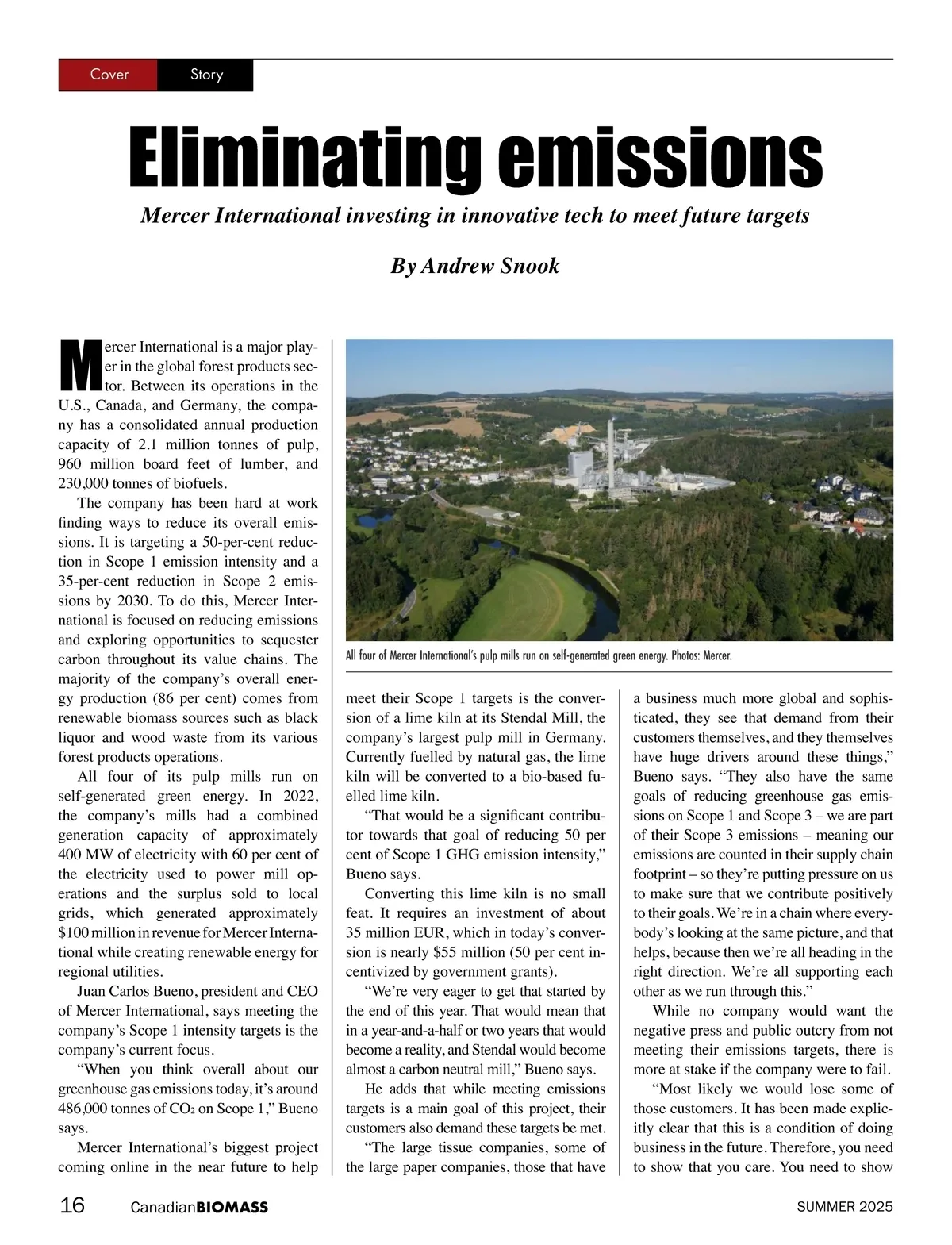
that you’re willing to put your wallet where your mouth is and that you are really going to contribute positively to this outcome,” Bueno says. The Stendal Mill conver-sion project is of particular importance because it is Mer-cer International’s largest pulp mill with the largest lime kiln within the company’s pulp mill assets. The mill produces 740,000 tonnes of softwood pulp (mostly spruce with a diet of spruce, pine and fir). The company’s other pulp mill in Germany, Mercer Rosenthal, produces 363,000 tonnes of softwood pulp, and could also undergo a similar conversion project sometime in the future. Given the customer profile for Mercer International’s Eu-ropean pulp mills, these types of projects are a priority for them versus the company’s Canadian mills. This is be-cause most of the customers for its Canadian mills oper-ate within the Asian markets, where the same pressures re-lated to meeting emissions tar-gets are a much lower priority. However, Mercer Internation-al is still focused on reducing emissions at its Canadian pulp mill operations. “We do have another proj-ect, a carbon sequestration project, and that would be for the Alberta pulp mill that we have in Canada.” The Mercer Peace River pulp mill in Peace River, Alta. is a swing mill that produces approximately 475,000 tonnes of hardwood and softwood Mercer CEO Juan Carlos Bueno. pulp. The company is in the process of potentially investing heavily into a new technology for sequestering the CO 2 from the flue gases of the pulp mill. “We’re working with a company in Canada that de-veloped a technology for capturing that CO 2 . The rea-son why we’re doing it there is because the mill is located in Alberta, where you have geological formations that are suitable for sequestering CO 2 ,” Bueno explains. “You don’t have to take it long dis-tances. You’re right where you need to be, and that makes the project financially viable.” The process for removing the CO 2 from Mercer Peace River’s pulp mill operations would be a non-intrusive, me-chanical process using a pro-prietary technology developed by Svante, a carbon capture and removal solutions provider based in Burnaby, B.C. “We’re working with them, going through all the phases that are needed, before we are ready for an investment decision,” Bueno says. “It’s making sure that the technology works, that is the big hurdle. They tested it. RELIABLE HIGH PERFORMANCE PELLET FIBRE DRYING HOT GAS GENERATORS FOR ROTARY DRYERS • THERMAL FLUID HEATERS FOR BELT DRYERS www.wellons.ca Heat and Energy Specialists in the Forest Products Industry
Canadian Biomass Summer 2025: Page 17