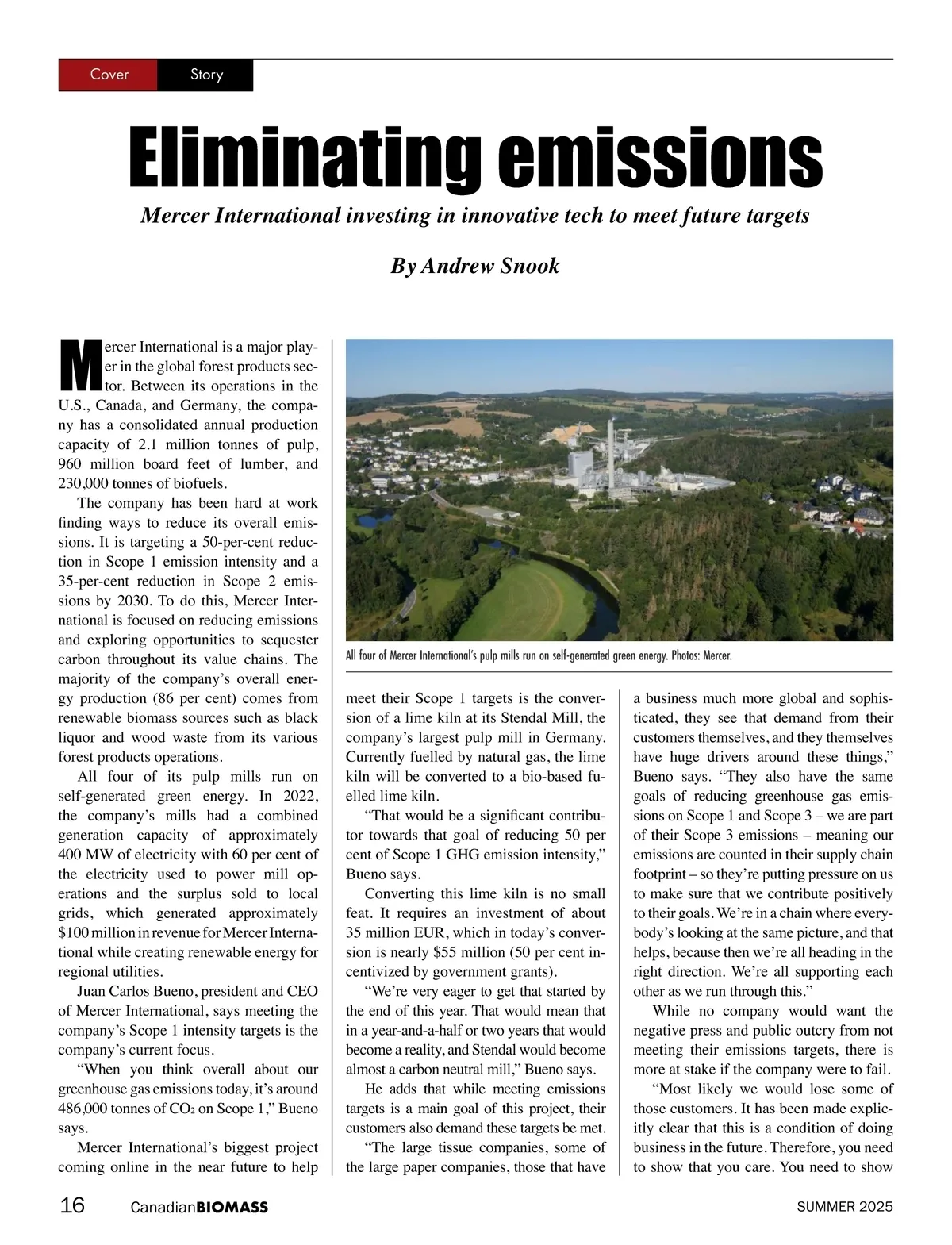
Cover Story Eliminating emissions Mercer International investing in innovative tech to meet future targets By Andrew Snook M ercer International is a major play-er in the global forest products sec-tor. Between its operations in the U.S., Canada, and Germany, the compa-ny has a consolidated annual production capacity of 2.1 million tonnes of pulp, 960 million board feet of lumber, and 230,000 tonnes of biofuels. The company has been hard at work finding ways to reduce its overall emis -sions. It is targeting a 50-per-cent reduc-tion in Scope 1 emission intensity and a 35-per-cent reduction in Scope 2 emis-sions by 2030. To do this, Mercer Inter-national is focused on reducing emissions and exploring opportunities to sequester carbon throughout its value chains. The majority of the company’s overall ener-gy production (86 per cent) comes from renewable biomass sources such as black liquor and wood waste from its various forest products operations. All four of its pulp mills run on self-generated green energy. In 2022, the company’s mills had a combined generation capacity of approximately 400 MW of electricity with 60 per cent of the electricity used to power mill op-erations and the surplus sold to local grids, which generated approximately $100 million in revenue for Mercer Interna-tional while creating renewable energy for regional utilities. Juan Carlos Bueno, president and CEO of Mercer International, says meeting the company’s Scope 1 intensity targets is the company’s current focus. “When you think overall about our greenhouse gas emissions today, it’s around 486,000 tonnes of CO 2 on Scope 1,” Bueno says. Mercer International’s biggest project coming online in the near future to help All four of Mercer International’s pulp mills run on self-generated green energy. Photos: Mercer. meet their Scope 1 targets is the conver-sion of a lime kiln at its Stendal Mill, the company’s largest pulp mill in Germany. Currently fuelled by natural gas, the lime kiln will be converted to a bio-based fu-elled lime kiln. “That would be a significant contribu -tor towards that goal of reducing 50 per cent of Scope 1 GHG emission intensity,” Bueno says. Converting this lime kiln is no small feat. It requires an investment of about 35 million EUR, which in today’s conver-sion is nearly $55 million (50 per cent in-centivized by government grants). “We’re very eager to get that started by the end of this year. That would mean that in a year-and-a-half or two years that would become a reality, and Stendal would become almost a carbon neutral mill,” Bueno says. He adds that while meeting emissions targets is a main goal of this project, their customers also demand these targets be met. “The large tissue companies, some of the large paper companies, those that have a business much more global and sophis-ticated, they see that demand from their customers themselves, and they themselves have huge drivers around these things,” Bueno says. “They also have the same goals of reducing greenhouse gas emis-sions on Scope 1 and Scope 3 – we are part of their Scope 3 emissions – meaning our emissions are counted in their supply chain footprint – so they’re putting pressure on us to make sure that we contribute positively to their goals. We’re in a chain where every-body’s looking at the same picture, and that helps, because then we’re all heading in the right direction. We’re all supporting each other as we run through this.” While no company would want the negative press and public outcry from not meeting their emissions targets, there is more at stake if the company were to fail. “Most likely we would lose some of those customers. It has been made explic-itly clear that this is a condition of doing business in the future. Therefore, you need to show that you care. You need to show SUMMER 2025 16 Canadian BIOMASS
Canadian Biomass Summer 2025: Page 16