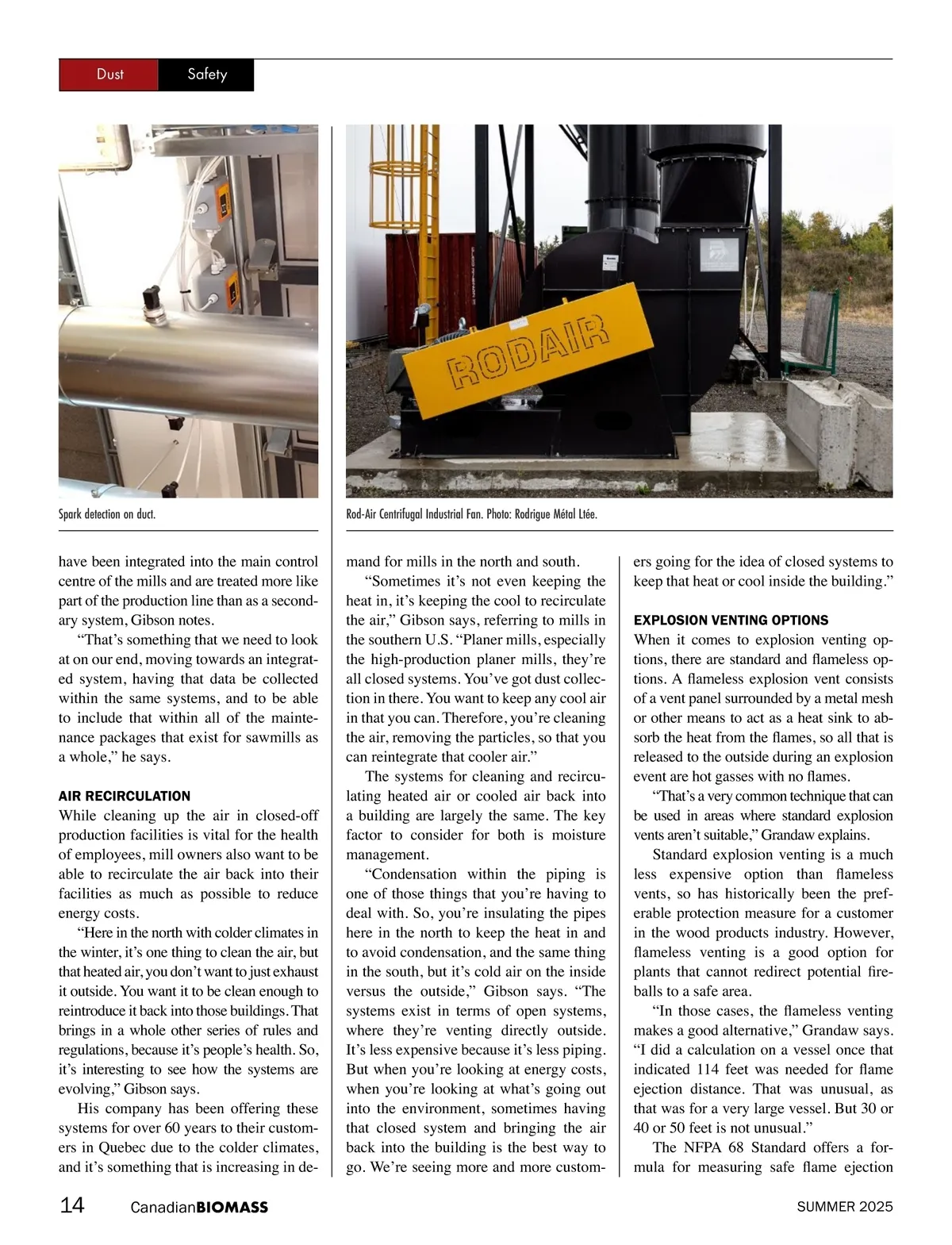
IV8 Flameless Explosion Relief Vent. distance. Additional thermal effects must also be considered, as the heat generated from an explosion can travel farther than the fire and can still be hot enough for someone to be injured or worse. CURRENT CHALLENGES quirements in Canadian standards relating to combustible dusts compared to the U.S. “Most sawmills would need tradition-al explosion protection (e.g., venting or suppression) on some vessels handling their dry materials, spark detection and extinguishing systems where saws, mills or sanding equipment are tied to dust col-lection systems, and deflagration isolation on any vessel having an explosion hazard. This along with housekeeping procedures to limit dust accumulation inside the facil-ity would go a long way. However, in most cases, I see one or two of these safeguards provided, with some equipment having no protection at all where there should be protection,” Cormier says. Another major challenge can be the age of the mills, and the cost involved in retrofitting the equipment. “A lot of these facilities tend to have older equipment which might be difficult to retrofit, and cost of upgrading to a fully compliant facility may be prohibitive for a lot of these sawmills, which is probably one of the biggest obstacles they face,” Cormier says. Grandaw says price is a major factor for wood products plants when looking at whether to install passive or active dust and explosion mitigation and suppres-sion systems. “Not only initial cost, but long-term cost of ownership, because pas-sive systems do not typically require the maintenance that an active system would. Active systems need to be inspected, just like any other process area of the plant. Usually, since these are specialized sys-tems, you would have the manufacturer send their own field technicians to do that inspection. So, the cost is much higher to maintain the active systems than the most passive systems. Passive systems are things such as the flap valves, standard and flameless vents. Those require mostly visual inspections so they can be done at the plant level. So, the long-term cost of ownership is less.” • One of the biggest challenges for some wood products manufacturers keeping current with the latest dust and explosion mitigation technologies has been a misin-terpretation of the standards that results in plants using the wrong technology for the goals of the safety standard, Petit notes. “We have seen plenty of spark detec-tion systems as the only line of defense, in place of explosion isolation,” he says. “Catching up with the current standards is not incredibly hard; as in, we are not see-ing any drastic changes of the methods of mitigation being changed drastically with each revision.” Some companies want to continue us-ing legacy systems instead of purchasing new systems, but this can be an issue as older standards may have been originally misinterpreted and were always deficient, Petit adds. Luc Cormier, explosion protection con-sultant for Fike, says Canadian facilities are probably less protected than the U.S. facilities overall due to there being less re-Combustible Dust Specialists NFPA68 NFPA69 NFPA77 NFPA91 NFPA499 NFPA654 NFPA664 Allied brings 49 years experience to help you meet current NFPA Standards with: system design/documentation, spark detection, isolation, grounding, PLC, venting, blast path management, clean-up systems and duct audits — CWB certified and member SMACNA. Sawmill – Biomass – Boardplants – Pulp & Paper – Power Generation – Mining www.alliedblower.com Phone: 800-576-3611 Surrey,BC Vernon,BC WilliamsLake,BC Edmonton,Alberta PrinceAlbert,Sask Mobile, Alabama 50 years of Industrial Air Systems Canadian BIOMASS CFI_AlliedBlower_JanFeb24_MLD.indd 1 2024-01-23 1:51 PM 15
Canadian Biomass Summer 2025: Page 15