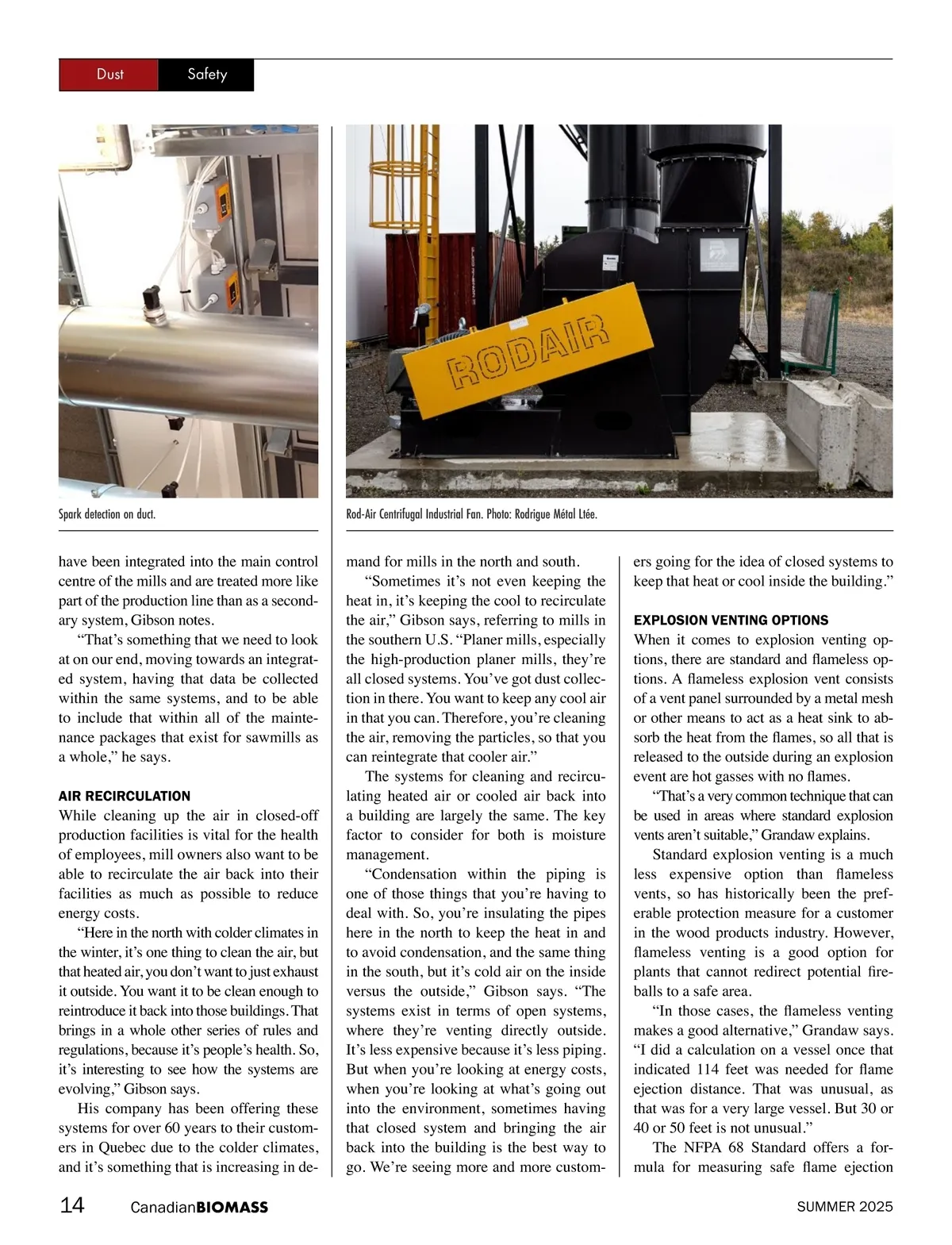
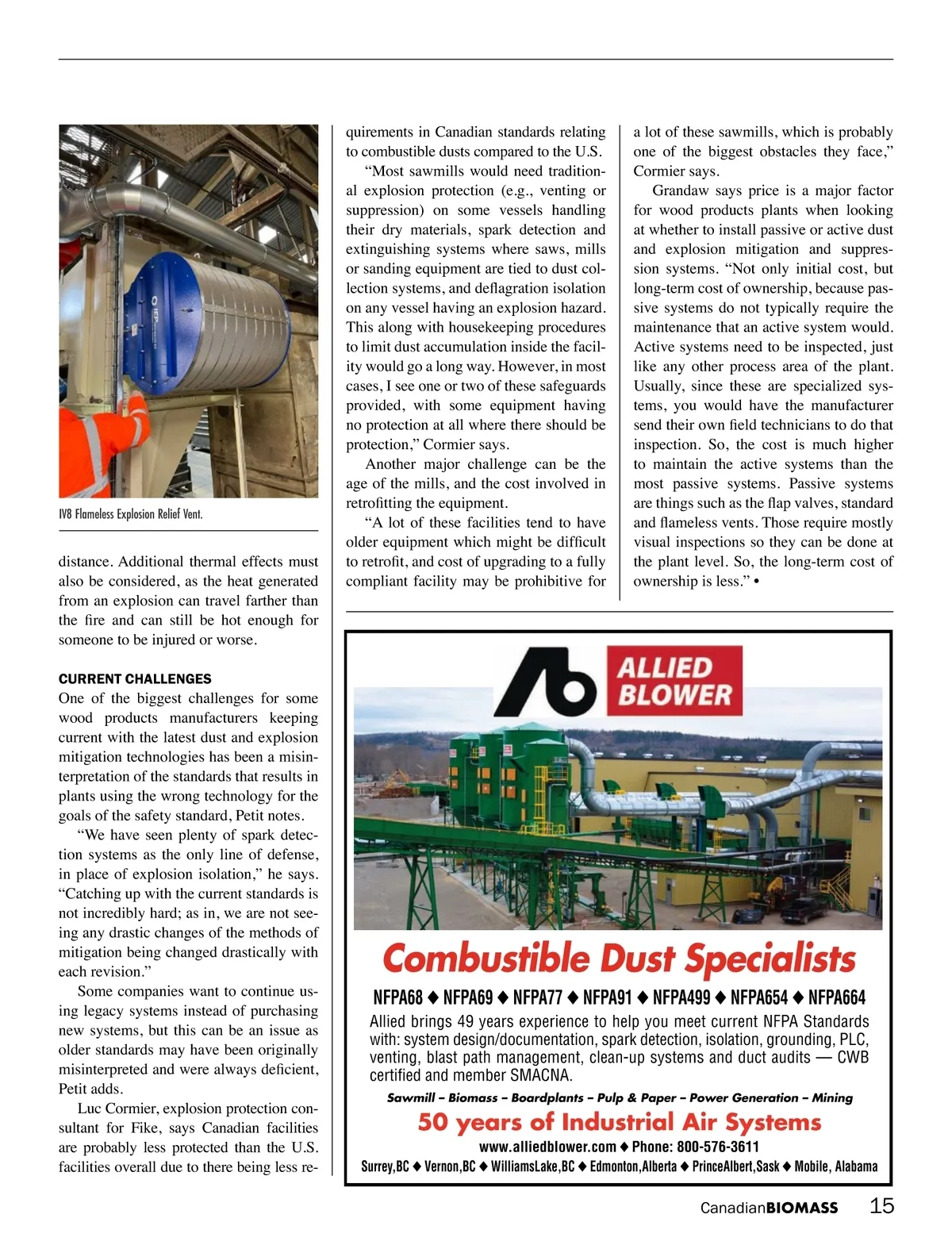
Dust Safety Spark detection on duct. Rod-Air Centrifugal Industrial Fan. Photo: Rodrigue Métal Ltée. have been integrated into the main control centre of the mills and are treated more like part of the production line than as a second-ary system, Gibson notes. “That’s something that we need to look at on our end, moving towards an integrat-ed system, having that data be collected within the same systems, and to be able to include that within all of the mainte-nance packages that exist for sawmills as a whole,” he says. AIR RECIRCULATION While cleaning up the air in closed-off production facilities is vital for the health of employees, mill owners also want to be able to recirculate the air back into their facilities as much as possible to reduce energy costs. “Here in the north with colder climates in the winter, it’s one thing to clean the air, but that heated air, you don’t want to just exhaust it outside. You want it to be clean enough to reintroduce it back into those buildings. That brings in a whole other series of rules and regulations, because it’s people’s health. So, it’s interesting to see how the systems are evolving,” Gibson says. His company has been offering these systems for over 60 years to their custom-ers in Quebec due to the colder climates, and it’s something that is increasing in de-mand for mills in the north and south. “Sometimes it’s not even keeping the heat in, it’s keeping the cool to recirculate the air,” Gibson says, referring to mills in the southern U.S. “Planer mills, especially the high-production planer mills, they’re all closed systems. You’ve got dust collec-tion in there. You want to keep any cool air in that you can. Therefore, you’re cleaning the air, removing the particles, so that you can reintegrate that cooler air.” The systems for cleaning and recircu-lating heated air or cooled air back into a building are largely the same. The key factor to consider for both is moisture management. “Condensation within the piping is one of those things that you’re having to deal with. So, you’re insulating the pipes here in the north to keep the heat in and to avoid condensation, and the same thing in the south, but it’s cold air on the inside versus the outside,” Gibson says. “The systems exist in terms of open systems, where they’re venting directly outside. It’s less expensive because it’s less piping. But when you’re looking at energy costs, when you’re looking at what’s going out into the environment, sometimes having that closed system and bringing the air back into the building is the best way to go. We’re seeing more and more custom-ers going for the idea of closed systems to keep that heat or cool inside the building.” EXPLOSION VENTING OPTIONS When it comes to explosion venting op-tions, there are standard and flameless op -tions. A flameless explosion vent consists of a vent panel surrounded by a metal mesh or other means to act as a heat sink to ab-sorb the heat from the flames, so all that is released to the outside during an explosion event are hot gasses with no flames. “That’s a very common technique that can be used in areas where standard explosion vents aren’t suitable,” Grandaw explains. Standard explosion venting is a much less expensive option than flameless vents, so has historically been the pref-erable protection measure for a customer in the wood products industry. However, flameless venting is a good option for plants that cannot redirect potential fire -balls to a safe area. “In those cases, the flameless venting makes a good alternative,” Grandaw says. “I did a calculation on a vessel once that indicated 114 feet was needed for flame ejection distance. That was unusual, as that was for a very large vessel. But 30 or 40 or 50 feet is not unusual.” The NFPA 68 Standard offers a for-mula for measuring safe flame ejection SUMMER 2025 14 Canadian BIOMASS
Canadian Biomass Summer 2025: Page 14