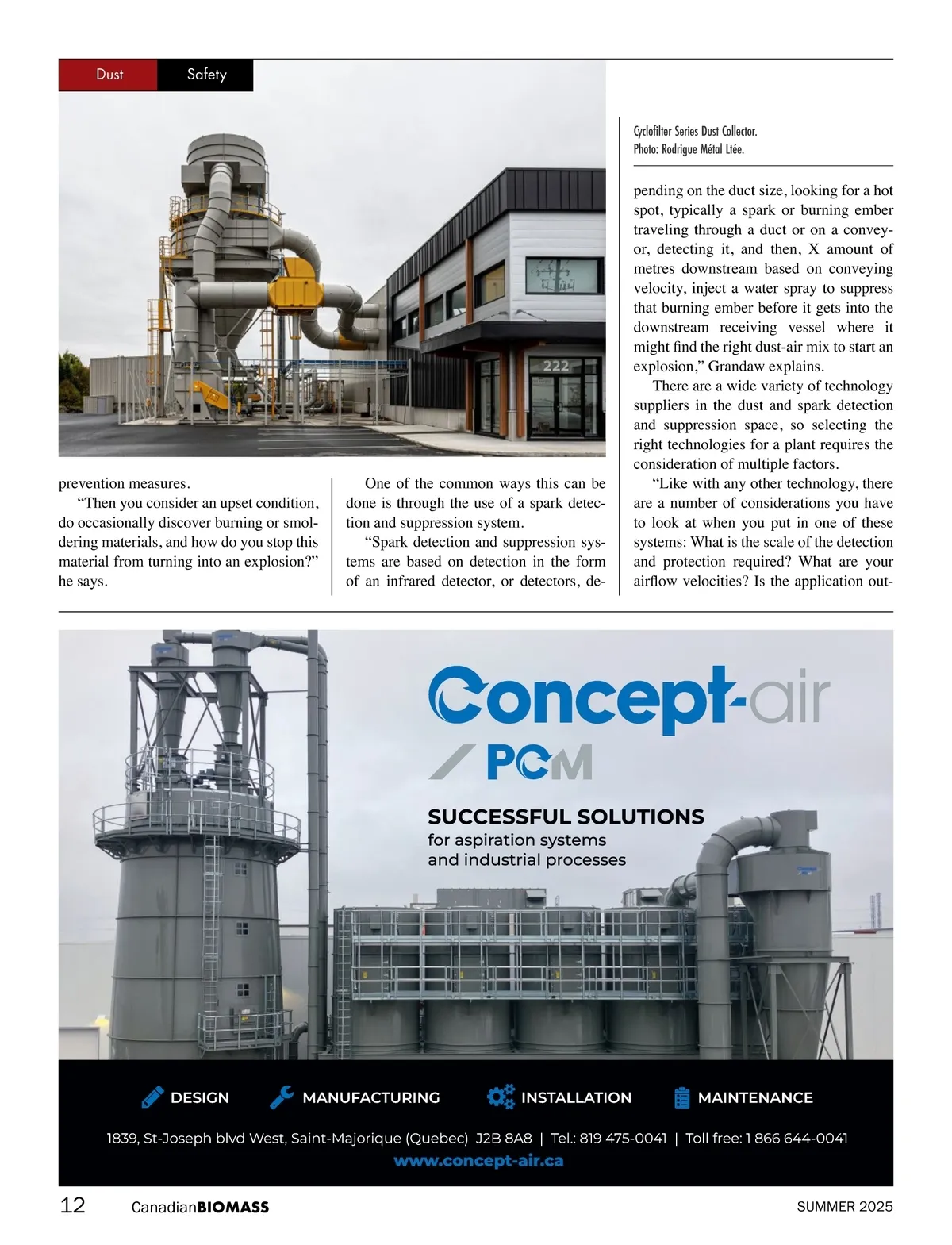
TIPS Petit offers sawmills and pellet plants the following tips for optimizing their dust and explosion mitigation operations: • Keep the records/drawings of the duct layouts and capture the changes made. This way a technical review is possible without wasting too much time and resources. • Expanding a system is more technically challenging than it seems. Consult with the original designer. • Containment of the dust-generating equipment will reduce wasted air from the exhaust system. • Keep the Dust Hazard Assessment (DHA) up to date. It VKRXOGEHUHYLHZHGHYHU\ÀYH\HDUVRUHYHU\WLPHWKH process or dust changes • Training of staff around the hazard and how to maintain safety equipment is also a key factor in mitigating the hazard. side where you must heat trace the water pipes, since in the win-tertime up in Canada, we don’t want pipes to freeze and break,” Grandaw says. INCREASED INTEGRATION IsoFlap passive isolation flap valve. Photo: IEP Technologies. In sawmills in Canada and the U.S., dust collection systems are always located outside, so people tend not to consider them when they’re talking about the automation within a facility, Gibson notes. “It’s almost secondary. So very often, there’ll be maximum two inspections annually where you’re going to be looking inside the system to see if there’s any escaping material, to see if there’s any gap in pressure, or anything like that. But the systems are standalone, and they operate on their own,” he says. In the majority of European mills, the dust collection systems S O L U T I O N P R O V I D E R S F O R T H E E X T R A C T I O N A N D M A N A G E M E N T O F D U S T A N D O T H E R C O -P R O D U C T S SINCE 1964 PHONE 418-839-0671 | EMAIL [email protected] Canadian BIOMASS 13
Canadian Biomass Summer 2025: Page 13