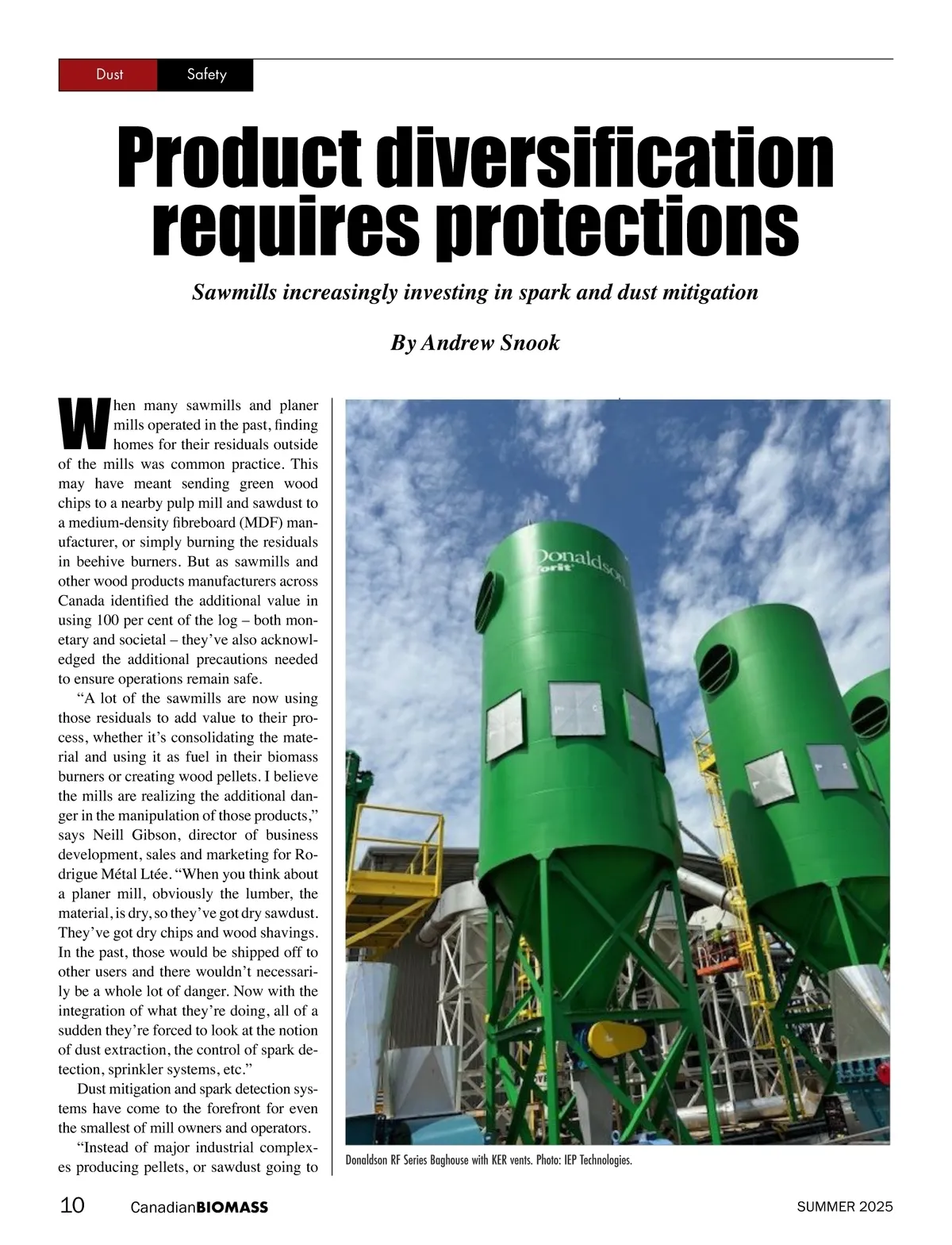
Dust Safety Product diversification requires protections Sawmills increasingly investing in spark and dust mitigation By Andrew Snook W hen many sawmills and planer mills operated in the past, finding homes for their residuals outside of the mills was common practice. This may have meant sending green wood chips to a nearby pulp mill and sawdust to a medium-density fibreboard (MDF) man -ufacturer, or simply burning the residuals in beehive burners. But as sawmills and other wood products manufacturers across Canada identified the additional value in using 100 per cent of the log – both mon-etary and societal – they’ve also acknowl-edged the additional precautions needed to ensure operations remain safe. “A lot of the sawmills are now using those residuals to add value to their pro-cess, whether it’s consolidating the mate-rial and using it as fuel in their biomass burners or creating wood pellets. I believe the mills are realizing the additional dan-ger in the manipulation of those products,” says Neill Gibson, director of business development, sales and marketing for Ro-drigue Métal Ltée. “When you think about a planer mill, obviously the lumber, the material, is dry, so they’ve got dry sawdust. They’ve got dry chips and wood shavings. In the past, those would be shipped off to other users and there wouldn’t necessari-ly be a whole lot of danger. Now with the integration of what they’re doing, all of a sudden they’re forced to look at the notion of dust extraction, the control of spark de-tection, sprinkler systems, etc.” Dust mitigation and spark detection sys-tems have come to the forefront for even the smallest of mill owners and operators. “Instead of major industrial complex-es producing pellets, or sawdust going to Donaldson RF Series Baghouse with KER vents. Photo: IEP Technologies. SUMMER 2025 10 Canadian BIOMASS
Canadian Biomass Summer 2025: Page 10