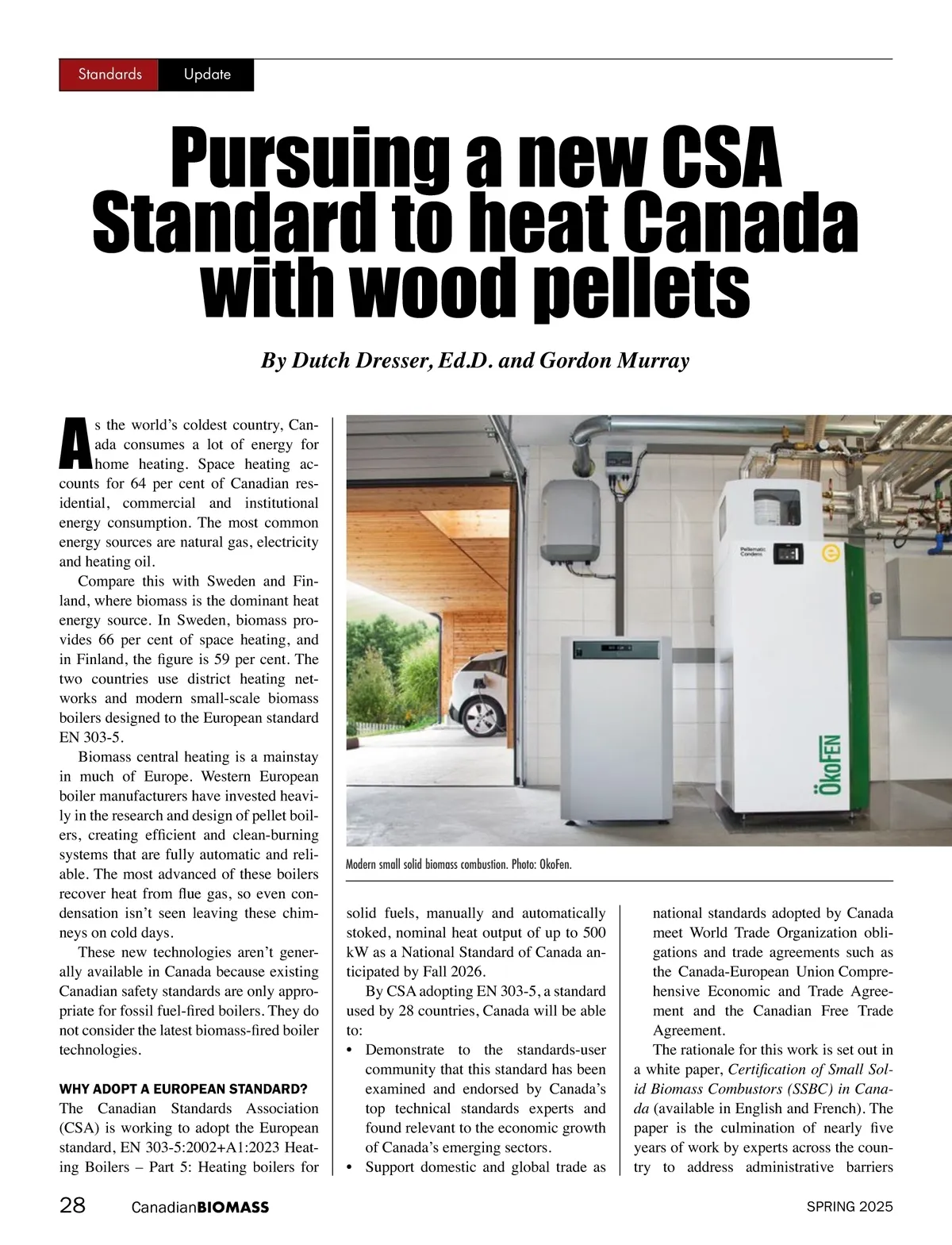
Standards Update Pursuing a new CSA Standard to heat Canada with wood pellets By Dutch Dresser, Ed.D. and Gordon Murray A s the world’s coldest country, Can -ada consumes a lot of energy for home heating. Space heating ac -counts for 64 per cent of Canadian res-idential, commercial and institutional energy consumption. The most common energy sources are natural gas, electricity and heating oil. Compare this with Sweden and Fin -land, where biomass is the dominant heat energy source. In Sweden, biomass pro -vides 66 per cent of space heating, and in Finland, the figure is 59 per cent. The two countries use district heating net-works and modern small-scale biomass boilers designed to the European standard EN 303-5. Biomass central heating is a mainstay in much of Europe. Western European boiler manufacturers have invested heavi-ly in the research and design of pellet boil-ers, creating efficient and clean-burning systems that are fully automatic and reli-able. The most advanced of these boilers recover heat from flue gas, so even con -densation isn’t seen leaving these chim -neys on cold days. These new technologies aren’t gener -ally available in Canada because existing Canadian safety standards are only appro-priate for fossil fuel-fired boilers. They do not consider the latest biomass-fired boiler technologies. WHY ADOPT A EUROPEAN STANDARD? Modern small solid biomass combustion. Photo: OkoFen. The Canadian Standards Association (CSA) is working to adopt the European standard, EN 303-5:2002+A1:2023 Heat -ing Boilers – Part 5: Heating boilers for solid fuels, manually and automatically stoked, nominal heat output of up to 500 kW as a National Standard of Canada an -ticipated by Fall 2026. By CSA adopting EN 303-5, a standard used by 28 countries, Canada will be able to: • Demonstrate to the standards-user community that this standard has been examined and endorsed by Canada’s top technical standards experts and found relevant to the economic growth of Canada’s emerging sectors. • Support domestic and global trade as national standards adopted by Canada meet World Trade Organization obli -gations and trade agreements such as the Canada-European Union Compre-hensive Economic and Trade Agree -ment and the Canadian Free Trade Agreement. The rationale for this work is set out in a white paper, Certification of Small Sol -id Biomass Combustors (SSBC) in Cana -da (available in English and French). The paper is the culmination of nearly five years of work by experts across the coun -try to address administrative barriers SPRING 2025 28 Canadian BIOMASS
Canadian Biomass Spring 2025: Page 28