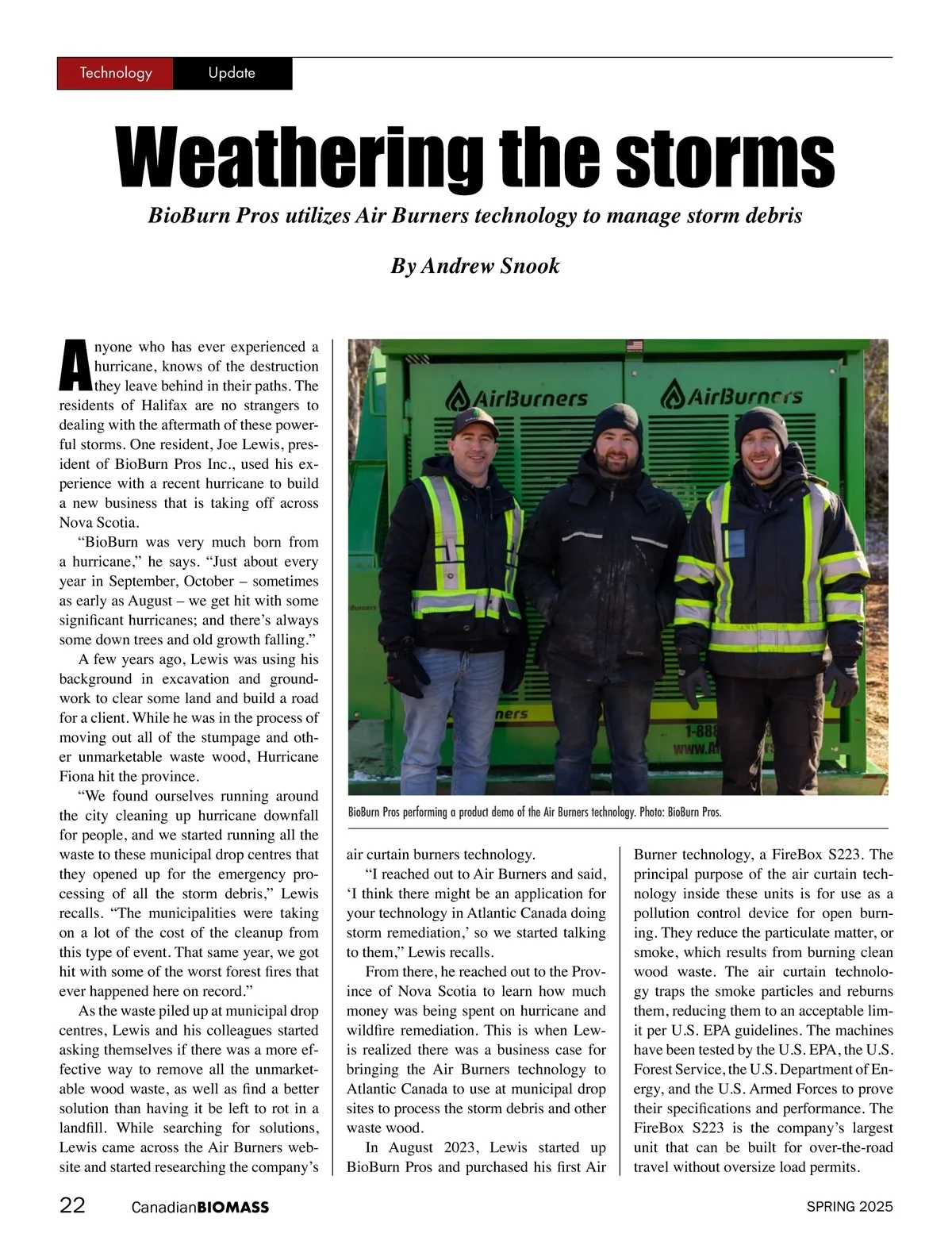
Technology Update Weathering the storms BioBurn Pros utilizes Air Burners technology to manage storm debris By Andrew Snook A nyone who has ever experienced a hurricane, knows of the destruction they leave behind in their paths. The residents of Halifax are no strangers to dealing with the aftermath of these power-ful storms. One resident, Joe Lewis, pres-ident of BioBurn Pros Inc., used his ex -perience with a recent hurricane to build a new business that is taking off across Nova Scotia. “BioBurn was very much born from a hurricane,” he says. “Just about every year in September, October – sometimes as early as August – we get hit with some significant hurricanes; and there’s always some down trees and old growth falling.” A few years ago, Lewis was using his background in excavation and ground -work to clear some land and build a road for a client. While he was in the process of moving out all of the stumpage and oth-er unmarketable waste wood, Hurricane Fiona hit the province. “We found ourselves running around the city cleaning up hurricane downfall for people, and we started running all the waste to these municipal drop centres that they opened up for the emergency pro-cessing of all the storm debris,” Lewis recalls. “The municipalities were taking on a lot of the cost of the cleanup from this type of event. That same year, we got hit with some of the worst forest fires that ever happened here on record.” As the waste piled up at municipal drop centres, Lewis and his colleagues started asking themselves if there was a more ef -fective way to remove all the unmarket -able wood waste, as well as find a better solution than having it be left to rot in a landfill. While searching for solutions, Lewis came across the Air Burners web -site and started researching the company’s BioBurn Pros performing a product demo of the Air Burners technology. Photo: BioBurn Pros. air curtain burners technology. “I reached out to Air Burners and said, ‘I think there might be an application for your technology in Atlantic Canada doing storm remediation,’ so we started talking to them,” Lewis recalls. From there, he reached out to the Prov -ince of Nova Scotia to learn how much money was being spent on hurricane and wildfire remediation. This is when Lew -is realized there was a business case for bringing the Air Burners technology to Atlantic Canada to use at municipal drop sites to process the storm debris and other waste wood. In August 2023, Lewis started up BioBurn Pros and purchased his first Air Burner technology, a FireBox S223. The principal purpose of the air curtain tech-nology inside these units is for use as a pollution control device for open burn-ing. They reduce the particulate matter, or smoke, which results from burning clean wood waste. The air curtain technolo -gy traps the smoke particles and reburns them, reducing them to an acceptable lim-it per U.S. EPA guidelines. The machines have been tested by the U.S. EPA, the U.S. Forest Service, the U.S. Department of En -ergy, and the U.S. Armed Forces to prove their specifications and performance. The FireBox S223 is the company’s largest unit that can be built for over-the-road travel without oversize load permits. SPRING 2025 22 Canadian BIOMASS
Canadian Biomass Spring 2025: Page 22