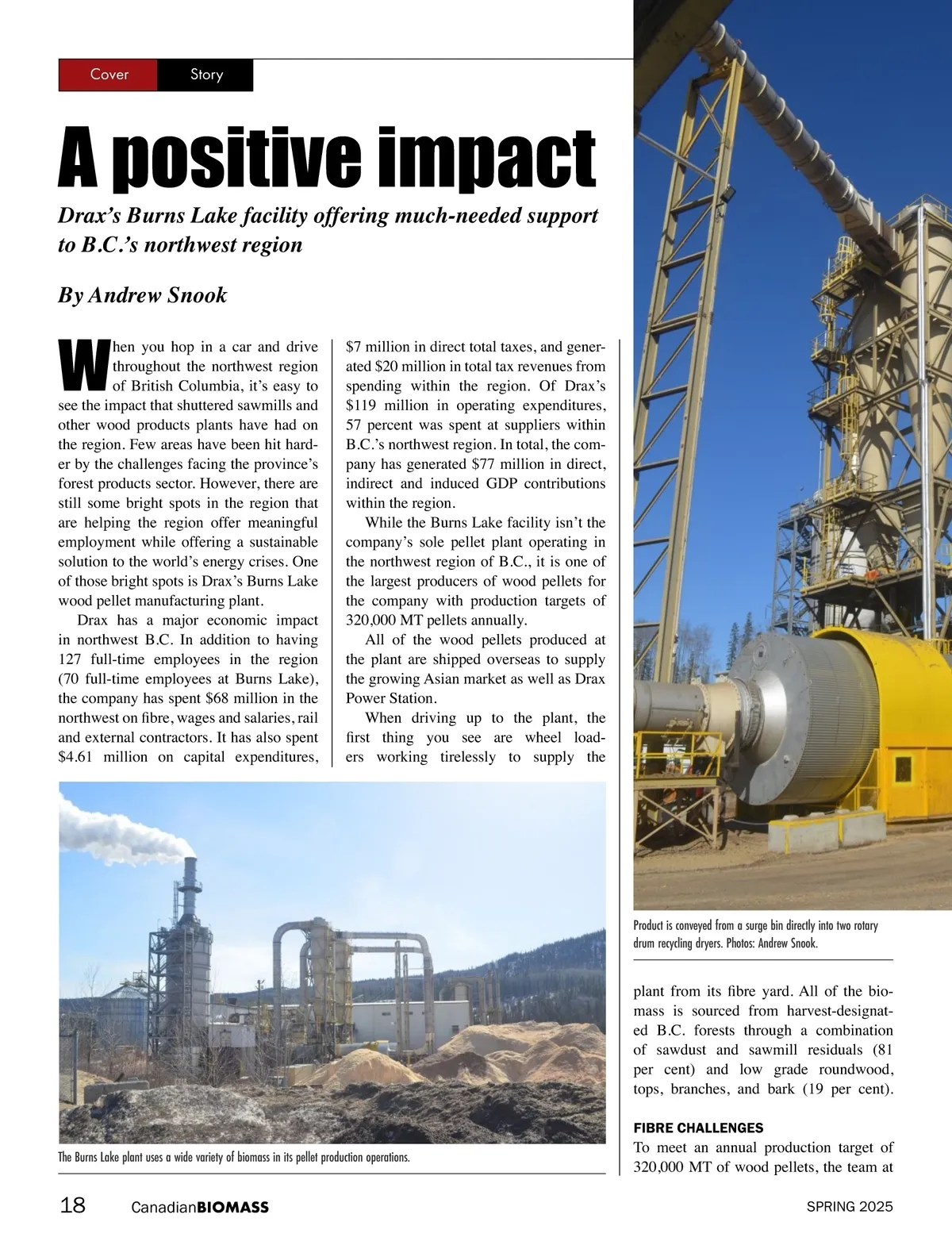
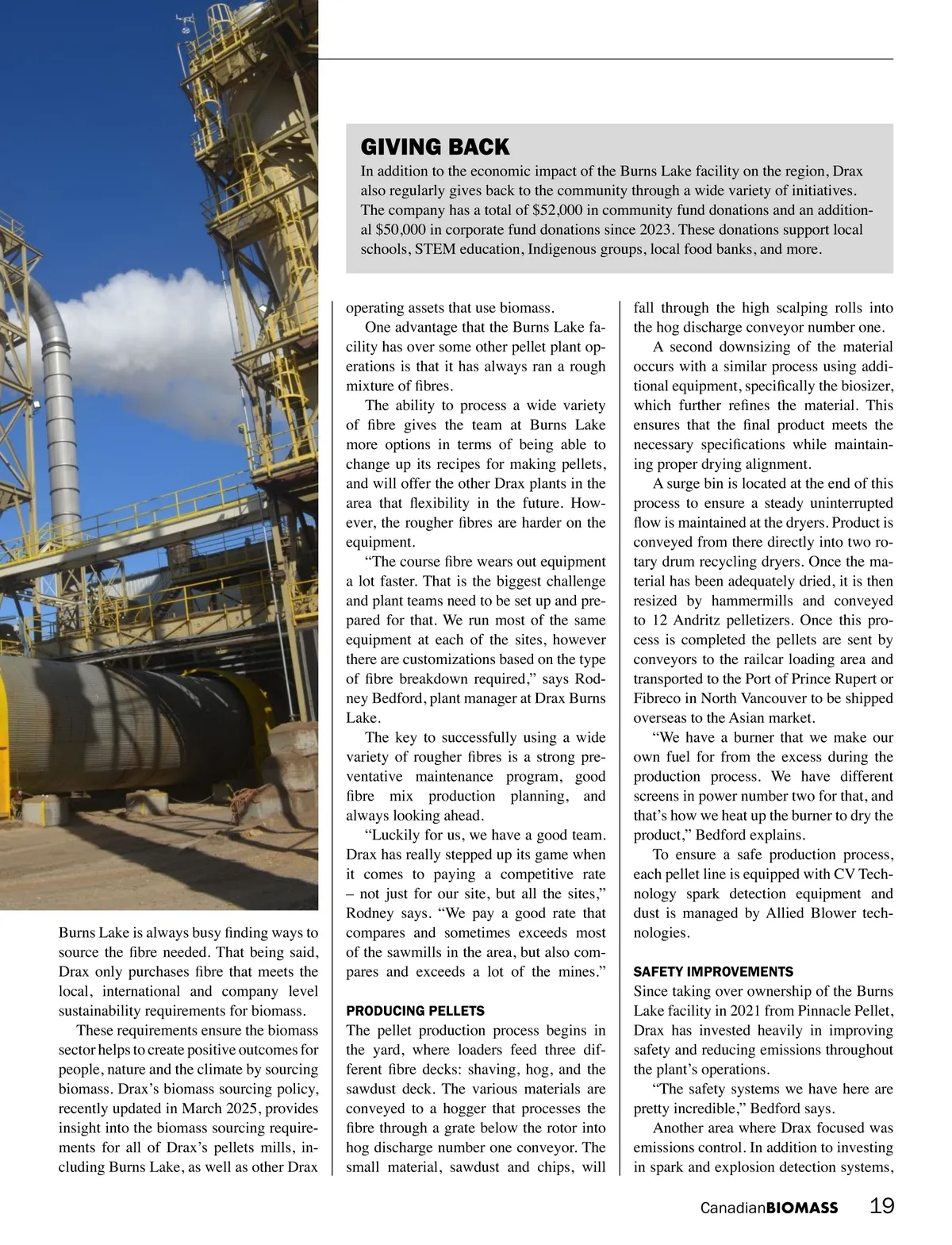
GIVING BACK In addition to the economic impact of the Burns Lake facility on the region, Drax also regularly gives back to the community through a wide variety of initiatives. The company has a total of $52,000 in community fund donations and an addition -al $50,000 in corporate fund donations since 2023. These donations support local schools, STEM education, Indigenous groups, local food banks, and more. operating assets that use biomass. One advantage that the Burns Lake fa -cility has over some other pellet plant op-erations is that it has always ran a rough mixture of fibres. The ability to process a wide variety of fibre gives the team at Burns Lake more options in terms of being able to change up its recipes for making pellets, and will offer the other Drax plants in the area that flexibility in the future. How -ever, the rougher fibres are harder on the equipment. “The course fibre wears out equipment a lot faster. That is the biggest challenge and plant teams need to be set up and pre-pared for that. We run most of the same equipment at each of the sites, however there are customizations based on the type of fibre breakdown required,” says Rod -ney Bedford, plant manager at Drax Burns Lake. The key to successfully using a wide variety of rougher fibres is a strong pre -ventative maintenance program, good fibre mix production planning, and always looking ahead. “Luckily for us, we have a good team. Drax has really stepped up its game when it comes to paying a competitive rate – not just for our site, but all the sites,” Rodney says. “We pay a good rate that compares and sometimes exceeds most of the sawmills in the area, but also com-pares and exceeds a lot of the mines.” PRODUCING PELLETS Burns Lake is always busy finding ways to source the fibre needed. That being said, Drax only purchases fibre that meets the local, international and company level sustainability requirements for biomass. These requirements ensure the biomass sector helps to create positive outcomes for people, nature and the climate by sourcing biomass. Drax’s biomass sourcing policy, recently updated in March 2025, provides insight into the biomass sourcing require-ments for all of Drax’s pellets mills, in -cluding Burns Lake, as well as other Drax fall through the high scalping rolls into the hog discharge conveyor number one. A second downsizing of the material occurs with a similar process using addi-tional equipment, specifically the biosizer, which further refines the material. This ensures that the final product meets the necessary specifications while maintain -ing proper drying alignment. A surge bin is located at the end of this process to ensure a steady uninterrupted flow is maintained at the dryers. Product is conveyed from there directly into two ro-tary drum recycling dryers. Once the ma-terial has been adequately dried, it is then resized by hammermills and conveyed to 12 Andritz pelletizers. Once this pro -cess is completed the pellets are sent by conveyors to the railcar loading area and transported to the Port of Prince Rupert or Fibreco in North Vancouver to be shipped overseas to the Asian market. “We have a burner that we make our own fuel for from the excess during the production process. We have different screens in power number two for that, and that’s how we heat up the burner to dry the product,” Bedford explains. To ensure a safe production process, each pellet line is equipped with CV Tech -nology spark detection equipment and dust is managed by Allied Blower tech -nologies. SAFETY IMPROVEMENTS The pellet production process begins in the yard, where loaders feed three dif-ferent fibre decks: shaving, hog, and the sawdust deck. The various materials are conveyed to a hogger that processes the fibre through a grate below the rotor into hog discharge number one conveyor. The small material, sawdust and chips, will Since taking over ownership of the Burns Lake facility in 2021 from Pinnacle Pellet, Drax has invested heavily in improving safety and reducing emissions throughout the plant’s operations. “The safety systems we have here are pretty incredible,” Bedford says. Another area where Drax focused was emissions control. In addition to investing in spark and explosion detection systems, Canadian BIOMASS 19
Canadian Biomass Spring 2025: Page 19