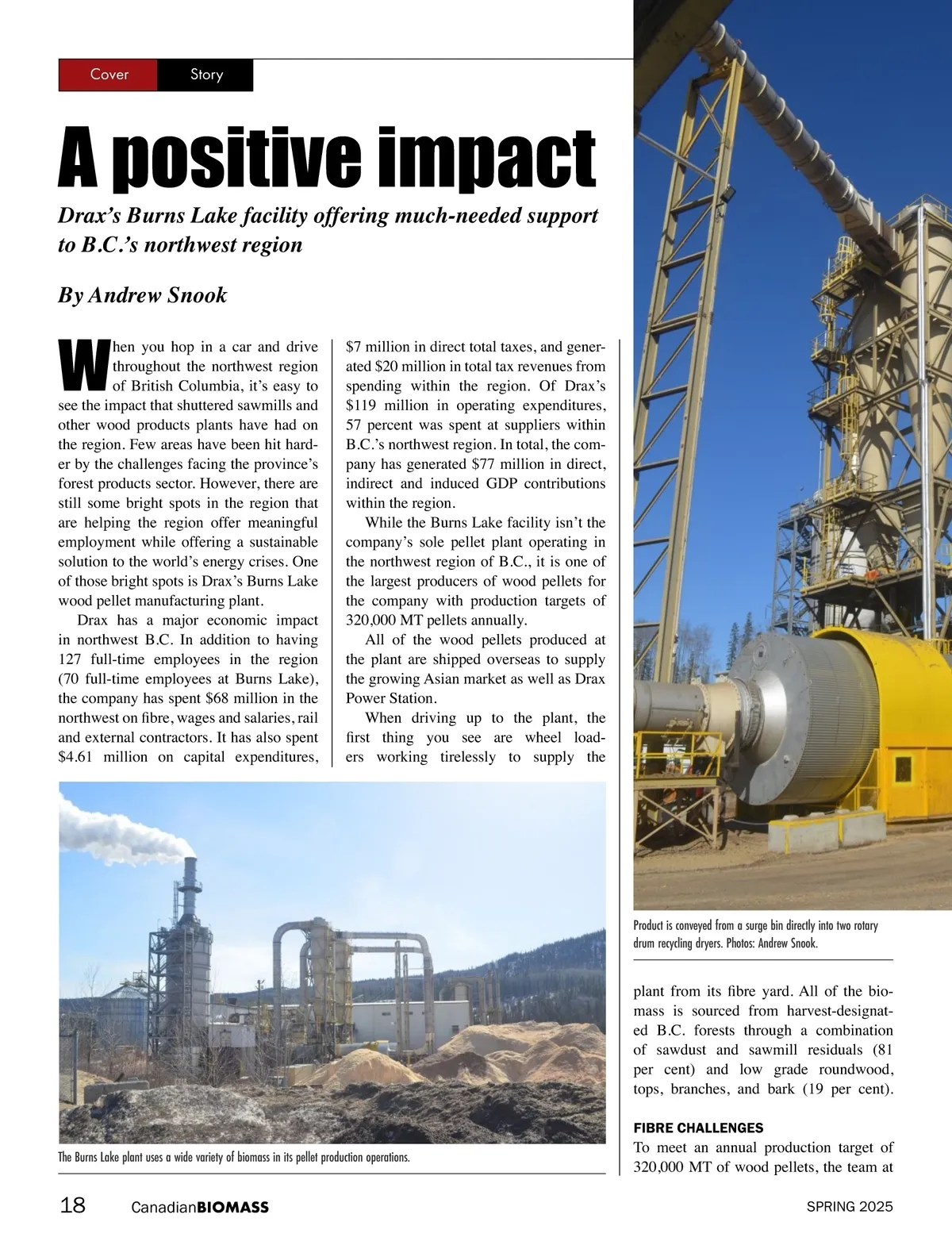
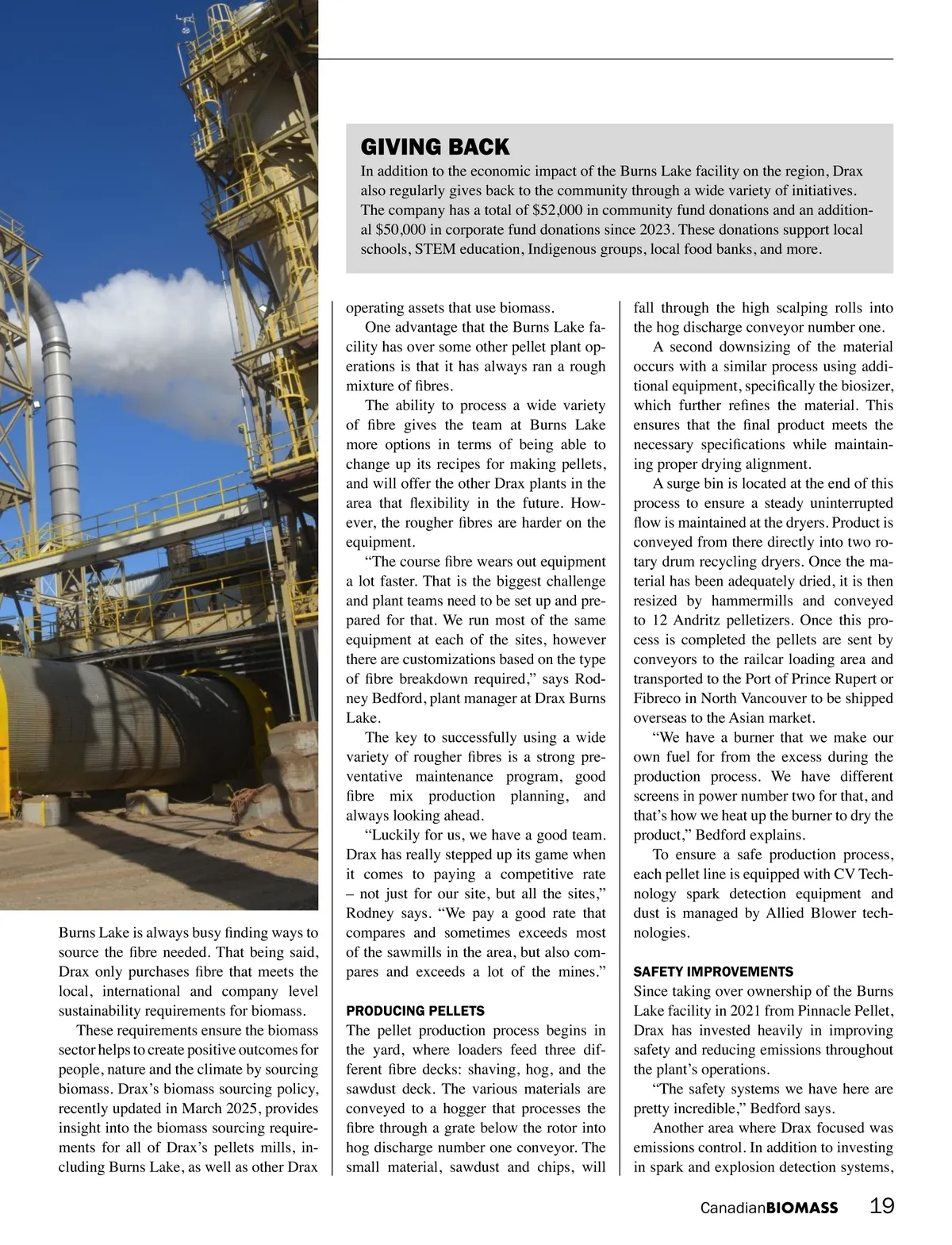
Cover Story A positive impact By Andrew Snook Drax’s Burns Lake facility offering much-needed support to B.C.’s northwest region W hen you hop in a car and drive throughout the northwest region of British Columbia, it’s easy to see the impact that shuttered sawmills and other wood products plants have had on the region. Few areas have been hit hard-er by the challenges facing the province’s forest products sector. However, there are still some bright spots in the region that are helping the region offer meaningful employment while offering a sustainable solution to the world’s energy crises. One of those bright spots is Drax’s Burns Lake wood pellet manufacturing plant. Drax has a major economic impact in northwest B.C. In addition to having 127 full-time employees in the region (70 full-time employees at Burns Lake), the company has spent $68 million in the northwest on fibre, wages and salaries, rail and external contractors. It has also spent $4.61 million on capital expenditures, $7 million in direct total taxes, and gener-ated $20 million in total tax revenues from spending within the region. Of Drax’s $119 million in operating expenditures, 57 percent was spent at suppliers within B.C.’s northwest region. In total, the com -pany has generated $77 million in direct, indirect and induced GDP contributions within the region. While the Burns Lake facility isn’t the company’s sole pellet plant operating in the northwest region of B.C., it is one of the largest producers of wood pellets for the company with production targets of 320,000 MT pellets annually. All of the wood pellets produced at the plant are shipped overseas to supply the growing Asian market as well as Drax Power Station. When driving up to the plant, the first thing you see are wheel load -ers working tirelessly to supply the Product is conveyed from a surge bin directly into two rotary drum recycling dryers. Photos: Andrew Snook. plant from its fibre yard. All of the bio -mass is sourced from harvest-designat-ed B.C. forests through a combination of sawdust and sawmill residuals (81 per cent) and low grade roundwood, tops, branches, and bark (19 per cent). FIBRE CHALLENGES The Burns Lake plant uses a wide variety of biomass in its pellet production operations. To meet an annual production target of 320,000 MT of wood pellets, the team at SPRING 2025 18 Canadian BIOMASS
Canadian Biomass Spring 2025: Page 18