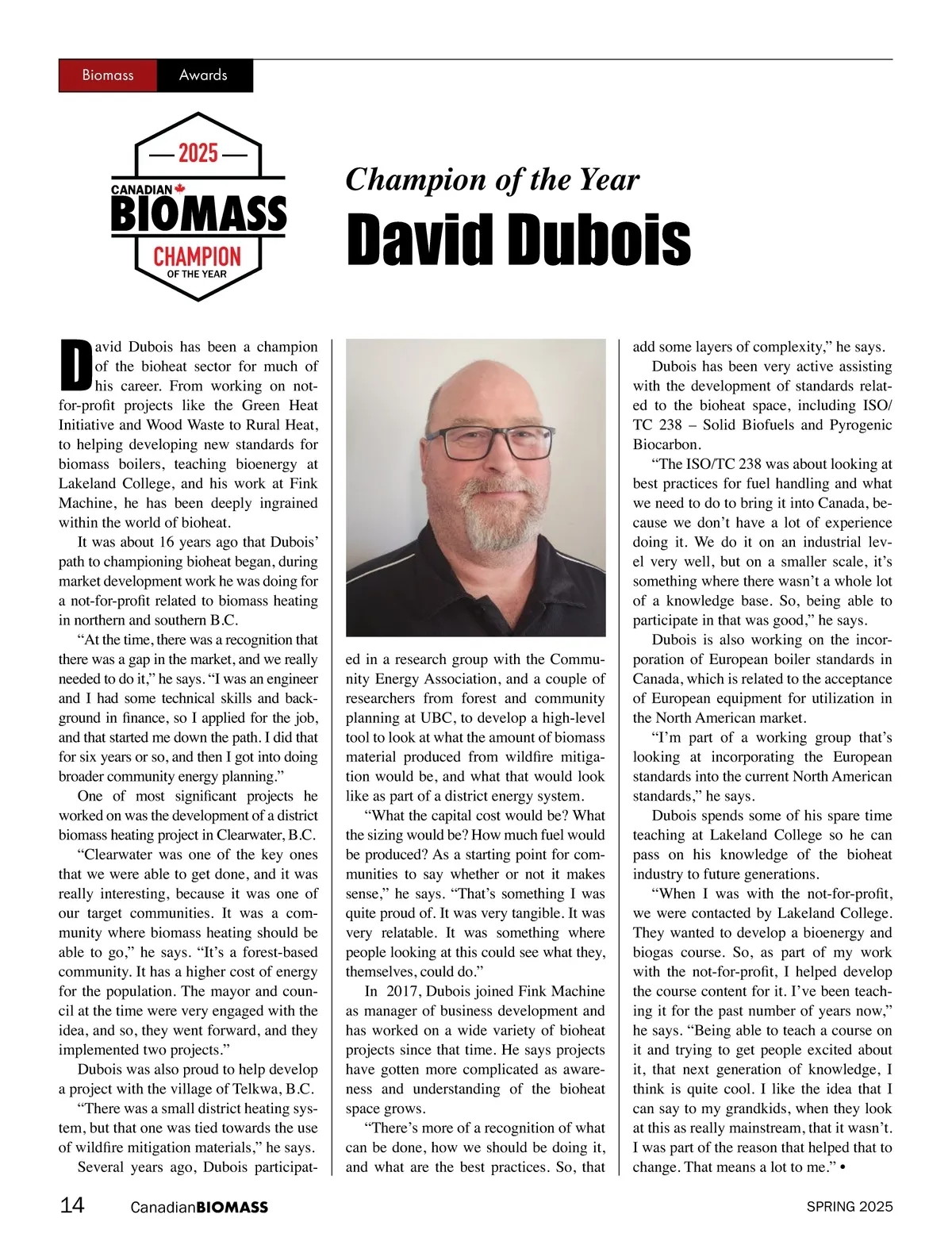
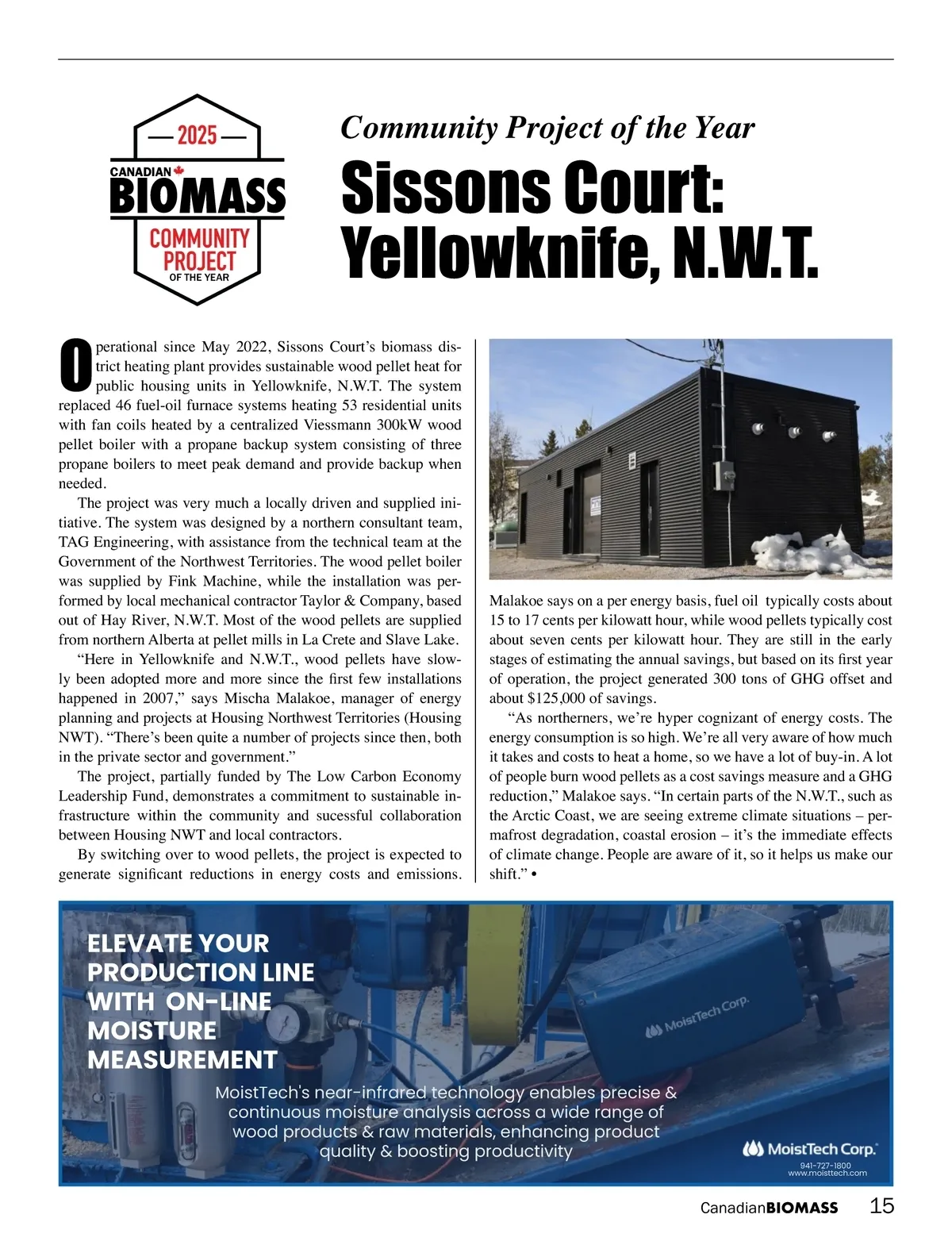
Biomass Awards 2025 Champion of the Year OF THE YEAR 2025 2025 2025 ARDS025 CHAMPION OF THE YEAR David Dubois THOUGHT COMPANY LEADER OF THE YEAR COMMUNITY PROJECT OF THE YEAR AC D avid Dubois has been a champion of the bioheat sector for much of his career. From working on not-for-profit projects like the Green Heat Initiative and Wood Waste to Rural Heat, to helping developing new standards for biomass boilers, teaching bioenergy at Lakeland College, and his work at Fink Machine, he has been deeply ingrained within the world of bioheat. It was about 16 years ago that Dubois’ path to championing bioheat began, during market development work he was doing for a not-for-profit related to biomass heating in northern and southern B.C. “At the time, there was a recognition that there was a gap in the market, and we really needed to do it,” he says. “I was an engineer and I had some technical skills and back -ground in finance, so I applied for the job, and that started me down the path. I did that for six years or so, and then I got into doing broader community energy planning.” One of most significant projects he worked on was the development of a district biomass heating project in Clearwater, B.C. “Clearwater was one of the key ones that we were able to get done, and it was really interesting, because it was one of our target communities. It was a com-munity where biomass heating should be able to go,” he says. “It’s a forest-based community. It has a higher cost of energy for the population. The mayor and coun -cil at the time were very engaged with the idea, and so, they went forward, and they implemented two projects.” Dubois was also proud to help develop a project with the village of Telkwa, B.C. “There was a small district heating sys -tem, but that one was tied towards the use of wildfire mitigation materials,” he says. Several years ago, Dubois participat -ed in a research group with the Commu-nity Energy Association, and a couple of researchers from forest and community planning at UBC, to develop a high-level tool to look at what the amount of biomass material produced from wildfire mitiga -tion would be, and what that would look like as part of a district energy system. “What the capital cost would be? What the sizing would be? How much fuel would be produced? As a starting point for com -munities to say whether or not it makes sense,” he says. “That’s something I was quite proud of. It was very tangible. It was very relatable. It was something where people looking at this could see what they, themselves, could do.” In 2017, Dubois joined Fink Machine as manager of business development and has worked on a wide variety of bioheat projects since that time. He says projects have gotten more complicated as aware-ness and understanding of the bioheat space grows. “There’s more of a recognition of what can be done, how we should be doing it, and what are the best practices. So, that add some layers of complexity,” he says. Dubois has been very active assisting with the development of standards relat-ed to the bioheat space, including ISO/ TC 238 – Solid Biofuels and Pyrogenic Biocarbon. “The ISO/TC 238 was about looking at best practices for fuel handling and what we need to do to bring it into Canada, be-cause we don’t have a lot of experience doing it. We do it on an industrial lev-el very well, but on a smaller scale, it’s something where there wasn’t a whole lot of a knowledge base. So, being able to participate in that was good,” he says. Dubois is also working on the incor -poration of European boiler standards in Canada, which is related to the acceptance of European equipment for utilization in the North American market. “I’m part of a working group that’s looking at incorporating the European standards into the current North American standards,” he says. Dubois spends some of his spare time teaching at Lakeland College so he can pass on his knowledge of the bioheat industry to future generations. “When I was with the not-for-profit, we were contacted by Lakeland College. They wanted to develop a bioenergy and biogas course. So, as part of my work with the not-for-profit, I helped develop the course content for it. I’ve been teach -ing it for the past number of years now,” he says. “Being able to teach a course on it and trying to get people excited about it, that next generation of knowledge, I think is quite cool. I like the idea that I can say to my grandkids, when they look at this as really mainstream, that it wasn’t. I was part of the reason that helped that to change. That means a lot to me.” • SPRING 2025 14 Canadian BIOMASS
Canadian Biomass Spring 2025: Page 14