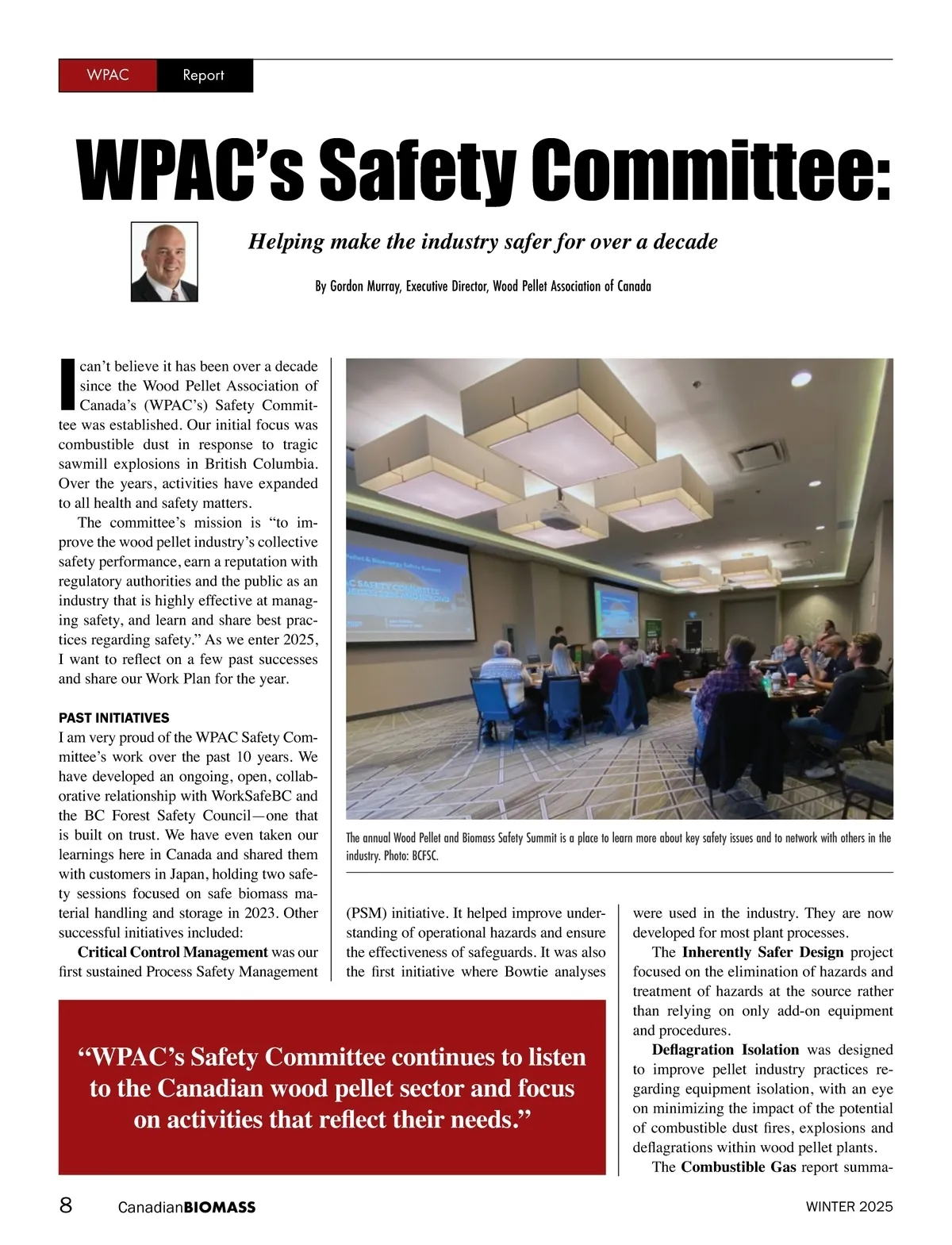
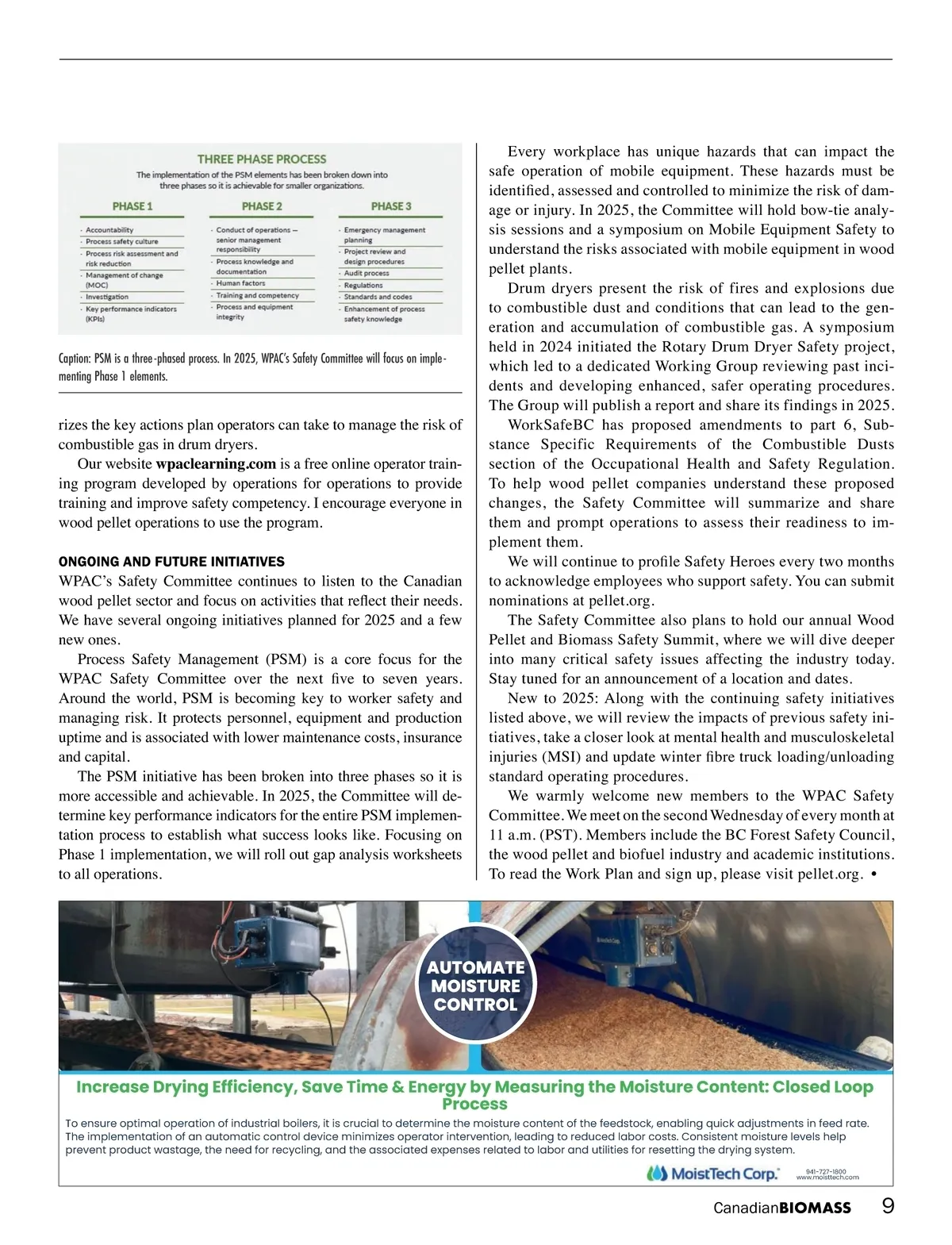
WPAC Report WPAC’s Safety Committee: Helping make the industry safer for over a decade By Gordon Murray, Executive Director, Wood Pellet Association of Canada I can’t believe it has been over a decade since the Wood Pellet Association of Canada’s (WPAC’s) Safety Commit -tee was established. Our initial focus was combustible dust in response to tragic sawmill explosions in British Columbia. Over the years, activities have expanded to all health and safety matters. The committee’s mission is “to im -prove the wood pellet industry’s collective safety performance, earn a reputation with regulatory authorities and the public as an industry that is highly effective at manag -ing safety, and learn and share best prac -tices regarding safety.” As we enter 2025, I want to reflect on a few past successes and share our Work Plan for the year. PAST INITIATIVES I am very proud of the WPAC Safety Com -mittee’s work over the past 10 years. We have developed an ongoing, open, collab -orative relationship with WorkSafeBC and the BC Forest Safety Council—one that is built on trust. We have even taken our learnings here in Canada and shared them with customers in Japan, holding two safe -ty sessions focused on safe biomass ma -terial handling and storage in 2023. Other successful initiatives included: Critical Control Management was our first sustained Process Safety Management The annual Wood Pellet and Biomass Safety Summit is a place to learn more about key safety issues and to network with others in the industry. Photo: BCFSC. (PSM) initiative. It helped improve under -standing of operational hazards and ensure the effectiveness of safeguards. It was also the first initiative where Bowtie analyses “WPAC’s Safety Committee continues to listen to the Canadian wood pellet sector and focus on activities that reflect their needs.” 8 Canadian BIOMASS were used in the industry. They are now developed for most plant processes. The Inherently Safer Design project focused on the elimination of hazards and treatment of hazards at the source rather than relying on only add-on equipment and procedures. Deflagration Isolation was designed to improve pellet industry practices re -garding equipment isolation, with an eye on minimizing the impact of the potential of combustible dust fires, explosions and deflagrations within wood pellet plants. The Combustible Gas report summa -WINTER 2025
Canadian Biomass Winter 2025: Page 8