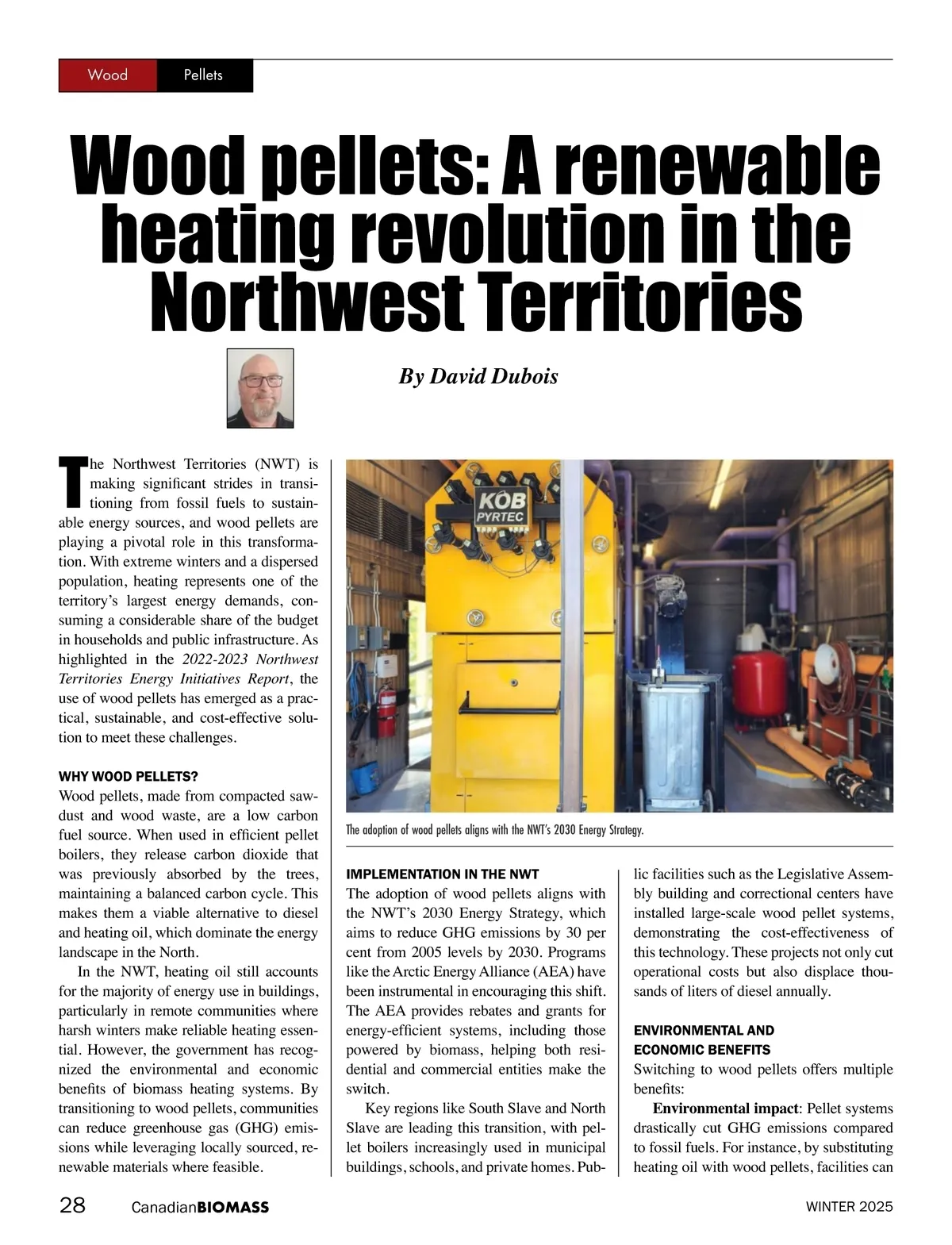
Wood Pellets Wood pellets: A renewable heating revolution in the Northwest Territories By David Dubois he Northwest Territories (NWT) is making significant strides in transi -tioning from fossil fuels to sustain -able energy sources, and wood pellets are playing a pivotal role in this transforma -tion. With extreme winters and a dispersed population, heating represents one of the territory’s largest energy demands, con -suming a considerable share of the budget in households and public infrastructure. As highlighted in the 2022-2023 Northwest Territories Energy Initiatives Report , the use of wood pellets has emerged as a prac -tical, sustainable, and cost-effective solu -tion to meet these challenges. WHY WOOD PELLETS? T Wood pellets, made from compacted saw -dust and wood waste, are a low carbon fuel source. When used in efficient pellet boilers, they release carbon dioxide that was previously absorbed by the trees, maintaining a balanced carbon cycle. This makes them a viable alternative to diesel and heating oil, which dominate the energy landscape in the North. In the NWT, heating oil still accounts for the majority of energy use in buildings, particularly in remote communities where harsh winters make reliable heating essen -tial. However, the government has recog -nized the environmental and economic benefits of biomass heating systems. By transitioning to wood pellets, communities can reduce greenhouse gas (GHG) emis -sions while leveraging locally sourced, re -newable materials where feasible. The adoption of wood pellets aligns with the NWT’s 2030 Energy Strategy. IMPLEMENTATION IN THE NWT The adoption of wood pellets aligns with the NWT’s 2030 Energy Strategy, which aims to reduce GHG emissions by 30 per cent from 2005 levels by 2030. Programs like the Arctic Energy Alliance (AEA) have been instrumental in encouraging this shift. The AEA provides rebates and grants for energy-efficient systems, including those powered by biomass, helping both resi -dential and commercial entities make the switch. Key regions like South Slave and North Slave are leading this transition, with pel -let boilers increasingly used in municipal buildings, schools, and private homes. Pub -lic facilities such as the Legislative Assem -bly building and correctional centers have installed large-scale wood pellet systems, demonstrating the cost-effectiveness of this technology. These projects not only cut operational costs but also displace thou -sands of liters of diesel annually. ENVIRONMENTAL AND ECONOMIC BENEFITS Switching to wood pellets offers multiple benefits: Environmental impact : Pellet systems drastically cut GHG emissions compared to fossil fuels. For instance, by substituting heating oil with wood pellets, facilities can WINTER 2025 28 Canadian BIOMASS
Canadian Biomass Winter 2025: Page 28