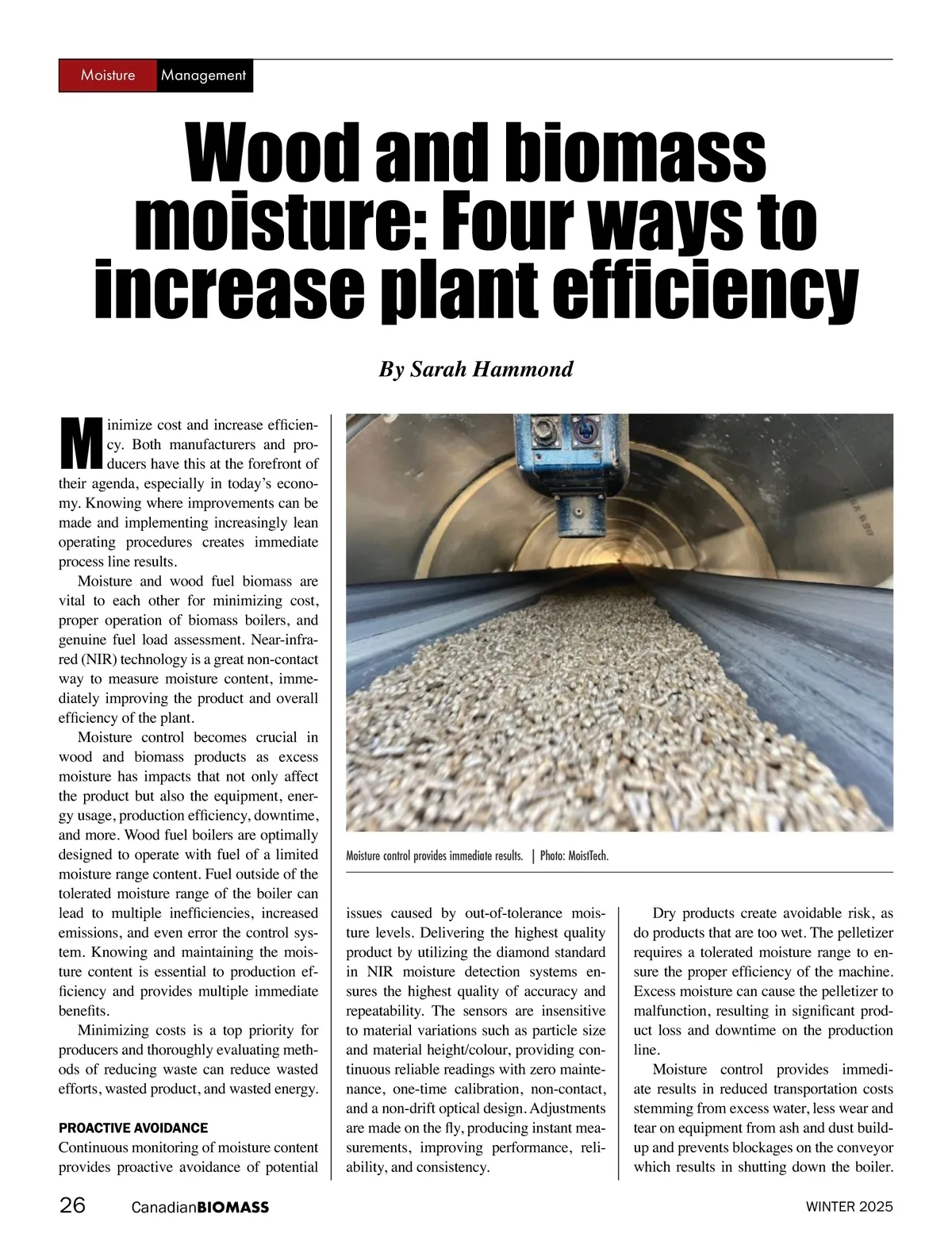
Moisture Management Wood and biomass moisture: Four ways to increase plant efficiency By Sarah Hammond M inimize cost and increase efficien -cy. Both manufacturers and pro -ducers have this at the forefront of their agenda, especially in today’s econo -my. Knowing where improvements can be made and implementing increasingly lean operating procedures creates immediate process line results. Moisture and wood fuel biomass are vital to each other for minimizing cost, proper operation of biomass boilers, and genuine fuel load assessment. Near-infra -red (NIR) technology is a great non-contact way to measure moisture content, imme -diately improving the product and overall efficiency of the plant. Moisture control becomes crucial in wood and biomass products as excess moisture has impacts that not only affect the product but also the equipment, ener -gy usage, production efficiency, downtime, and more. Wood fuel boilers are optimally designed to operate with fuel of a limited moisture range content. Fuel outside of the tolerated moisture range of the boiler can lead to multiple inefficiencies, increased emissions, and even error the control sys -tem. Knowing and maintaining the mois -ture content is essential to production ef -ficiency and provides multiple immediate benefits. Minimizing costs is a top priority for producers and thoroughly evaluating meth -ods of reducing waste can reduce wasted efforts, wasted product, and wasted energy. Moisture control provides immediate results. | Photo: MoistTech. PROACTIVE AVOIDANCE Continuous monitoring of moisture content provides proactive avoidance of potential issues caused by out-of-tolerance mois -ture levels. Delivering the highest quality product by utilizing the diamond standard in NIR moisture detection systems en -sures the highest quality of accuracy and repeatability. The sensors are insensitive to material variations such as particle size and material height/colour, providing con -tinuous reliable readings with zero mainte -nance, one-time calibration, non-contact, and a non-drift optical design. Adjustments are made on the fly, producing instant mea -surements, improving performance, reli -ability, and consistency. Dry products create avoidable risk, as do products that are too wet. The pelletizer requires a tolerated moisture range to en -sure the proper efficiency of the machine. Excess moisture can cause the pelletizer to malfunction, resulting in significant prod -uct loss and downtime on the production line. Moisture control provides immedi -ate results in reduced transportation costs stemming from excess water, less wear and tear on equipment from ash and dust build-up and prevents blockages on the conveyor which results in shutting down the boiler. WINTER 2025 26 Canadian BIOMASS
Canadian Biomass Winter 2025: Page 26