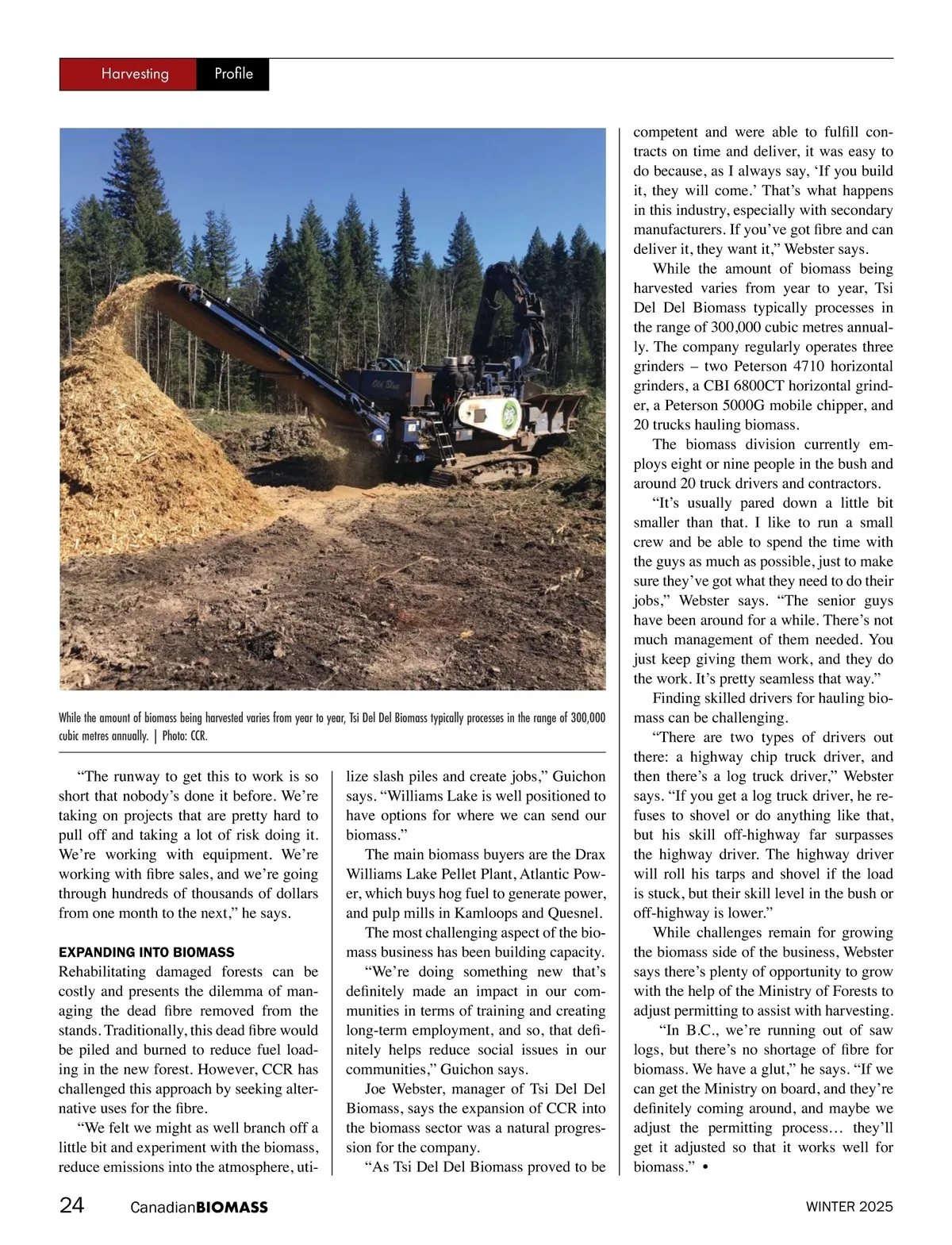
Harvesting Profile competent and were able to fulfill con -tracts on time and deliver, it was easy to do because, as I always say, ‘If you build it, they will come.’ That’s what happens in this industry, especially with secondary manufacturers. If you’ve got fibre and can deliver it, they want it,” Webster says. While the amount of biomass being harvested varies from year to year, Tsi Del Del Biomass typically processes in the range of 300,000 cubic metres annual -ly. The company regularly operates three grinders – two Peterson 4710 horizontal grinders, a CBI 6800CT horizontal grind -er, a Peterson 5000G mobile chipper, and 20 trucks hauling biomass. The biomass division currently em -ploys eight or nine people in the bush and around 20 truck drivers and contractors. “It’s usually pared down a little bit smaller than that. I like to run a small crew and be able to spend the time with the guys as much as possible, just to make sure they’ve got what they need to do their jobs,” Webster says. “The senior guys have been around for a while. There’s not much management of them needed. You just keep giving them work, and they do the work. It’s pretty seamless that way.” Finding skilled drivers for hauling bio -mass can be challenging. “There are two types of drivers out there: a highway chip truck driver, and then there’s a log truck driver,” Webster says. “If you get a log truck driver, he re -fuses to shovel or do anything like that, but his skill off-highway far surpasses the highway driver. The highway driver will roll his tarps and shovel if the load is stuck, but their skill level in the bush or off-highway is lower.” While challenges remain for growing the biomass side of the business, Webster says there’s plenty of opportunity to grow with the help of the Ministry of Forests to adjust permitting to assist with harvesting. “In B.C., we’re running out of saw logs, but there’s no shortage of fibre for biomass. We have a glut,” he says. “If we can get the Ministry on board, and they’re definitely coming around, and maybe we adjust the permitting process… they’ll get it adjusted so that it works well for biomass.” • WINTER 2025 While the amount of biomass being harvested varies from year to year, Tsi Del Del Biomass typically processes in the range of 300,000 cubic metres annually. | Photo: CCR. “The runway to get this to work is so short that nobody’s done it before. We’re taking on projects that are pretty hard to pull off and taking a lot of risk doing it. We’re working with equipment. We’re working with fibre sales, and we’re going through hundreds of thousands of dollars from one month to the next,” he says. EXPANDING INTO BIOMASS Rehabilitating damaged forests can be costly and presents the dilemma of man -aging the dead fibre removed from the stands. Traditionally, this dead fibre would be piled and burned to reduce fuel load -ing in the new forest. However, CCR has challenged this approach by seeking alter -native uses for the fibre. “We felt we might as well branch off a little bit and experiment with the biomass, reduce emissions into the atmosphere, uti -lize slash piles and create jobs,” Guichon says. “Williams Lake is well positioned to have options for where we can send our biomass.” The main biomass buyers are the Drax Williams Lake Pellet Plant, Atlantic Pow -er, which buys hog fuel to generate power, and pulp mills in Kamloops and Quesnel. The most challenging aspect of the bio -mass business has been building capacity. “We’re doing something new that’s definitely made an impact in our com -munities in terms of training and creating long-term employment, and so, that defi -nitely helps reduce social issues in our communities,” Guichon says. Joe Webster, manager of Tsi Del Del Biomass, says the expansion of CCR into the biomass sector was a natural progres -sion for the company. “As Tsi Del Del Biomass proved to be 24 Canadian BIOMASS
Canadian Biomass Winter 2025: Page 24