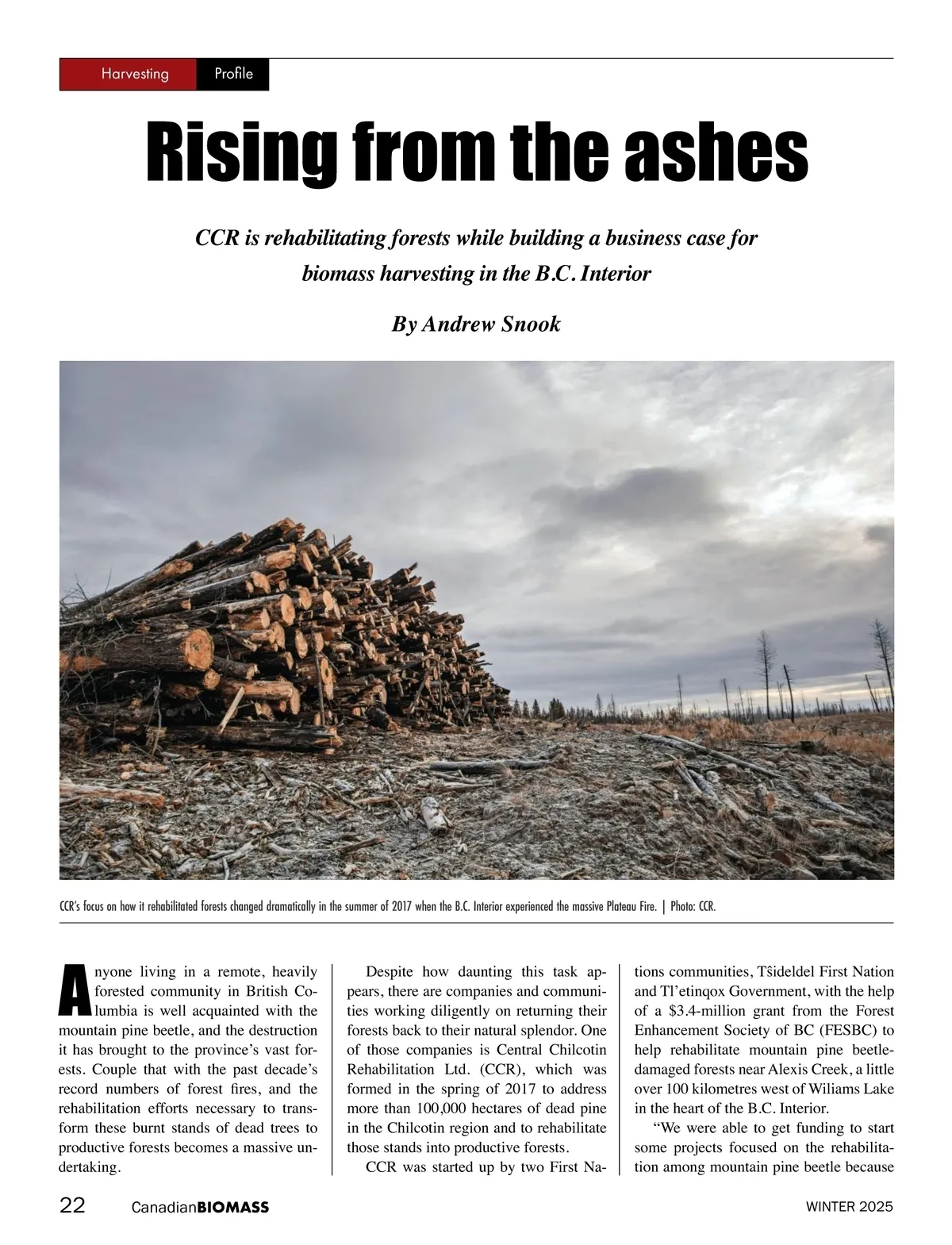
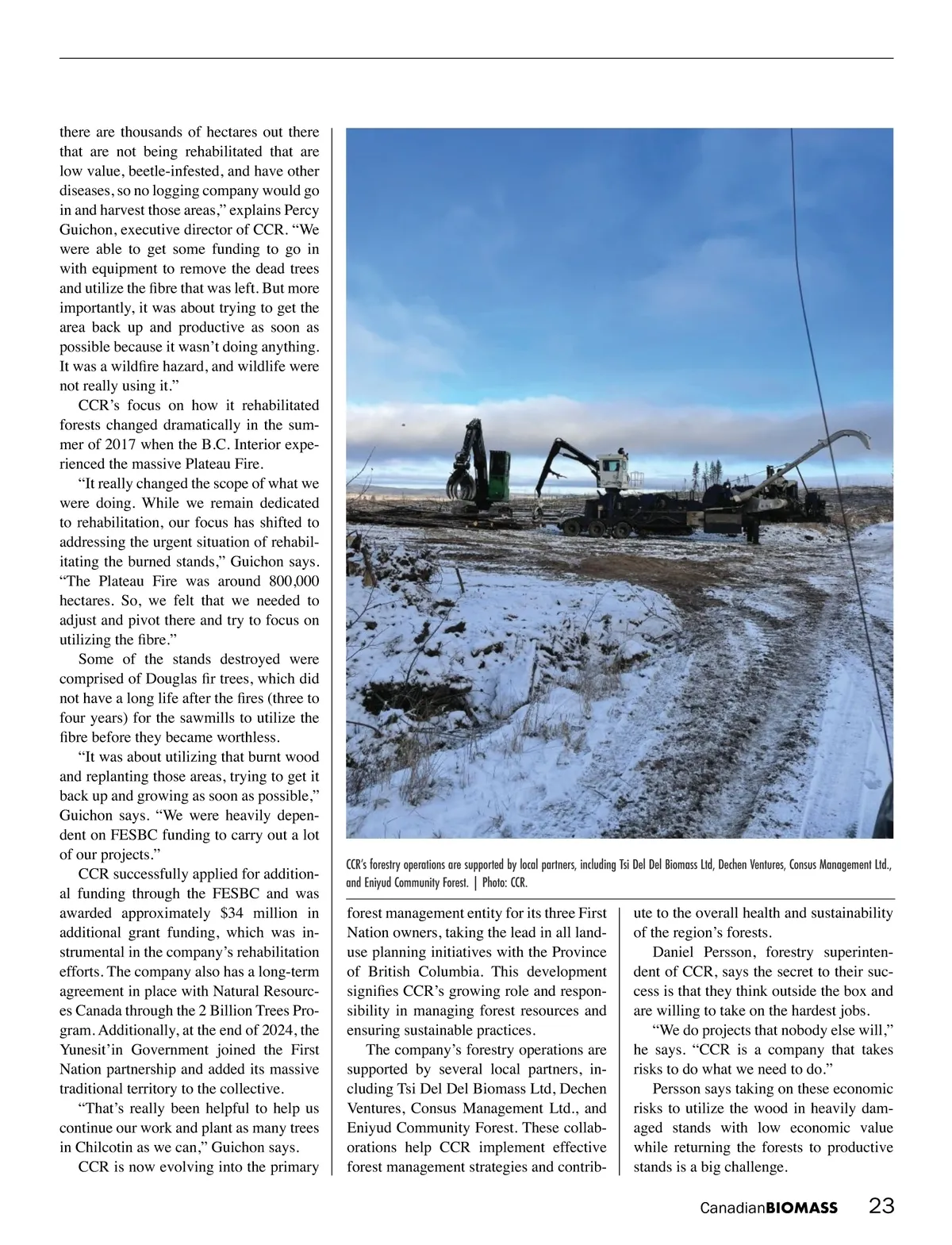
there are thousands of hectares out there that are not being rehabilitated that are low value, beetle-infested, and have other diseases, so no logging company would go in and harvest those areas,” explains Percy Guichon, executive director of CCR. “We were able to get some funding to go in with equipment to remove the dead trees and utilize the fibre that was left. But more importantly, it was about trying to get the area back up and productive as soon as possible because it wasn’t doing anything. It was a wildfire hazard, and wildlife were not really using it.” CCR’s focus on how it rehabilitated forests changed dramatically in the sum -mer of 2017 when the B.C. Interior expe -rienced the massive Plateau Fire. “It really changed the scope of what we were doing. While we remain dedicated to rehabilitation, our focus has shifted to addressing the urgent situation of rehabil -itating the burned stands,” Guichon says. “The Plateau Fire was around 800,000 hectares. So, we felt that we needed to adjust and pivot there and try to focus on utilizing the fibre.” Some of the stands destroyed were comprised of Douglas fir trees, which did not have a long life after the fires (three to four years) for the sawmills to utilize the fibre before they became worthless. “It was about utilizing that burnt wood and replanting those areas, trying to get it back up and growing as soon as possible,” Guichon says. “We were heavily depen -dent on FESBC funding to carry out a lot of our projects.” CCR successfully applied for addition -al funding through the FESBC and was awarded approximately $34 million in additional grant funding, which was in -strumental in the company’s rehabilitation efforts. The company also has a long-term agreement in place with Natural Resourc -es Canada through the 2 Billion Trees Pro -gram. Additionally, at the end of 2024, the Yunesit’in Government joined the First Nation partnership and added its massive traditional territory to the collective. “That’s really been helpful to help us continue our work and plant as many trees in Chilcotin as we can,” Guichon says. CCR is now evolving into the primary CCR’s forestry operations are supported by local partners, including Tsi Del Del Biomass Ltd, Dechen Ventures, Consus Management Ltd., and Eniyud Community Forest. | Photo: CCR. forest management entity for its three First Nation owners, taking the lead in all land-use planning initiatives with the Province of British Columbia. This development signifies CCR’s growing role and respon -sibility in managing forest resources and ensuring sustainable practices. The company’s forestry operations are supported by several local partners, in -cluding Tsi Del Del Biomass Ltd, Dechen Ventures, Consus Management Ltd., and Eniyud Community Forest. These collab -orations help CCR implement effective forest management strategies and contrib -ute to the overall health and sustainability of the region’s forests. Daniel Persson, forestry superinten -dent of CCR, says the secret to their suc -cess is that they think outside the box and are willing to take on the hardest jobs. “We do projects that nobody else will,” he says. “CCR is a company that takes risks to do what we need to do.” Persson says taking on these economic risks to utilize the wood in heavily dam -aged stands with low economic value while returning the forests to productive stands is a big challenge. Canadian BIOMASS 23
Canadian Biomass Winter 2025: Page 23