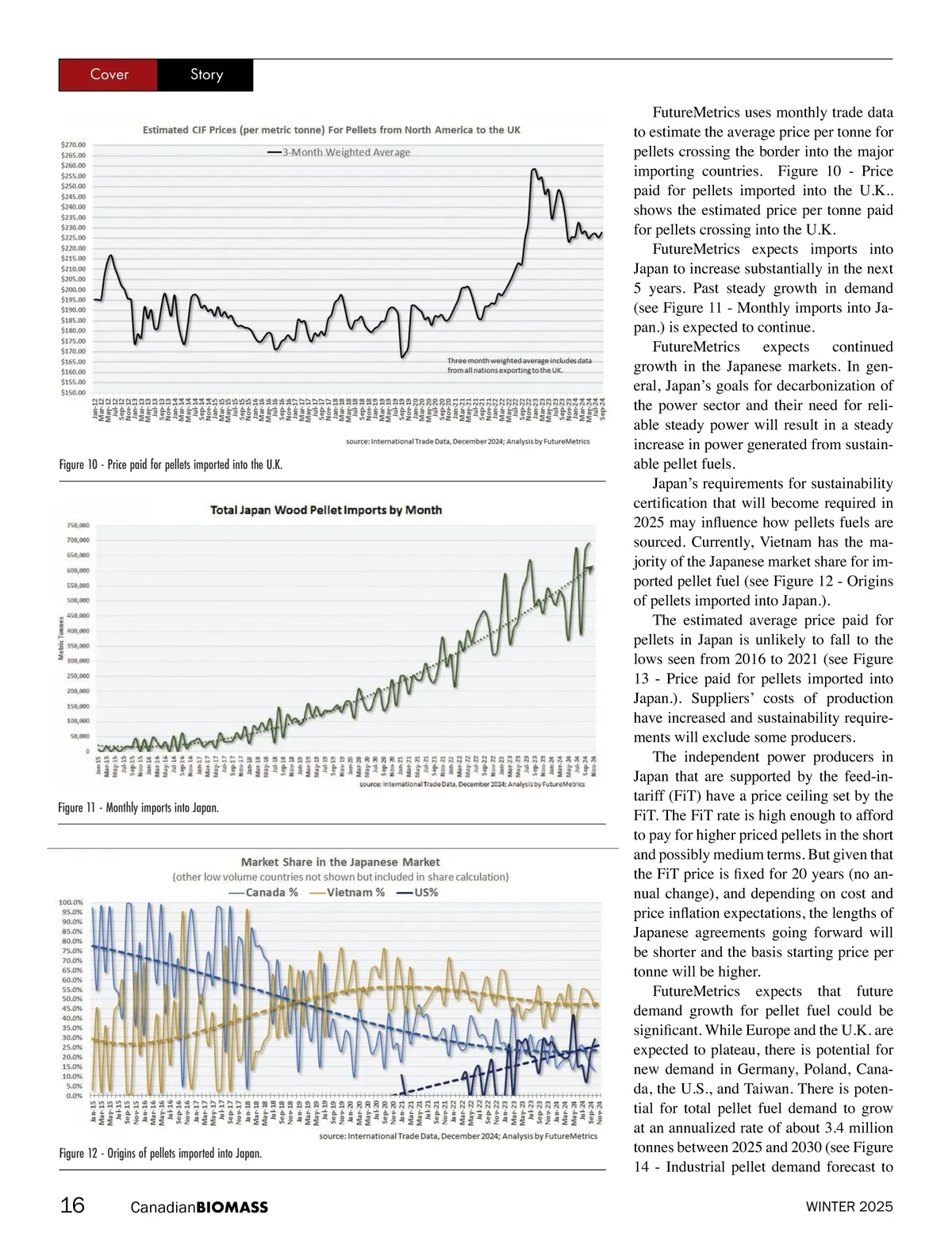
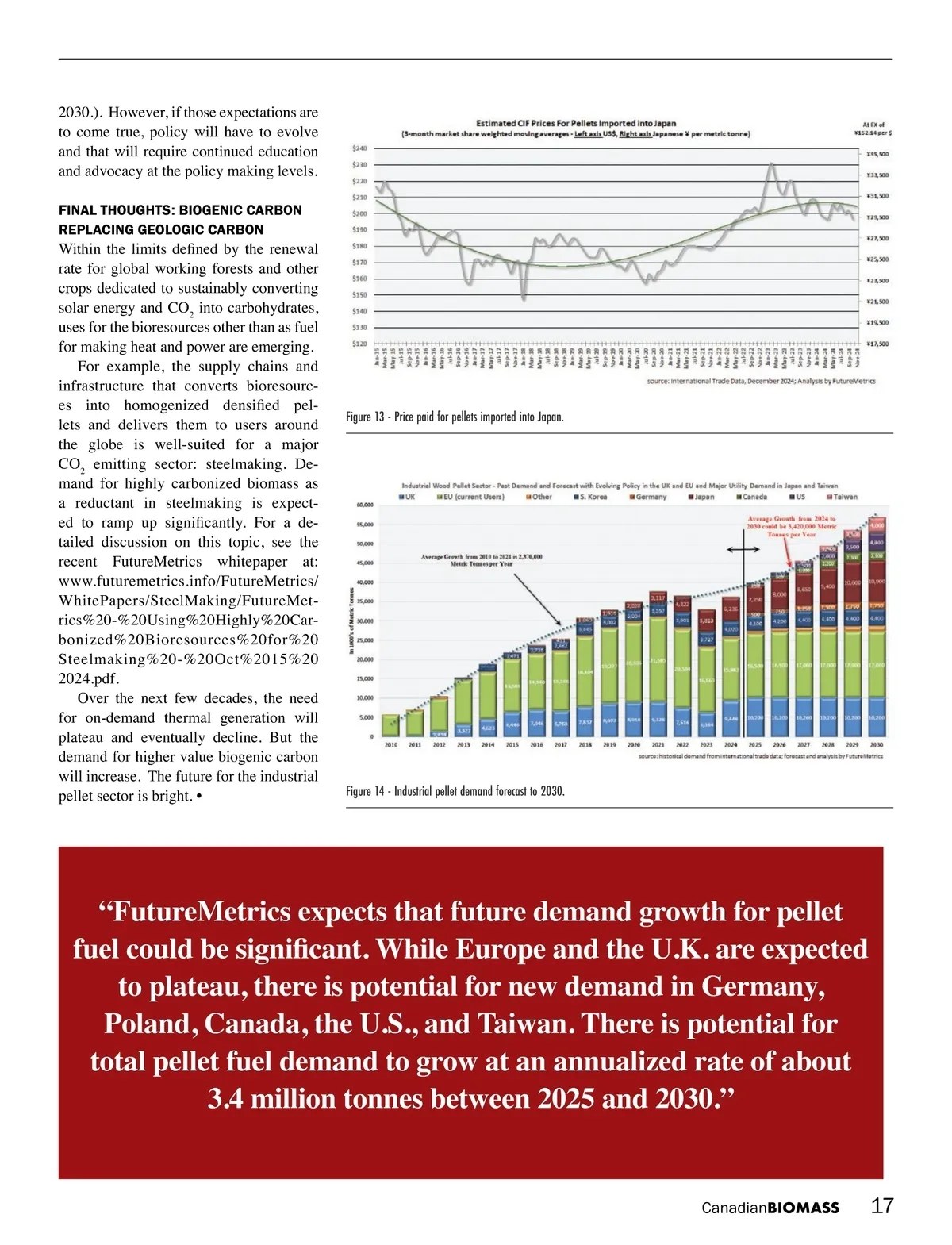
2030.). However, if those expectations are to come true, policy will have to evolve and that will require continued education and advocacy at the policy making levels. FINAL THOUGHTS: BIOGENIC CARBON REPLACING GEOLOGIC CARBON Within the limits defined by the renewal rate for global working forests and other crops dedicated to sustainably converting solar energy and CO 2 into carbohydrates, uses for the bioresources other than as fuel for making heat and power are emerging. For example, the supply chains and infrastructure that converts bioresourc -es into homogenized densified pel -lets and delivers them to users around the globe is well-suited for a major CO 2 emitting sector: steelmaking. De -mand for highly carbonized biomass as a reductant in steelmaking is expect -ed to ramp up significantly. For a de -tailed discussion on this topic, see the recent FutureMetrics whitepaper at: www.futuremetrics.info/FutureMetrics/ WhitePapers/SteelMaking/FutureMet -rics%20-%20Using%20Highly%20Car -bonized%20Bioresources%20for%20 Steelmaking%20-%20Oct%2015%20 2024.pdf. Over the next few decades, the need for on-demand thermal generation will plateau and eventually decline. But the demand for higher value biogenic carbon will increase. The future for the industrial pellet sector is bright. • Figure 13 -Price paid for pellets imported into Japan. Figure 14 -Industrial pellet demand forecast to 2030. “FutureMetrics expects that future demand growth for pellet fuel could be significant. While Europe and the U.K. are expected to plateau, there is potential for new demand in Germany, Poland, Canada, the U.S., and Taiwan. There is potential for total pellet fuel demand to grow at an annualized rate of about 3.4 million tonnes between 2025 and 2030.” 17 Canadian BIOMASS
Canadian Biomass Winter 2025: Page 17